
 E-Paper



My early Mumbai experiences impacted my work in its transport infra
As time went by, and Ashwini Bhide warmed up to the city, realisation dawned that change was the order of the day in a city that was on the cusp of transition

 Prefer HTon Google


MUMBAI: She was terrified of travelling in local trains when she first visited Mumbai (Bombay, then) as a young girl in 1985. Ashwini Bhide, 55, managing director of Mumbai Metro Rail Corporation (MMRC) and additional chief secretary to the Chief Minister’s Office (CMO), has come a long way since then.
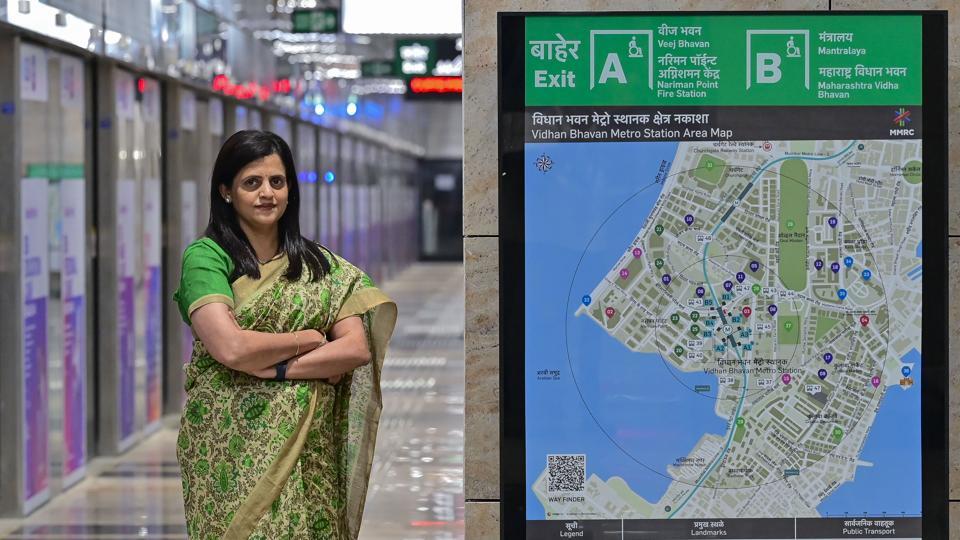
Getting over that first disconcerting experience, kicked off a series of events that readied her for the task of Mumbai’s transformation. As time went by, and she warmed up to the city, realisation dawned that change was the order of the day in a city that was on the cusp of transition. Through the early 2000s, she assumed the power to steer this change. Among many projects, the recently inaugurated Mumbai Metro’s Aqua line is a feather in her cap.
In a freewheeling interview Bhide spoke about her tryst with the city of dreams and her views on its transformation.
Excerpts:
The Aqua line, Mumbai’s first underground mode of public transportation, has become the talk of the town. Are you happy with how it has shaped up, as it was your baby?
I am very happy. In fact, I travelled on Metro-3 earlier this week from Chhatrapati Shivaji Maharaj Terminus (CSMT), which is closest to my house, to the Science Centre and back. I have an employee card but my husband uses the National Common Mobility Card (NCMC). I saw the ease with which people were travelling – from senior citizens, to pregnant women and children. Even people from rural areas were using the service effortlessly. There was happiness on everyone’s faces.
Our decade-long hard work paid off. This metro line is a valuable addition to Mumbai’s overall transport infrastructure.
Did people recognize you when you travelled as a regular commuter? Did you like the attention?
I guess some of them did. But no, I don’t like the attention (laughs).
CSMT bridges old and new Mumbai’s public transit. How did it feel connecting an edifice built in 1888 to a piece of modern transportation?
CSMT, without a doubt, is symbolic – the building is an inspiration of how structures are built mindfully to sustain over a period of time – which is over a century old.
Now, we have built something that is comparable to the old edifice; it should serve people with the same intensity. People now have a railway system available to carry them beyond CSMT and Churchgate stations.
A decade back, the Metro-3 project was vociferously opposed by environmentalists and a section of Mumbaikars. Now, the line is seeing good footfalls. How do you see this turnaround?
The turnaround was expected – there is a reason why we insisted on the car depot for this line in Aarey; anyone who understands engineering and transport would have agreed. Shifting a car depot would have been viable only if the length of the corridor were extended. But then there is something called optimum length to a corridor, which means you cannot build a Metro line for 50 or 100 kilometers at a single stretch. From that perspective, this was the ideal length for an underground metro route and car depot for which government land was available.
We knew at the time that people would eventually understand the virtue of the underground corridor. Hence, I kept my fight on. This was a transformative and crucial project for Mumbai, which requires you to stay invested.
At the time I put myself in the shoes of people who would benefit from the line 20 or 30 years later. The ridership is growing slowly but this line has the potential to carry 17 lakh passengers every day.
Did you have a mental map of the alignment when you envisaged the project?
I remember travelling the entire corridor with the team to understand the alignment. It was important to identify the entry and exit points so that people’s movement becomes easy, and crowds do not spill on the roads. That is the reason why most of the stations have more than four entry and exit points.
There was a plan at the time to also connect Dadar and Churchgate Metro stations with the respective suburban railway stations. However, to reduce cost and save trees, we opted to take this up at a later stage.
Did you take a cue from the plans made by P G Patankar (an engineer with the Indian Railways, who later headed BEST) in the 1950s-’60s for an underground metro alignment?
This underground corridor is partly similar to what was proposed for Mumbai back in the 1960s. The corridor stretched from south Mumbai to Bandra back then. I have seen the plan, which had underlined that it would cost ₹4 crore per kilometer, which was a tall order at the time. An underground metro was required to transform the city, which was understood and envisioned so long ago.
Milestones and boards were put up at Matunga informing people about such an underground line.
So, yes the idea was there, discussions were on but it somehow did not work out back then. One of the most important reasons is that Mumbai was already served by very robust and efficient suburban trains. The Indian Railways is trying to segregate suburban and main lines. The current plans made for Metro rails is such that it marries the suburban rail system.
Are you seeing people making a shift from locals to Metro?
There are roughly 1 million passengers travelling in Mumbai’s Metro trains, which also includes Monorail. At present 100 kms of the Metro network (lines 1, 2A, 3, 7 and Monorail) are operational. By 2035-40 we will see a gradual shift when the Metro rail corridors are fully operational by the time we can expect the ridership to touch 10 million while suburban trains will drop to 5 million.
Over the years Mumbai was identified with Bollywood, the underworld and politics. Now, massive multi-crore infrastructure projects are redefining the city. How do you see this change? Globally are there other countries/ cities that are growing at this pace?
Most of the cities in the western countries and some Asian countries have matured. They added this kind of infrastructure in the 19th and 20th centuries. So in the modern times I do not think any other city is focusing so much on infrastructure as Mumbai, which is second only to China perhaps. We have created 5 lakh square meters of space under Mumbai through tunnels and stations of Metro-3.
What was your first impression of the city when you first came here?
After being placed 22nd in the state board exams, I came to Mumbai in 1985 to participate in a felicitation programme at the Taj Mahal Palace Hotel. We used to live in a small town called Jaysingpur, in Kolhapur district, where my father was posted. He worked for the State Bank of India.
Up until then we had only heard about Mumbai as a big and scary city. We stayed at my uncle’s place in Dombivali; and the ride from there to the city by a local train was truly terrifying. I could not imagine travelling in a crowded train or ever returning to Mumbai. Mumbai was intimidating; it made you feel very small.
How did your relationship with the city evolve subsequently?
I was next here to take my UPSC prelims in 1993, which I failed to clear. I returned for a few months the following year to the State Institute for Administrative Careers (SIAC), and lived at the Savitri Bai Phule Hostel in Charni Road, which is now being redeveloped. While most of my time was spent studying, I did manage to explore the city as well. I took buses and trains accompanied by my hostel mate. I remember a journey from Thane to Vile Parle, which involved taking multi-mode transports such as buses and trains. It was a far cry from the quiet life of our small town.
I also experienced the full force of Ganeshotsav, as we were living in Marine Drive. Trips to Malabar Hill, the Hanging Gardens, Dadar Chowpatty etc warmed me up to Mumbai gradually.
And your relationship with the city deepened further through your career as a civil servant.
I came to the city intermittently. In the beginning, I came for the 15-day Mantralaya attachment during training, after I was chosen for the Maharashtra cadre. I returned often during my posting as CEO of the Sindhudurg Zilla Parishad, as Mumbai was the headquarters.
Coming here was a big hassle, particularly the train ride and accommodation in guest houses where the living conditions were very poor. I preferred to return to base the same evening that I arrived.
All these experiences may have had a bearing in the work I went on to do on Mumbai’s transport infrastructure. Never could I imagine that I would get such a potential position.
Your next big stint in Mumbai began in 2003 when you started living here.
I was posted in Mantralaya -- first as deputy secretary, and then joint secretary to the governor. My husband was also posted in Mantralaya and then the Brihanmumbai Municipal Corporation (BMC) as joint commissioner.
We lived well, in a big house. My daughter was young and my son was on the way. We had a lot of help and support all around. Five years just flew by.
How did your impression of Mumbai evolve in this time?
As a family, we started exploring the city more. We had a small car, a Maruti 800, which we then upgraded to an Indica. As I was from Sangli and my husband from Satara, we would rush back home every chance we got and along the way, would experiment with different roads on our way out, which were not crowded and the traffic was disciplined.
You were then posted to the Mumbai Metropolitan Development Authority (MMRDA) in 2008.
Even as I was given the charge of the department, I was abreast of Mumbai’s evolving infrastructure. I used the Tulsi Pipe road to reach Bandra Kurla Complex (BKC), until the Bandra Worli Sea Link opened up in 2009. That was like a breath of fresh air, and demonstrated the difference good infrastructure and connectivity can make in our lives.
Through this stint, I roamed various parts of Mumbai and understood its geography. I understood issues plaguing the city – east-west connectivity, the need for railway crossings, the humongous task of rehabilitation, traffic management and coordination among different agencies.
The period from 2008 to 2014 in MMRDA was a time of intense learning. I dug deep to understand the hindrances in the system, and had ample opportunity to experiment and resolve these issues. Policy changes were inked and political support garnered, with an eye on development.
Those years infused in me the confidence that no project was impossible.
How have you seen Mumbai change?
Mumbai has changed in so many ways, thanks to endless infrastructure upgrades. At first, the focus was on road infrastructure. The Western and Eastern expressways were realised a little before my time. Then came the flyovers on the expressways, the Milan ROB, Barfiwala flyover, Ambedkar flyover, all the railway overbridges, Sahar elevated road, and the Eastern freeway.
MMRDA was also involved in the revamping and beautification of Marine Drive. I also got an opportunity to work on the Coastal Road when I was in the BMC.
What is next for you?
Well, Line 11 is on the cards right now, as well as other Metro lines. I am also overseeing many other projects, at the chief minister’s office. We are helping with the Coastal Road north in all the ways we can, the Worli-Sewri connector is ongoing, the Orange Gate tunnel and Thane-Mulund tunnel will also help ease traffic immensely.
The new airport has come up, third and fourth Mumbai are being created. The Vadhawan port will be another gamechanger. A vision document for Maharashtra was recently released. I continue to see Mumbai transforming in front of me.
Looks like the city’s approach to such big ticket infrastructure projects has changed.
Definitely. People and agencies are not shy of big projects any more, funding can be arranged, which were big constraints then. But the main transformation of Mumbai will be brought by the completion of the entire metro system, which will take another four to five years. That will make all the difference.


Stay updated with all the Breaking News and Latest News from Mumbai. Click here for comprehensive coverage of top Cities including Bengaluru, Delhi, Hyderabad, and more across India along with Stay informed on the latest happenings in World News.


