
 E-Paper



Delhi hires men to mimic langurs to scare monkeys from BWF World Championships. The science is more complicated
Before the BWF World Championships, Delhi turned to men mimicking langurs to keep monkeys away. The evidence for why it might — or might not — work.

 Prefer HTon Google


Three men, among them Jabbar, will be paid to make guttural, short and sharp calls – resembling the angry sound of grey langurs – around the Indira Gandhi Indoor Stadium in New Delhi, when it hosts the BWF World Championships next week. The group's brief is to keep rhesus macaques off the courts of the newly renovated venue after a monkey wandered into the practice hall at the India Open in January.
The men will be paid between ₹20,000 and ₹25,000 an assignment. "When we make these calls, monkeys just run away," Jabbar told HT.
It is the second time in three years that authorities in Delhi have reached for a similar trick, after the mimics and life-sized langur cutouts were deployed at the G20 Summit in 2023.
The trick rests on the belief that rhesus macaques are afraid of langurs, and can be reliably driven off by anything that sounds or looks like one. But how scientific is it?
Is there rivalry?
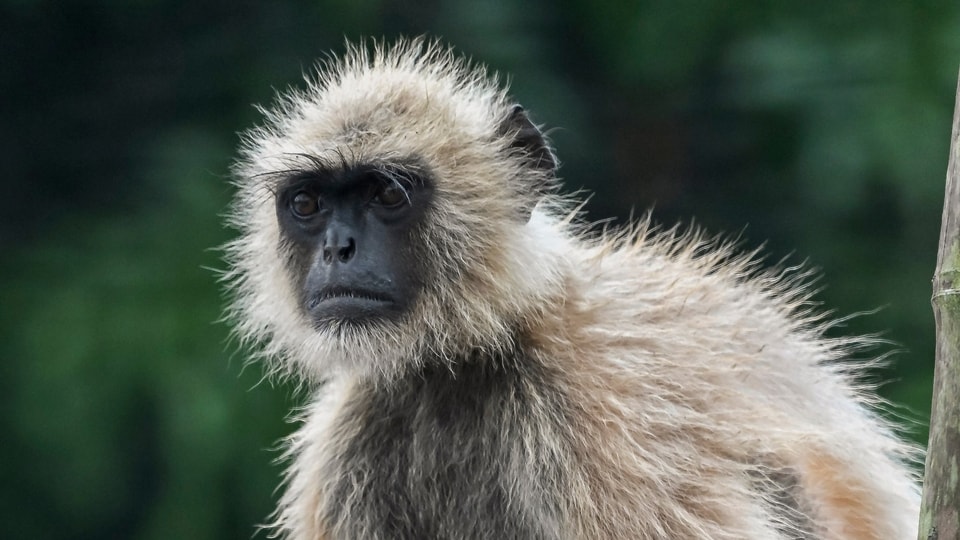
The theory goes that the rhesus macaque is smaller, and the langur (semnopithecus entellus) is larger, black-faced, and, in folk telling, its natural predator. Deploy a langur and the macaques will scatter.
But researchers have not been able to establish this link.
The two species, when they meet in the wild, have been seen getting along.
Writing in ZOO's Print — a monthly magazine published by a Coimbatore-based non-profit — in August 2012, ecologist Ashish Nerlekar reported observing a rhesus macaque juvenile at Pench Tiger Reserve in Madhya Pradesh clambering onto the back of an adult langur, sitting on it and feeding alongside it. Nerlekar wrote that this instance reflected inter-species interaction that mirrored the climbing and clinging reflexes of primate infants.
He cited a 1990 study by B Ram Manohar and Reena Mathur, which – he said – had documented "significant play behaviour" between infants and juveniles of the two species at a pilgrim-fed site.
Faiyaz Khudsar, a wildlife biologist, told Down to Earth in April 2024 that the foraging guilds of the two species overlap — langurs on foliage, macaques on fruit and foliage — and that the species "live peaceably enough in the wild and such conflict management is not needed there".
Isabelle Catherine Winder, a senior lecturer in zoology at Bangor University in Wales, made a similar case in The Conversation in September 2023. Langurs are largely folivorous, that is, leaf-eating species. And rhesus macaques are broad omnivores – ranging from Afghanistan to China and eating fruit, seeds, insects, honeycomb and shellfish. "Research shows this is unlikely to be the case for langurs and macaques," Winder wrote of the natural-enemies premise.
If the two species do not typically treat each other as enemies, why would the langur call have any deterrent value at all?
So, would mimicking help?
According to Winder, the deterrent in the case of monkeys may not be the mimicking, but the men itself.
Those who mimic the call of langurs often carry sticks. Their calls are loud, sometimes "ear-piercing", and often louder than an actual langur. Being pursued around a compound by a shouting, stick-wielding human is aversive whatever noise is being made, she wrote in the article.
But, researchers say, rhesus macaques are a species that has flourished in urban India because of their behavioural elasticity. So, effects that rest on a bluff could decay once the bluff is called. It is possibly why the Noida Authority's 2024 attempt to protect a residential society in Sector 144 with posters of langurs was called off within days. An authority official had said at the time that the experiment had "failed".
The mimics, it appears, may still buy time. For a badminton championship that runs from August 17 to August 23, time may be all that is required, before the monkeys get used to the sound and acclimate to it.
What about scarecrows?
Scarecrows, an age-old predator-cue deterrent, work briefly and then their efficacy declines.
Studies in the US and the UK have found that scarecrows — the traditional straw-stuffed figures on poles that stand still in the middle of a field — reduces bird activity in the first week of deployment, but that efficacy drops sharply within a fortnight. Birds watch, learn that the anthropomorphic figure never chases them and carries no consequence, and then stop responding.
A 2025 review in the Journal of Natural Sciences, Engineering and Technology described conventional scarecrows, reflective materials and chemical repellents as having "demonstrated ineffectiveness over time due to habituation".
What tends to work in their case is either unpredictable motion or a cue that an animal has genuine evolutionary reason to fear.
In a 2022 study published in the Journal of the Royal Society Interface, researchers at the Groningen Institute for Evolutionary Life Sciences in the Netherlands deployed a robotic peregrine falcon — called the RobotFalcon — against flocks of corvids, gulls, starlings and lapwings at a Dutch airbase. Fields cleared immediately and stayed clear for hours, the study found, concluding that the RobotFalcon had outperformed both drones and the airbase's existing distress-call system.
The researchers reported no evidence of habituation over the course of their fieldwork, in effect, indicating that peregrine falcons were what these birds were evolved to run from.
Why humans do this job in India
Till about a decade ago, 'handlers' would walk the bungalows of Lutyens' Delhi, farmhouses along the capital, and even government offices, with a chained langur.
But langurs are listed under Schedule II of the Wildlife (Protection) Act, 1972, which bars the ownership, sale, purchase, trade or hire of the species. Penalties run up to imprisonment, a fine, or both. Separately, Section 22(ii) of the Prevention of Cruelty to Animals Act, 1960, prohibits the training and exhibition of wild monkeys, alongside bears, tigers, panthers and lions. And the Performing Animals Rules, 1973, reinforce the bar.
As enforcement of the laws caught up, the need for alternatives did too. Jabbar and his colleagues are likely to keep getting called, as long as there are thriving monkey populations, and tournaments and summits being organised in Indian cities.


