
 E-Paper



Runners brave winter’s coldest morning and hazardous air
As the starter pistol went off at CSMT at 5:15am on Sunday, flagging off the 42-km long amateur marathon, the racers were pumped up to brave the nip in the air. There was, however, another challenge the runners had to endure- the air quality, which dropped to its poorest in at least two weeks


Mumbai: As if the run wasn’t hard enough. Tens and thousands of marathoners racing the Mumbai Marathon faced the city’s coldest winter morning with temperatures dropping to as little as 13.8 degrees Celsius, as per the India Meteorological Department’s (IMD) base weather station in Santacruz.
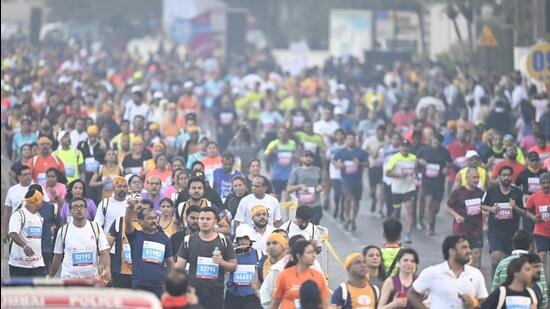
As the starter pistol went off at CSMT at 5:15am on Sunday, flagging off the 42-km long amateur marathon, the racers were pumped up to brave the nip in the air. There was, however, another challenge the runners had to endure- the air quality, which dropped to its poorest in at least two weeks. The System of Air Quality Forecasting and Research’s (SAFAR) monitoring station in Colaba -- the closest official device -- reflected a ‘very poor’ air quality index (AQI) of 351, while another in Worli (which was part of the route) showed a ‘poor’ AQI value of 259.
The city’s lowest temperature of the season so far has been 15 degrees Celsius on December 25 morning.
Data from an independent weather watcher showed a slightly higher temperature in the nearby locality of Fort, at 15.8 degrees Celsius, on Sunday morning. There has been a steep dip in mercury across the rest of the MMR, with Badlapur clocking Sunday’s in an 8.8 degrees Celsius, Virar at 9.7 degrees Celsius, and Kandivali at 11.9 degrees Celsius, according to independent observations.
Cooler temperatures over such a large geographic region are typically followed by a spike in pollution levels. Unlike warm air, which rises, cold air settles close to the ground and traps suspended particulate matter and other pollutants. Cooler temperatures also lead to slower winds, hampering the dispersal of pollutants (which is much more efficient during summer months).
“Over the last two months, owing to the phenomenon of La Nina (cold ocean temperatures in the Equatorial Pacific), India has been experiencing and will continue to experience an unusually cooler and extended winter. In addition to this, the western part of India is influenced by the warming of the Mediterranean Sea. As a result, there are calm winds across the Mumbai region. This has ensured that the dispersion of air pollutants being emitted from pollution-related activities does not happen swiftly despite Mumbai being surrounded by the ocean,” said Gufran Beig, project director, SAFAR.
Hindustan Times did not observe a significant number of marathon runners, or bystanders, express concern over prevailing pollution levels. Nor did many people show symptoms of cough, congestion, dizziness and others which are usually brought on by a rapid spike in pollution. Experts, however, cautioned against doing any strenuous physical activity under such conditions.
“You may not be feeling unwell today, but the evidence of the impact of air pollution on human health is fairly clear. The direct impact of air pollution on marathon performance has been studied to some extent, but there is enough research which already shows that exposure to PM2.5 and PM10 does reduce the efficiency of exercise,”
These pollutants can trigger rapid fatigue, which exacerbates the risk of heart disease and stroke. PM2.5, especially, can pass the blood-barrier and enter your heart vessels. And that too when you are breathing at a normal pace. The risk of this increases when you breathe at a faster rate during exercise, because your body is taking in larger volumes of polluted air,” he added.
Stay updated with all the Breaking News and Latest News from Mumbai. Click here for comprehensive coverage of top Cities including Bengaluru, Delhi, Hyderabad, and more across India along with Stay informed on the latest happenings in World News.


