
 E-Paper



Saki Naka chokes on pre-monsoon showers: Is Mumbai prepared for the rains?
After the showers on Tuesday, videos began to flood social media, showing garbage floating on the streets in the commercial and industrial belt


MUMBAI: Brief but intense pre-monsoon showers that lasted 30 minutes on Tuesday night wrought havoc at Saki Naka, Andheri east, triggering unprecedented flooding. Viral videos began to flood social media, showing garbage floating on the streets in this commercial and industrial belt. Routine pre-monsoon showers turned into a nightmare for residents, commuters and shopkeepers in the area, prompting citizens to question Mumbai’s monsoon preparedness.
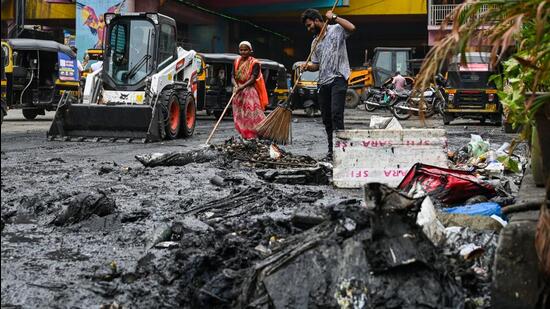
Heaps of garbage – equivalent in height to a single-storey building – lay unattended along 90ft Road. Citizens were furious as Saki Naka became a symbol of civic collapse, a sign of the city’s crumbling solid waste management collection.
On Wednesday, the civic administration reviewed the situation and claimed they had identified the culprit. They blamed Nallah No 10, which cuts through densely populated slums and small-scale industrial units. The problem, they said, was the dumping of waste into nallahs, particularly Nallah No 10, by residents of surrounding slums and small-scale units.
Residents and small business owners are not denying this. K Choudhary, an electrical shop owner on 90ft Road, said industrial units behind Khairani Road dump large amounts of non-biodegradable waste into the drains. “Who dumps a fridge or a sofa into a drain? Until this is checked, nothing will change.”
Another shopkeeper at Saki Naka, Sukhjit Singh Atwal, pointed to poor cleaning mechanisms and illegal encroachments. “The drains are blocked by street vendors who have no waste disposal system. Even light rain causes two feet of waterlogging.”
Mandeep Singh Makkar, founder of the Chandivali Citizens Welfare Association (CCWA), underlined the need for structured garbage collection systems in slums. “Unlike housing societies that segregate and compost waste, slums lack a proper collection system, so dumping in open spaces and nallahs becomes the norm.”
Civic activists such as RTI activist Santosh Daundkar blamed non-implementation of the Dattak Vasti Yojana (DVY), a civic scheme to maintain hygiene in slums, as the primary reason for the crisis. Though the scheme was later replaced by the Swachh Mumbai Prabodhan Abhiyan in 2013, activists say on-ground implementation is missing, especially in areas with industrial small-scale activity. This includes the dumping of waste from small-scale units such as foam, thermocol, plastics, and even furniture.
But that’s only half the problem. Activists say the Brihanmumbai Municipal Corporation (BMC) has never been serious about enforcing solid waste management protocols, and should shoulder half the blame.
Abhijit Bangar, additional municipal commissioner (projects), acknowledged that nallahs are overwhelmed with solid waste. He has a short-term fix: installing 7-8-foot mesh screens along the drains to catch solid waste. “Throwing plastic into nallahs is unprecedented. We plan to place wire mesh on both sides of the drains after the monsoon.”
Bangar added that similar mesh systems have been successfully deployed in Navi Mumbai and netted 90% garbage. “This will be extended to other high-waste areas such as Kurla, Govandi, and Deonar,” he assured.
Can wire mesh be a permanent solution to a complex challenge that has confounded the BMC for decades?
According to BMC rules, the building and factories department must submit an annual report on the quantum of industrial waste, but this appears to have fallen through the cracks, according to activists.
Also, despite tenders being issued for the cleaning of these drains, the situation suggests a lack of on-ground execution. The nallahs here are yet to be desilted.
As the BMC mulls a solution at Saki Naka, the 30-minute downpour on Tuesday exposed cracks in civic monsoon preparedness elsewhere as well. Pre-monsoon showers led to the closure of the Andheri subway, traffic was disrupted, and commuters were stranded. Flooding impacted other parts of the city, such as the Malad subway, Goregaon and Dadar.
Civic activist advocate Godfrey Pimenta urged the BMC to identify garbage hotspots in slums and levy localised solid waste management taxes. Daundkar wondered why, despite the successful implementation of mega projects like the Coastal Road, the simple task of cleaning nallahs has remained unresolved for years. “The real problem is DVY policies are made, but implementation is zero at the ward level.”

Stay updated with all the Breaking News and Latest News from Mumbai. Click here for comprehensive coverage of top Cities including Bengaluru, Delhi, Hyderabad, and more across India along with Stay informed on the latest happenings in World News.


