
 E-Paper



First time this month, air quality in Ghaziabad, Noida improves to ‘poor’
According to data from the Central Pollution Control Board (CPCB), the air quality index (AQI) of Ghaziabad and Noida on Monday was recorded at 254 (against 319 on Sunday) and 270 (322), respectively


The air quality of Ghaziabad and Noida improved significantly on Monday, moving to the ‘poor’ category for the first time this month. Experts have attributed the improvement to the rise in wind speed.
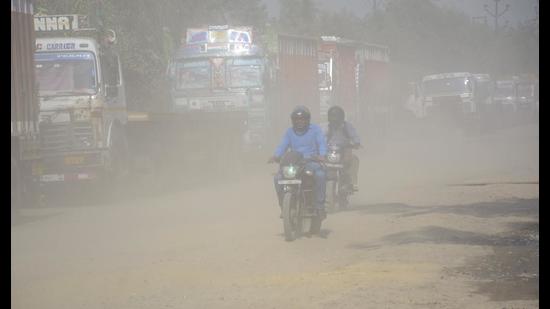
According to data from the Central Pollution Control Board (CPCB), the air quality index (AQI) of Ghaziabad and Noida on Monday was recorded at 254 (against 319 on Sunday) and 270 (322), respectively. The last time the Ghaziabad city experienced ‘poor’ air was on October 30 when its AQI value was recorded at 297, while Noida last witnessed ‘poor’ air on October 31 with an AQI of 292.
The AQI for Ghaziabad this month remained in ‘severe’ category for a period of 10 consecutive days from November 4 to 13 while Noida suffered six consecutive days of ‘severe’ air from November 4 to 9.
On Monday, Greater Noida, which has witnessed ‘poor’ air quality on several occasions this month, recorded an AQI of 202 against 298 a day earlier, showed the CPCB data.
According to the CPCB, the average of AQI in 22 days of November stood at 390.95, 350.72 and 381.22 for Ghaziabad, Greater Noida and Noida, respectively.
“The increase in wind speed and decrease in instances of stubble burning has improved the air quality in Noida and Ghaziabad. We are keeping control over local pollution factors. Since the wind speed has increased, the trapped pollutants in the region are dispersing fast,” said Utsav Sharma, regional officer of UP Pollution Control Board (UPPCB).
According to the India Meteorological Department (IMD), the present favourable wind conditions are likely to persist till November 24. “The present wind speed is about 15kmph with gusting to 25kmph. These winds are likely to be there till November 24 and will weaken thereafter. Since Diwali, we did not have any significant wind. Normally, the winds pick up during the end of November or start of December,” said RK Jenamani, senior scientist, IMD.
According to the System of Air Quality and Weather Forecasting and Research (Safar), stubble burning instances have reduced considerably and their contribution to Delhi’s PM2.5 is ranging below 10% since November 16. The share of stubble burning had spiked significantly to 48% on November 7 and gradually reduced thereafter.
Environmentalists said that only the meteorological conditions helped improve the air quality.
“It is finally the wind speed which has helped dispersal of pollutants. It shows that enforcement and actions on ground level by different agencies failed to make impact. The pollution level is in ‘poor’ category which indicates that the air is still not better but the spell of high levels of AQI has certainly come down due to favourable wind speed,” said Akash Vashishtha, a city-based environmentalist.
The Safar forecast on Monday said that the north-westerly winds are likely to continue on Tuesday and likely to further improve the air quality. “Air quality is likely to improve to ‘poor’ or lower end of ‘very poor’ category for the next two days. From November 24 onwards, local as well as transport level winds are likely to slow down resulting in slight deterioration of air quality but expected to be within the lower end of ‘very poor’ category. The effective fire count is 909 and its % share in Delhi’s PM2.5 is low,” the forecast added.

Stay updated with all the Breaking News and Latest News from Mumbai. Click here for comprehensive coverage of top Cities including Bengaluru, Delhi, Hyderabad, and more across India along with Stay informed on the latest happenings in World News.


