
 E-Paper



Ghaziabad surpasses Noida to become the worst polluted city in the country
Environmentalists said the pollution levels will improve on its own and there is no man-made intervention than can mitigate high pollution levels


The air quality, which started deteriorating on the day of Diwali, continued its downward trend with Ghaziabad and Noida emerging as the two most polluted cities across the country on Saturday.
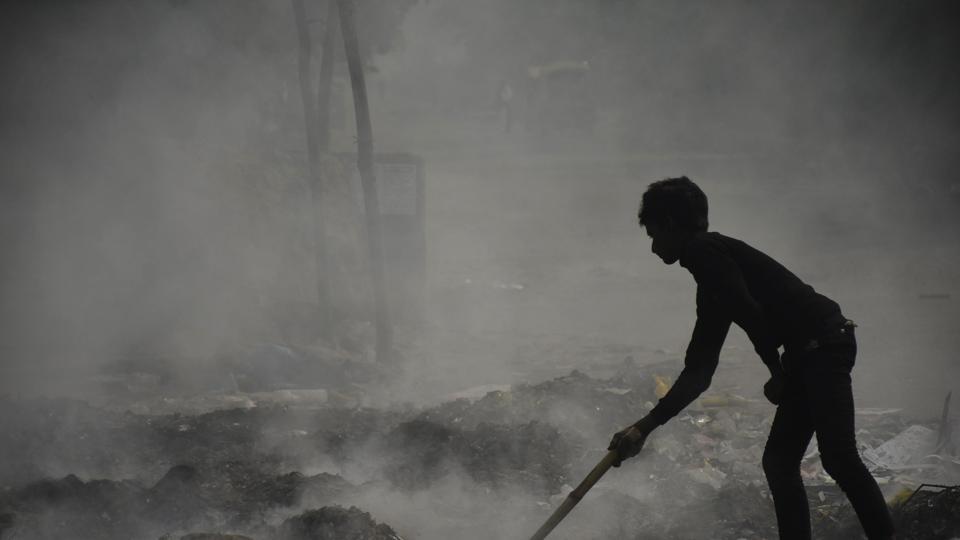
The air quality index (AQI) released by the Central Pollution Control Board (CPCB) indicated that Ghaziabad was most polluted on Saturday with an AQI reading of 466 while Noida, with an AQI of 461, was the second most polluted city in the country--the air quality of both the cities hovering in the ‘severe’ category. Greater Noida too was in the ‘severe’ category with an AQI of 414.
According to forecast of the System of air quality and weather forecasting and research (Safar), strong north-westerly winds have enhanced transport of emissions from stubble burning.
“Share of crop residue burning emissions in PM2.5 is 41% (effective fire count 5,159)... Delhi’s AQI is likely to improve to upper end of ‘very poor’ category as surface winds are becoming stronger in dispersing air pollutants,” said the Safar forecast.
An AQI reading between zero and 50 is considered ‘good’, 51 and 100 ‘satisfactory’, 101 and 200 ‘moderate’, 201 and 300 ‘poor’, 301 and 400 ‘very poor’, and above 400 “severe”.
Environmentalists said the pollution levels will improve on its own and there is no man-made intervention than can mitigate high pollution levels.
“It has been a regular feature in the past few years that meteorological conditions have spiked pollution and also mitigated it. The present spike in pollution levels is the result of burning crackers and also meteorological factors. It will subside on its own in the coming days as the volume of vehicles on roads, that shot up during the festive season, will also reduce. The inter-departmental coordination between the agencies is missing. There is hardly any effect of enforcement on the ground level,” said Akash Vashishtha, a city-based environmentalist.
On Saturday, the four stations monitoring air quality in Ghaziabad and the two in Greater Noida recorded PM2.5 as the primary pollutant while the four monitoring stations in Noida had both PM2.5 and PM10 as primary pollutants.
Officials of the Uttar Pradesh Pollution Control Board said the spike in pollution levels was higher during the intervening night of Thursday and Friday.
“The pollution levels increased due to burning of crackers. The effect reduced during the day on Friday as wind speed picked up and helped pollutants to disperse. It is expected that the upcoming spike will be more because of stubble burning, which has spiked to 41% as per the Safar forecast. It is likely that the pollution levels will improve from the evening of November 7,” said Utsav Sharma, regional officer of UPPCB, Ghaziabad, who is also officiating for Noida.
A day after Diwali on November 5, Ghaziabad, Greater Noida and Noida had an AQI of 470, 464 and 475 respectively, under the “severe” category, with Noida emerging as the most polluted city across the country.
“The spike in pollution levels during this time of the year is a feature prevailing in the Ghaziabad/Noida region for past several years and the trend is continuing this year as well. A comprehensive study about the meteorological factors, demography, wind pattern and other elements, must be conducted to find out the reasons behind the spike just before the onset of winter,” said Sushil Raghav, another city-based environmentalist.
According to the Ministry of Earth Sciences’ air quality early warning system for Delhi, the air quality is likely to improve further and reach the lower end of “very poor” category on November 8.
“The outlook for subsequent five days: The air quality is likely to improve progressively and remain in lower end of very poor category to poor category. PM2.5 to be the predominant pollutant,” the forecast said.

Stay updated with all the Breaking News and Latest News from Mumbai. Click here for comprehensive coverage of top Cities including Bengaluru, Delhi, Hyderabad, and more across India along with Stay informed on the latest happenings in World News.


