
 E-Paper



Noida, Ghaziabad get second best pre-Diwali air in four years
Both cities experienced its worst pre-Diwali month in 2020 when the monthly average AQI stood to 354.93 in Ghaziabad and 343.03 in Noida, the highest in the four years since 2018


The prolonged monsoon and its late withdrawal from northern India have helped Ghaziabad and Noida record the second best pre-Diwali air quality in the past four years.
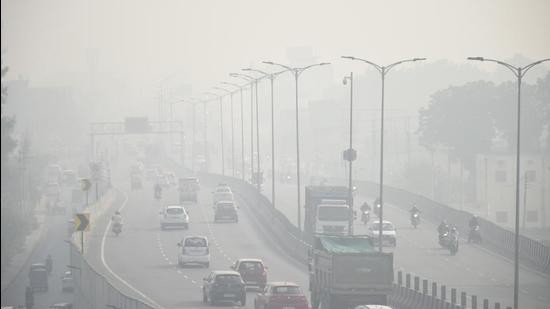
This year, the average monthly air quality index (AQI) before Diwali is 230.27 for Ghaziabad and 200 in Noida, the figures from the Uttar Pradesh Pollution Control Board (UPPCB), showed.
According to the state pollution control board, the month preceding Diwali was the cleanest in 2019 in the past four years. Data from the UPPCB showed that the average AQI for the month preceding Diwali was 198.6 in Ghaziabad and 193.57 in Noida in 2019.
Both cities experienced its worst pre-Diwali month in 2020 when the monthly average AQI stood to 354.93 in Ghaziabad and 343.03 in Noida, the highest in the four years since 2018.
“The pollution levels this year have increased a bit as compared to the monthly average AQI before Diwali in 2019. Diwali was celebrated on October 27 in 2019, right after the monsoon withdrawal. Hence, stubble burning was not at its peak and AQI readings were better in the run-up to Diwali that year,” said Utsav Sharma, regional officer for UPPCB, (Ghaziabad), who is also officiating for Noida.
“This year, the pre-Diwali period in Ghaziabad and Noida region is the second best in the last four years. For the past couple of days, stubble burning has increased and so has the emission from vehicles as markets have opened up after permission was granted for festivities following a drop in Covid-19 cases. All these factors have led to a minor rise in pollution as compared to 2019,” said Sharma.
When it comes to air quality, Noida has fared better than Ghaziabad during the one month preceding Diwali in all four years.
An AQI reading between zero and 50 is considered “good”, 51 and 100 “satisfactory”, 101 and 200 “moderate”, 201 and 300 “poor”, 301 and 400 “very poor”, and 401 and 500 “severe”.
As pollution levels continue to rise in Ghaziabad, the city emerged as the most polluted city in the country for the third consecutive day on Wednesday according to the AQI figures released by the Central Pollution Control Board (CPCB).
Ghaziabad recorded an AQI of 353 (very poor) on Wednesday, with the primary pollutant being particulate matter (PM)2.5, which are fine particles with a diameter less than 2.5 micrometres. This is mostly the result of stubble burning and vehicular pollution.
The AQI for Greater Noida stood at 286 under the “poor” category. Noida too had “very poor” air on Wednesday with an AQI reading of 327.
The PM2.5 was the primary pollutant at two monitoring stations in Greater Noida and at three monitoring stations in Noida on Wednesday.
Environmentalists said the economic activity during the festive season started late this year. Thus, it is leading to a rise in AQI in the region.
“Rise in pollution in Ghaziabad and Noida is largely due to meteorological factors and also due to higher vehicular emissions during the festive season. The enforcement lacks sting. If the average of pre-Diwali AQI is second best in past four years, it is not due to enforcement but due to prolonged monsoon which ended just last month,” said Akash Vashishtha, a city-based environmentalist.
“In the coming days, the level of pollution is likely to rise as bursting of crackers has already started in localities despite the administration not issuing any licences for firecrackers. The post-Diwali period will reveal the true picture of air pollution, hence the enforcement agencies need to act now,” said Sushil Raghav, a city-based environmentalist.
According to the System of air quality and weather forecasting and research (Safar), the AQI of Delhi will start deteriorating from November 4 to touch the upper end of “very poor” range on November 4.
“As per the Safar sensitivity simulation, stubble share on November 4 is predicted to increase to 20% and will touch a peak of 35-40% on November 5 and 6, if fire counts are considered same as today (3500-4000)... In addition, very calm local Delhi wind condition with little ventilation is expected for next three days. Under zero firecracker emission scenario, the level of PM2.5 is predicted to be at the upper end of ‘very poor’ during November 4-6,” the forecast said.
It predicted that if 50% of additional fire cracker load of 2019 is considered, then AQI is predicted to enter “severe” category during November 4-6.
“It is predicted to improve slightly on November 6 evening onwards but will fluctuate between high-end of ‘very poor’ to the ‘severe’ range. This is mainly due to coinciding of all three critical factors with a peak PM2.5 surpassing AQI value of 500+ on November 5,” the forecast said.

Stay updated with all the Breaking News and Latest News from Mumbai. Click here for comprehensive coverage of top Cities including Bengaluru, Delhi, Hyderabad, and more across India along with Stay informed on the latest happenings in World News.


