
 E-Paper



Noida sees drop in mercury after icy cold winds sweep NCR
Temperatures are likely to fall over the next three days, and later stabilise only to drop further when the next western disturbance hits the region later this week, said weather analysts


Icy cold north-westerly winds swept the National Capital Region on Tuesday as daytime temperature dropped in Noida and adjoining areas, according to weather analysts.
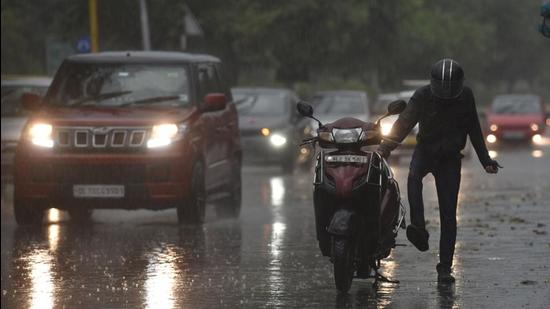
Temperatures are likely to fall over the next three days, and later stabilise only to drop further when the next western disturbance hits the region later this week.
According to the India Meteorological Department (IMD), the maximum and minimum temperatures in Noida on Tuesday were recorded at 27.4 degrees Celsius (°C) and 17.6°C against 28.5°C and 17°C, respectively, a day earlier.
Maximum and minimum temperatures will hover around 29°C and 15°C on Wednesday, said an IMD official, requesting anonymity.
“The mercury may drop further over the next three days as the icy cold winds will continue to flow from the mountain region which recently received snowfall. After three days, the temperature will be stable for some time until the next western disturbance, when temperatures will start to fall again,” said Mahesh Palawat, vice-president, meteorology and climate change, Skymet.
Meanwhile, pollution monitoring agencies predicted that the air quality may drop as stubble burning incidents are likely to increase ahead of the winter season.
According to the Central Pollution Control Board (CPCB), the air quality index (AQI) reading -- on a scale of 0 to 500 -- in Noida on Tuesday was recorded at 154 against 150 a day earlier. Similarly, Ghaziabad’s AQI was 176 against 80 on Monday, and 149 at Greater Noida against 90 a day earlier.
An AQI reading between 101 and 200 is considered ‘moderate’, between 201 and 300 is ‘poor’, between 301 and 400 ‘very poor’, and above 400 ‘severe’.
The air quality is likely to worsen in the region, according to the System of Air Quality and Weather Forecasting and Research (SAFAR) on Tuesday. “Fire emission is expected to increase due to dry weather over North India (upwind region) in the next three days, due to which the particular matter -- PM2.5 -- is likely to increase. Drier conditions tend to increase PM10. Thus, the overall AQI is likely to degrade to ‘moderate’ to ‘poor’ category for the next three days. The effective fire count over the northwest region is 348 and its share in PM2.5 is 8% as westerly winds are partly favourable,” according to a statement issued by the SAFAR on Tuesday.
Stay updated with all the Breaking News and Latest News from Mumbai. Click here for comprehensive coverage of top Cities including Bengaluru, Delhi, Hyderabad, and more across India along with Stay informed on the latest happenings in World News.


