
 E-Paper



26 times this November, Punjab’s AQI slipped into ‘severe’ category
The AQI of Punjab had also been rated, on the average daily count basis, as poor, data with the CPCB shows; in the state, AQI on most days November reached a much higher level than the average readings


Bathinda The Air Quality Index (AQI) of Punjab has been of severe quality (401 upwards on the measuring scale) on 26 different occasions across eight air pollution audit spots over November to date. AQI above 401 means it was five times worse than the ‘satisfactory’ AQI value of 51-100. A severe AQI rating means the air affects healthy people and seriously impacts those with existing diseases.
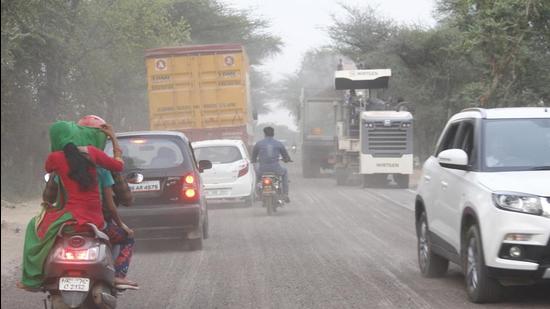
An analysis of the Central Pollution Control Board (CPCB) data says the average daily AQI was rated ‘poor’ (201-300) on up to 14 days in the state, since November 1. The daily AQI average did not touch the ‘severe’ level this month, but the daily average of ‘very poor’ scale of 301-400 was recorded on up to four days at four AQI assessment spots.
The debate over air standards in Punjab, however, has failed to get due attention with the pollution levels in Delhi-NCR (National Capital Region) grabbing headlines.The CPCB audits air quality at eight places in six districts — three in Ludhiana (Khanna, Mandi Gobindgarh and Ludhiana City) and one each in Bathinda, Jalandhar, Amritsar, Patiala and Rupnagar.
Data says, the maximum overall high-pollution days this month in Punjab was at Punjab Agriculture University (PAU) in Ludhiana. On 14 days, AQI was rated ‘poor’ in the city, and one day it was ‘very poor’. Jalandhar, the air quality indicator of Doaba region, faced average ‘poor’ air on 12 days this month and it was reported ‘very poor’ on one day.
The daily average assessment in Amritsar, the sole pollution indicator of Majha, was ‘poor’ air on 11 days whereas it was moderate (101- 200) on four days. In Bathinda, average daily ‘poor’ air was recorded on eight days and ‘moderate’ for seven days this month.
In the state, AQI on most days this month reached a much higher level than the average readings.
‘No data on which activity
adds how much to pollution’
Vinod Kumar Garg, professor, School of Environmental Science and Technology at the Bathinda-based Central University of Punjab, “Burning of organic waste, vehicular emission, power generation plants, dust etc cause smog and the problem turns worse in winters due to climatic conditions. There is no scientific mechanism to confirm how much use of various resources contribute to pollution,” he said.
CPCB data says on 78 occasions, air quality deteriorated and fell in ‘very poor’ category.
Bathinda, the only centre of south Malwa to audit air quality, saw eight days in November where AQI scaled beyond 401. Of these, the AQI was at the highest scale of 500 on four occasions since November 11. Patiala and Rupnagar recorded a maximum scale of ‘severe’ levels on three days. Ludhiana recorded very poor air on 15 occasions in November when AQI was very poor.
The only exception was the Shivalik foothill region near the Rupnagar sample collection site, where daily AQI was ‘poor’ only twice; but severe air pollution was recorded thrice over the past 16 days.


