E-Paper



Bahraich: Ghaghra’s wrath yatra fails to find poll resonance
Villagers here know that in a few weeks from now as the political temperature goes down with the 2024 Lok Sabha election results, the Ghaghra will swell amid the rains and eat up more land of theirs, push them even farther from the present riverbank and compel them to find a new place for their huts.

 Prefer HTon Google


A 500-metre walk on a brick road inside Kayampur village in Mahsi assembly segment of Bahraich brings you straight to a desolate end amid hot and gusty winds straight from the riverbed of the Ghaghra that has eroded fertile land equal to at least two football fields in and around this village, dislocated and deprived hundreds of villagers from their basic source of income – agriculture.
Villagers here know that in a few weeks from now as the political temperature goes down with the 2024 Lok Sabha election results, the Ghaghra will swell amid the rains and eat up more land of theirs, push them even farther from the present riverbank and compel them to find a new place for their huts.
“I am 28 and I have built my house four times after the Ghaghra washed away our land and took away every brick in its swift current,” says Ram Shankar, a villager.
“Half of our village is gone. Come peak monsoon, the remaining village with about 25 houses will also be gone,” he said.
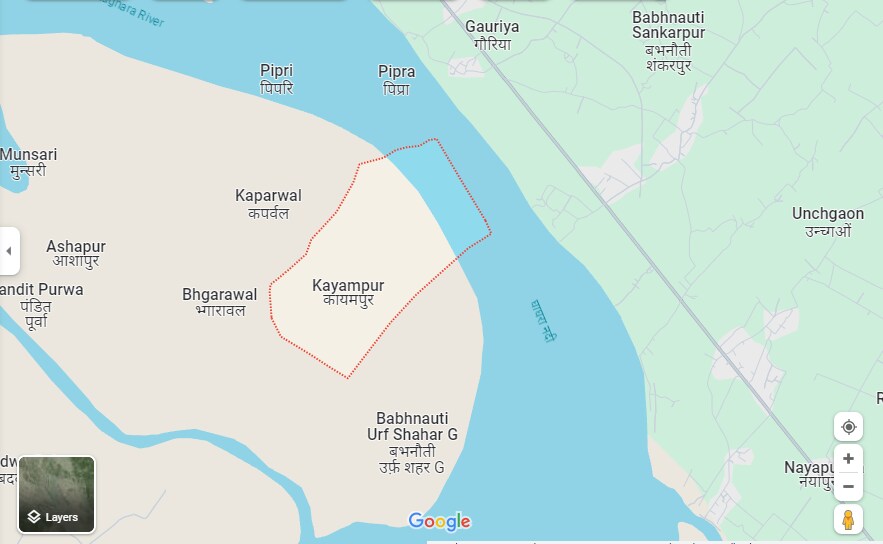
With about 1200 residents, Kayampur village is spread over a 158-hectare area. It is 20 kilometres from the Mahsi sub-district headquarters, which comprises 235 villages. Mehsi tehsil has a population of 5.46 lakh.
Villagers know the river will inevitably enter their houses and fields. They lament that politicians haven’t paid heed to their woes.
“The politicians and authorities have not shown concern or arranged any facilities to help us,” says Ram Shanker who lives with his sister, brother and mother.
“Our family has lost about 10-bigha land,” One bigha is equivalent to 27,000 sq feet and one hectare is 1.07-lakh square feet.
“Bagia was the first village to get eroded completely. Villagers from Golaganj Khas settled back and named it Golaganj. The erosion never stopped. I have seen Shukulpurwa, Dhobinpurwa, Kaharanpurwa, Tapri, Karinpurwa vanishing with floods in the Ghaghra. Tiwaripurwa village was eroded twice before my eyes,” says Karipranam, 80, a retired teacher who lives in Lohiyanpurwa, another village on the Ghaghra bank in Bahraich, which votes in the fourth phase of the Lok Sabha election on May 13.
“I have lost 33-acre of my family land till now,” he said.
Villagers here have little or no hope from politicians. “They come to take our vote. We do vote at a polling booth in a nearby school, but not a single politician has returned to help us,” the retired teacher says.
“All my land was gone in the monsoon a couple of years ago. I built a new house by purchasing some (land). My savings gave me a roof over my head,” says Vikram Kumar, another villager.
As politicians travel across the Ghaghra for campaigning, thousands of farmers in 100-odd villages in Bahraich are almost solely concerned about the issue of “kataan” or soil erosion caused by the river that’s killing their earnings every year.
With the farmers losing their fertile land, their income, too, is affected.
Bahraich has over six lakh farmers against a total rural population of over 19 lakh. At least one lakh farmers live in areas in the grip of annual soil erosion. As the river meanders, it erodes the sediments of an outer, concave bank. This process is threatening agricultural land in Bahraich.
But there is a silver lining for those living on the Ghaghra bank.
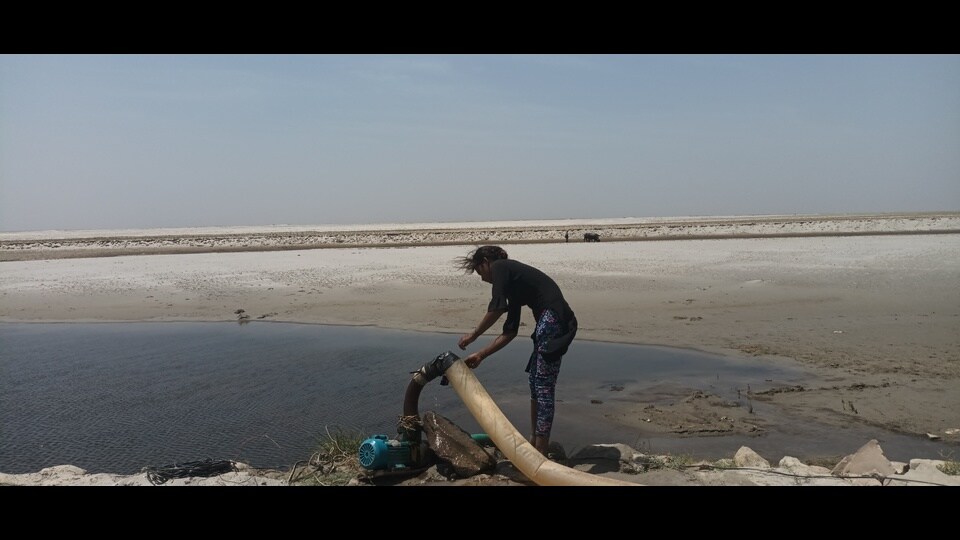
“I lost 32-bigha land and only 15 bigha remains with my family. The only hope is that the land near the riverbank is fertile and we don’t have to struggle for water,” says Suresh Kumar , 35, who lives in the ‘kataan’ area. Villagers use a pump to irrigate their fields that grow wheat and vegetables for their own consumption.
In the erosion process, the water current comes from the north-western direction of the village and it (river) turns south a bit. It (river) hits the east side hard, where villages are located.
“It takes one hour to fill my field with water,” says Soni, 16, another villager. A pipe fetches water from the riverbed to her field.
With earnings affected by erosion, many youths have had to leave the village.
“I have gone twice to Punjab to work in the construction industry for three or four months in the past year. There are hundreds of others who do the same to bring money back home,” says Ram Shankar.
The Ghaghra enters India via Nepal. “Heavy discharge of water from Nepal causes floods in the district mostly during July, August and mid-September,” Suresh Kumar says.
Three tehsils —Nanpara, Mahsi and Kaiserganj — are worst affected by soil erosion due to the Ghaghra’s strong water current.
To check the water flow, a 95-km-long check dam was built in 1957 at Belha-Behrandi. It was supposed to protect 157 villages in three tehsils – 62 villages in Mahsi, 32 in Nanpara and 35 in Kaiserganj. Yet, villages get flooded.
During the reign of the nawabs, the Ghaghra was also a waterway for ferrying indigo, sugar, poppy seed and mustard. Till the late 1970s, there was a ferry service from Bahraich to the neighbouring Barabanki district.
Bahraich is in the north-eastern part of Devipatan division. The area of the district is 4696.8-sq km, 31.99% of the Devipatan division. Bahraich shares the international border with Nepal on the northern part while Sitapur district is in the south, Kheri in the west and Gonda and Shravasti on the eastern side. The northern part of the district consists of the Terai region covered with natural forest.
The Ghaghra basin has a total catchment area of 1,27,950 square kilometres, of which 45% is in India and 55% in Nepal.
While villagers plead for protection against “kataan”, officials say they are doing the best possible.
Additional district magistrate (finance and revenue) Gaurav Ranjan Srivastava says: “Compensation is paid both for damage to house and loss of agricultural land. We ensure the pendency gets over soon. As the financial year came to a closure in March, we cleared all pendency accumulated till then.”