
 E-Paper



Chhattisgarh: Doorstep ration reaches Abujhmad as Narayanpur pilots decentralised PDS
The tractor-based decentralised public distribution system, introduced by the district administration this year, currently covers 4,136 ration card holders in inaccessible villages of Abujhmad

 Prefer HTon Google


Chhattisgarh’s Narayanpur district administration has launched a decentralised public distribution system (PDS) delivering ration in the remote Abujhmad region directly to 11,764 beneficiaries across 67 villages in Orchha block.
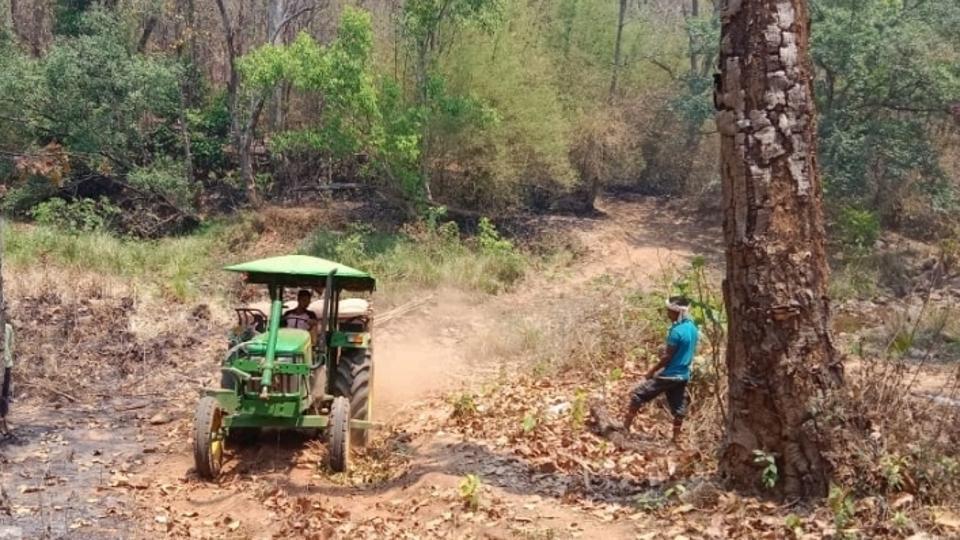
The tractor-based decentralised public distribution system, introduced by the district administration this year, currently covers 4,136 ration card holders in some of the most inaccessible villages of Abujhmad, officials said.
The initiative comes after security forces and the state administration in January this year declared Abujhmad “Maoist-free” following sustained anti-insurgency operations in the region.
Long regarded as the core area of Maoist influence in Bastar and often described by officials as a stronghold of the insurgency, large parts of Abujhmad had remained beyond the routine reach of state services for years.
Narayanpur, Chhattisgarh, is one of the three districts (Bijapur and Dantewada are the other two) covered by one of India’s most inhospitable forests, Abujhmad, which translates as hills of the unknown in Gondi.
Under the arrangement, food grains are transported every month directly to gram panchayat-level distribution points, with about 34.05 metric tonnes (1,340.5 quintals) being moved under the scheme monthly.
Also Read: Once off map and under Maoist control: Inside Abujhmad’s journey to government records
The villages and their residents were cut off not just by geography, but by a five-decade-long Maoist insurgency.
The initiative began in January 2026 with Mandali gram panchayat and was expanded to 13 more gram panchayats from February 2026, according to district officials.
District collector Namrata Jain along with her team are currently mapping the area and it was during this time Jain witnessed the hardship faced by residents, particularly women, who had to travel long distances on foot to collect ration.
“In several interior villages, collecting ration had meant a journey of nearly three days every month, involving forest routes, river crossings and overnight halts in Orchha or nearby settlements. During the monsoon, many habitations remained cut off for months as streams became impassable, said Jain.
Jain cited the example of Somari Bai of Thulthuli village, who earlier spent nearly three days travelling to and from Orchha to collect monthly ration, often losing workdays in the process.
“The entitlement existed on paper, but physical access to it fell entirely on the poorest residents,” Jain said.
The 14 gram panchayats currently covered under the model are Murumwada, Jatloor, Thulthuli, Aader, Ghamandi, Pochawada, Kodoli, Dhodarbeda, Mandali, Hikul, Gomagal, Rekawaya, Handawada and Aadnar.
Among them, Aader and Handawada have the highest beneficiary counts, with 1,241 and 1,249 beneficiaries respectively, while Ghamandi covers villages located as far as 70 km from the erstwhile ration shop point in Sonpur.
The collector said the transportation cost for the decentralised delivery system is currently being borne by the district administration.
The administration has described the arrangement as temporary until permanent fair price shops and road connectivity are developed in the region.
According to district records, PDS shops have been sanctioned in 13 of the 14 gram panchayats under the initiative, with Aadnar yet to receive sanction. Permanent fair price shops are planned to be established in phases based on infrastructure readiness.
To address monsoon inaccessibility, the district has also adopted a pre-positioning strategy under which food grains for the entire peak monsoon period will be supplied in advance to identified villages to ensure uninterrupted access when movement becomes impossible.
“A monitoring mechanism has been put in place to prevent diversion during transport and distribution, including district-level nodal officers, Food Department supervision, end-to-end supply chain monitoring and digital documentation through video recordings and photographs,” said Jain.
The district administration is considering scaling up the model to other inaccessible habitations in Abujhmad and the wider Bastar region, subject to feasibility, officials said.
Villagers have welcomed the new arrangement.
“This is a great step. It was very difficult to travel to Orchha from here on foot and get ration, but now it is at our doorstep,” said Kamlu Ram Vadde, a resident of Ghamandi gram panchayat.
-kW0H-U20214218012MgB-250x250%40HT-Web.jpg)


