
 E-Paper



CM highlights Bihar’s march into prosperous future from darkness
Nitish Kumar said Bihar is advancing rapidly with Centre’s cooperation and will soon rank among the country’s most developed states, contributing meaningfully to national progress

 Prefer HTon Google


Chief minister Nitish Kumar on Friday said here that the state had moved from an era of fear and lawlessness to one of peace, brotherhood and steady development in the last two decades.
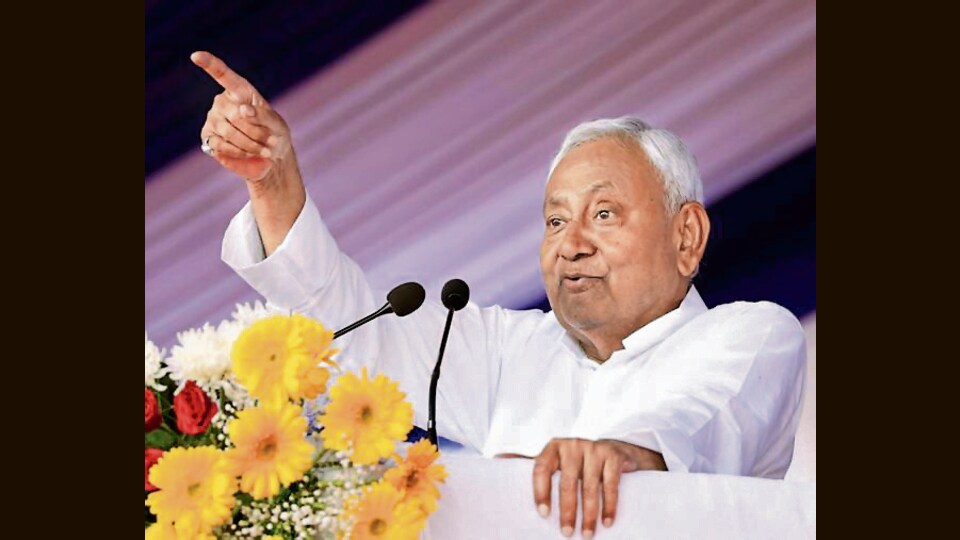
He said this while speaking at “Jan Samvad” programme in Saharsa, after laying the foundation stones and inaugurating around 125 schemes, costing around ₹500 crore. On the occasion, the CM asked the crowd to recall the past. “People did not step out after dark. Society was torn by endless conflicts, especially Hindu-Muslim tensions. Education was in shambles — very few children attended school. Medical care barely existed, roads were scarce and in poor shape, and electricity reached hardly any villages,” he said. “Now there is no atmosphere of terror. The state is filled with love, brotherhood and peace.”
To curb graveyard-related disputes that once flared frequently, fencing of cemeteries began on a large scale from 2006. Similarly, since 2016 old Hindu temples (over 60 years) have been fenced to prevent thefts. “No clashes happen now,” he noted.
The CM placed education at the forefront of change. Contractual teachers were regularised, thousands of new schools opened and uniform and bicycle schemes introduced for girls and boys. Since 2023 the Bihar Public Service Commission (BPSC) has appointed 258,000 government teachers. From 2006, 368,000 contractual teachers were taken on, and of them 28,976 were given the government status through alternate exams. The government exempted them from full BPSC exams, instead holding simpler tests with five attempts. Four such exams have been conducted so far, passing 266,000 teachers; only 73,000 remain for one final chance. The total government teacher strength now stands at 524,000, with another 45,000 posts under recruitment.
Healthcare has seen a similar transformation. Primary health centres once saw just 39 patients a month — one or two a day. Free medicines and treatment started in 2006. Today those centres handle an average 11,600 patients monthly. Medical colleges have doubled from six to twelve, with six more completing this year and construction advancing in the remaining 21 districts. Patna Medical College & Hospital is expanding to 5,400 beds, five older colleges to 2,500 each, and IGIMS to 3,000.
Infrastructure improvements include extensive roads, bridges, rail overbridges, bypasses and elevated corridors. The 2016 target of reaching Patna from remote areas in six hours was met; now many places connect in about five. Agriculture road maps since 2008 have boosted grain output sharply, while fruits, vegetables, milk, eggs, meat and fish production has more than doubled — making Bihar self-reliant in fish.
Under Saat Nischay launched in 2015, the government focused on youth empowerment, women’s rights, electricity and piped water to every home, toilets, pucca roads to villages and upliftment of weaker sections. Electricity reached all households by 2018, supplied at low rates and now largely free for domestic users. Solar panels are being installed on willing homes — approval already given for 50 lakh.
Saat Nischay-2 (from 2020) emphasised youth power, women’s empowerment, irrigation, clean villages and cities, connectivity and universal healthcare including telemedicine and child heart schemes. So far 10 lakh youth received government jobs and 4 million employment opportunities, totalling 5 million. The next five years target 10 million such positions.
The CM said that women’s reservation has been raised to 50% in panchayats (2006) and urban bodies (2007), and 35% in police (2013) and all state jobs (2016). Bihar now has the country’s highest proportion of women in police. JEEViKA self-help groups, started in 2006 with World Bank support, now number 1.105 million with 16.9 million members; urban groups added 77,000 more since 2024.
In Saharsa itself, developments include an engineering college, polytechnic, women’s ITI, GNM and para-medical institutes, ongoing medical college-hospital, hostels, residential schools, bridges (including Baluaha Ghat), road widening and drainage. Post-2008 Kosi flood relief was swift and comprehensive. Six new schemes from the yatra are under execution.
Concluding, Nitish Kumar said Bihar is advancing rapidly with Centre’s cooperation and will soon rank among the country’s most developed states, contributing meaningfully to national progress.
The event was attended by deputy CM Samrat Choudhary, water resources minister Vijay Kumar Choudhary, local MPs, MLAs, MLCs and a large public gathering.
In Khagaria, the CM inaugurated and laid the foundation stones for 319 development projects worth a total of ₹304 crore at Sansarpur Maidan (or a similar public ground) in the district. Of these, 284 schemes costing ₹261 crore were formally inaugurated (lokaarpan/udghaatan), while the foundation stones (shilaanyas) were laid for 35 new projects valued at ₹43 crore.
The event forms part of the ongoing ‘Samriddhi Yatra’, through which the state government is accelerating infrastructure and welfare initiatives across Bihar districts. The projects span various sectors aimed at boosting local development and public welfare in Khagaria.


