
 E-Paper



Delhi govt’s pothole quick-fix plan falls flat
Visits by HT found potholes from Malkaganj in north Delhi to popular pockets in south Delhi’s Vasant Kunj


New Delhi
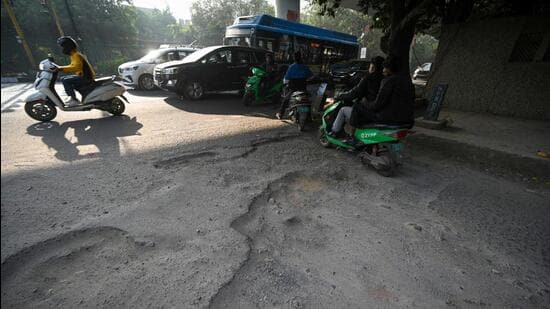
The Delhi government’s plan to fix all potholes by last Saturday has fallen flat, as spot checks by HT revealed that several localities, ranging from rural pockets to heavily urbanised areas, were all suffering from the malaise and subsequent dust pollution.
Visits by HT found potholes from student hub of Malkaganj in north Delhi to popular pockets in south Delhi’s Vasant Kunj.
Municipal agencies, meanwhile, admitted that the process may take longer. They said they are also undertaking other repair works, such as recarpeting, alongside fixing potholes, which has lengthened the process.
Residents, however, are an unhappy lot, as not only are they faced with tough commutes, but are also reeling from dust pollution caused due to potholed roads.
In north Delhi, the Malkaganj road from the Hansraj College is strewn with potholes and cracks, which also routinely fill up with water.
“The potholes make it difficult to walk here, as they are very deep and collect water from the overflowing sewers. At nighttime, it is almost impossible to walk due to the dark, as you can trip anywhere. People on bikes and rickshaws often get injured as the vehicles swerve and fall due to the uneven surface,” said Narender Kumar, who runs a construction material shop in front of the road.
Ashok Bhasin, president of a federation of north Delhi residents’ welfare associations (RWA), said that the problem is not unique to the spot. “With this road it is especially bad as people use it to reach the hospital. However, many localities have their internal roads broken as well, which no one pays attention to. These are managed by the MCD, which simply doesn’t have funds to fix it. How will it fix the roads if the government doesn’t give it funds?” he said.
In east Delhi’s Geeta colony, the Raja Ram Kohli Marg—in front of the Chacha Nehru children’s hospital—is riddled with multiple deep, waterlogged potholes, right in front of the hospital.
“A week ago, a man on a motorbike lost his balance due to the potholes, causing him and the bike to fall on me, injuring my leg. This happens often here as the entire road has many potholes. They are never permanently fixed, and the agencies only put a mixture of bricks and dirt, which is soon easily swept away by rain or sewer water,” said 61-year-old Om Prakash, an autorickshaw driver who works in the area.
A Municipal Corporation of Delhi (MCD) official aware of the matter said, “The roads across Delhi are under the control of different agencies. The MCD is working on filling the potholes across the city, and deputy commissioners across zones have been given directions by the chief minister regarding the same. She had also recently conducted a seminar on road development in partnership with the MCD.”
Residents said that even upscale south Delhi localities of Vasant Kunj and Greater Kailash-2 are not spared.
The road next to pockets 1 and 2 in Vasant Kunj’s sector C had a long pothole filled with dust and debris on one side of the road, and another pothole on the other.
“The problem here is that due to even just these two potholes, a bottleneck forms as everyone tries to avoid driving over them. This greatly increases traffic in the area. The potholes appeared around four to six months ago when a sewage line was being inserted and the road was dug up. However, it was not properly fixed,” said Naveen Vashisht, a member of Pocket C-2’s RWA.
Officials of the Public Works Department (PWD), under which the Vasant Kunj stretch falls, said that while pothole repair and patchwork is going on, it is also starting to recarpet and repairs nearly a third of its 1,400-kilometre road network.
“Along some of these 400-kilometre stretches, there may be few potholes or roads that are dug up. We are soon going to start a complete overhaul of these stretches, which is why duplication may have been avoided. For most of these roads, tendering has been done and work is likely to be started in less than a month,” a PWD official said.
In GK-2, long cracks and potholes were a common sight on internal roads.
“We feel as if the roads are missing. Dust gets picked up and accidents happen, but the potholes are not fixed. Even when they are repaired, they are temporarily repaired, causing them to break again. Additionally, as the agencies simply build over older roads, the height of the roads slowly rises, which is a problem,” said Sanjay Rana, president of GK-2 RWA.
HT also visited Karol Bagh, a popular student hub, which was also hit by the problem.
“Whenever roads inside the locality are dug up, new roads are not properly laid. As soon as water falls on these, they sink and potholes appear. Additionally, the sewage lines also do not function well, and when they overflow, the problem worsen,” said Savita Singh, a Karol Bagh RWA member.


