
 E-Paper



Into The Wild: Bharthapur’s daily struggle for edu, health & life itself
Distressed women implored for relocation due to constant life-threatening risks. Villagers lamented their children’s compromised education and the scarcity of livelihood opportunities due to menacing animals.

 Prefer HTon Google


Bahraich Imagine sending your child to school amidst the danger of encounters with wild beasts like tigers, leopards, and elephants. Or needing medical care for a sick parent, yet risking your life due to lurking predators. In Bharthapur, the last village on the Indo-Nepal border, these agonising choices are a grim reality.
Nestled between the Geruwa and Kaudiyala rivers, surrounded by dense forests, Bharthapur lies 122 kilometres from the district centre. It’s been recognised as a revenue village since 1834.
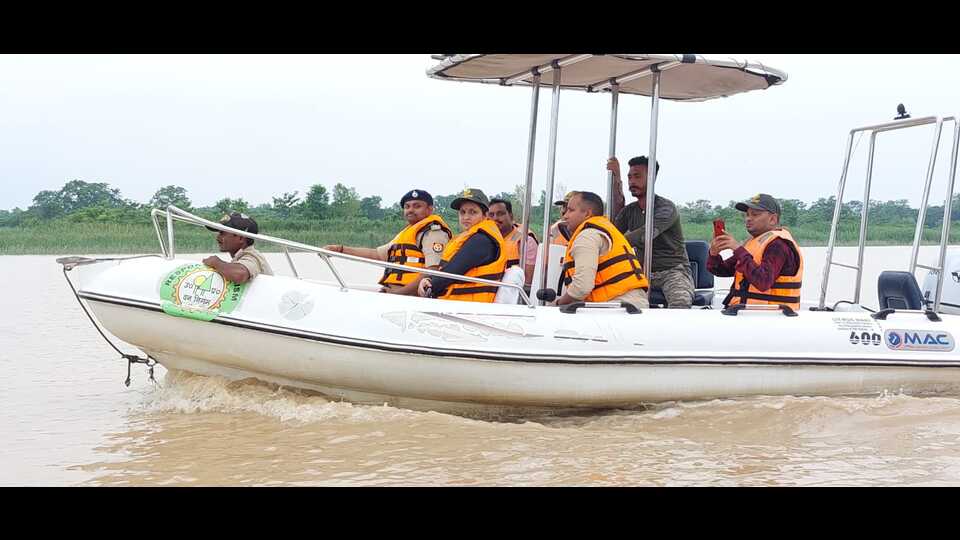
To access the village, one must navigate the waters, braving the Katarniaghat Wildlife Sanctuary (KWS) before crossing the Geruwa river by boat. The journey continues with a lengthy walk. Even district officials follow this arduous path to deliver government initiatives.
Linked to Amba Gram Panchayat, situated 15 kilometres away, Bharthapur’s life is hazardous and challenging. Iqrar Ansari, the head of Amba, described how villagers trek 6 kilometres through perilous forests teeming with wildlife. Many have left in pursuit of better lives elsewhere, leaving around 526 residents.
Significantly, the National Tiger Conservation Authority (NTCA) has been implementing the VVRP (Voluntary Village Relocation Program) in all tiger reserves across the country to create inviolate space for tigers.
“Our ancestors moved to this village around 350 years ago, but we are now forced to abandon this place due to the lack of basic infrastructure. There is only one school here, and that too only up to Class 5th,” said 44-year-old Munna Lal Maurya.
When asked about casualties due to man-animal conflict in the region, Maurya added, “Every year, at least one or two villagers lose their lives to wild animal attacks. In February, a 30-year-old named Chhote Lal was killed by a wild tusker. Previously, a 40-year-old named Lekhram Maurya was also killed by wild elephants. Another man, Ram Nath Kashyap, sustained injuries in an attack by a herd of elephants.”
Another reason behind the residents agreeing to relocate under the government’s Voluntary Village Relocation Program (VVRP) is the sense of hopelessness due to the lack of development. There are neither roads nor any solid houses in the village.
Laxmi Narayan, another local resident, said that about 50% of the village land gets inundated by the Geruwa and Kaudiyala rivers every year, causing massive losses to farmers.
It is worth mentioning that officials from the Katarniaghat Wildlife Sanctuary, home to 59 tigers, have proposed to the Bharthapur residents to vacate the village under the VVRP scheme.
Speaking to HT, Divisional Forest Officer (DFO) Akash Deep Badhawan said that one or two deaths due to wild animal attacks are reported in the area every year. However, flooding caused by overflowing rivers is the major cause of concern for the villagers.
The DFO added that VVRP schemes were introduced by the NTCA to relocate those living adjacent to tiger reserves. “Initially, villagers were not ready to relocate due to sentimental value. They were asking for either 2 hectares of land or ₹15 lakh in cash. However, after eight meetings, all villagers have now given their written consent to relocate.”
Recently, district magistrate Monica Rani, accompanied by forest officials, visited Bharthapur by motorboat. The journey revealed rhinos and crocodiles along the Geruwa river. Distressed women implored for relocation due to constant life-threatening risks. Villagers lamented their children’s compromised education and the scarcity of livelihood opportunities due to menacing animals.
Acknowledging the gravity of the situation, the DM promised a solution. A meeting was held with concerned officials, and an eligibility assessment committee was formed, consisting of administrative authorities.
Responding to the DM’s directive, the forest department conducted a survey in collaboration with other agencies. The voluntary displacement policy deemed 257 families eligible for a compensation of ₹15 lakh each. For 73 families, asset evaluation is ongoing prior to relocation.
Two relocation proposals have been formulated, one already submitted and the other to be sent shortly, said the DM. Despite the delay, the she has assured swift execution. If successful, Bharthapur will become the first village to be ‘relocated’ in the state.


