E-Paper



Miffed over NTCA numbers, Odisha begins its own tiger census in Similipal
The state alleged that not enough camera traps were put up and large inviolate areas and suitable habitats in south Odisha were not taken into account by the National Tiger Conservation Authority in the latest all India estimation of tigers

 Prefer HTon Google


Unhappy over the tiger count in the latest all India tiger estimation, the Odisha government on Wednesday began its own tiger census in Similipal Tiger Reserve of Mayurbhanj district.
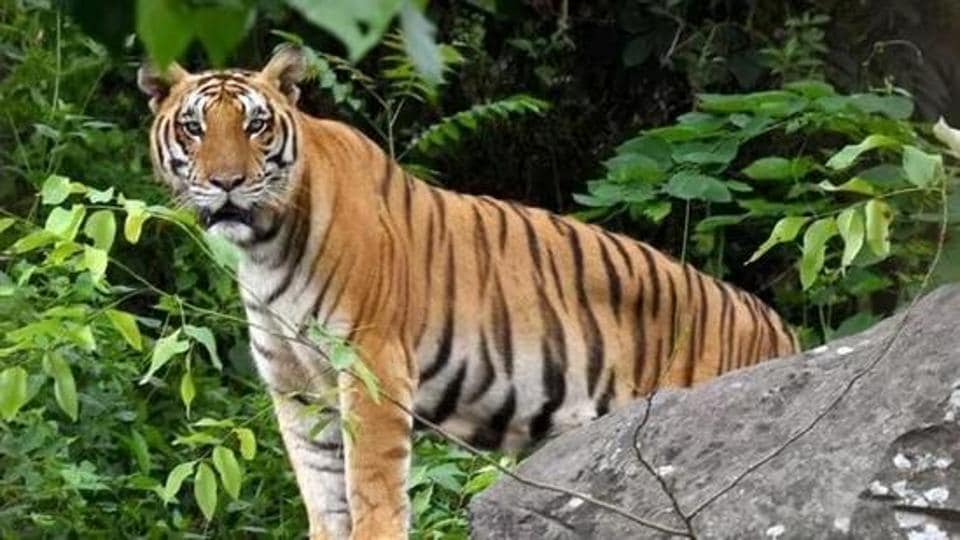
The state alleged that not enough camera traps were put up and large inviolate areas and suitable habitats in south Odisha were not taken into account by the National Tiger Conservation Authority (NTCA) in the latest all India estimation of tigers.
The NTCA said Odisha had 20 tigers, of which 16 were in Similipal alone. In 2018, the all India tiger estimation survey had found 28 tigers in the state.
Director of Similipal Tiger Reserve, Prakash Chand Gogineni said the counting began on Wednesday with 700 forest department employees from more than 200 beat houses in the Similipal forest joining the exercise.
“The sign survey process began on Wednesday while the line transect will be conducted from October 25 to 28. The line transect sampling will be done to find out prey species abundance, vegetation and human disturbances. After completion of the first phase exercise, around 600 camera traps would be installed. Subsequently, footprint samples will be surveyed in three phases from November 1, 2023, to January 18, 2024. In addition, the team will also assess the number of tigers in the region by identifying them through circumstantial evidence,” he said.
Gogineni said pugmarks and stool samples will be collected. “If required, we will go for DNA sampling if there is any doubt. Finally, the data will be submitted to the government as part of a comprehensive report,” he added. Three scientists from the Wildlife Institute of India (WII) had recently conducted training for master trainers and imparted handholding training to around 20 officials for the census.
According to All-India Tiger Estimation (AITE) 2022 released in July, the total number of tigers in Odisha’s forests has come down to 20 in 2022 from 45 in 2006 with one of its two notified tiger reserves, the Satkosia Tiger Reserve, left with none. Between 2018 and 2022, the state registered a drop in the population of the big cat from 28 to 20 with STR as the only silver lining, which saw the number double from eight to 16 during the period.
State wildlife officials said NTCA methodology of counting the tigers may not have been an accurate reflection of the presence, habitat occupancy and number of tigers in Odisha, as the sampling intensity was relatively low.
“The NTCA report had earlier said Similipal tiger reserve had a management effectiveness evaluation (MEE) score of 90.15 per cent which placed it among the 12 excellent tiger reserves of the country. We fail to understand how the number of tigers went down so much with such MEE score. Many tigers, who are adults now, were cubs and, thus, not counted during the census exercise around 2021. We are hopeful that the number of tigers in Similipal will increase from 16 to 35 once the estimation process is over,” said a senior wildlife official.
Odisha’s chief wildlife warden SK Popli said the latest tiger estimation by NTCA did not take into account large inviolate areas and suitable habitats in south Odisha districts such as Gajapati, Rayagada, Koraput and Malkangiri as well as areas adjoining Chhattisgarh such as the forests of Khariar.
“Though the forests of Odisha accounts for 39.31% of the state’s total geographic area, only 733 camera traps were also deployed, which is relatively low compared to 6,894 and 4,872 in the states of Madhya Pradesh and Maharashtra respectively, all from the same central Indian landscape,” he said.