E-Paper



Nearly 200 egrets, cormorant hatchlings die after Assam town committee fells bamboo trees over the fear of Covid spread
The trees were felled on an order issued this month by the executive officer of the Tangla Town Committee to five residents.


Nearly 200 egret and cormorant hatchlings died on Thursday after bamboo trees were felled in Assam’s Udalguri district over the fear of the spread of Covid-19 from the bird droppings.
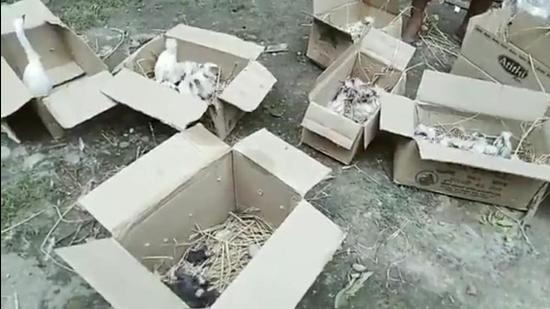
The trees were felled on an order issued this month by the executive officer of the Tangla Town Committee to five residents.
“The droppings of egrets nesting on bamboo trees in your property have led to unhygienic conditions and could lead to spread of Corona infection,” said the order issued on June 8.
“Residents in the neighbourhood are living in unhygienic conditions (because of the droppings). Therefore, you are directed to cut the bamboo trees in your property, which falls in the town’s area, and help create a healthy environment,” the order added.
After the residents did not cut the trees, the town committee went ahead and felled them on Thursday. This led to the destruction of the egret nests and many eggs, hatchlings fell on the ground.
Photos and videos showing the hatchlings lying dead or injured on the ground went viral on social media prompting Chief Minister Himanta Biswa Sarma to direct forest and environment minister Parimal Suklabaidya to inquire into the matter.
On Friday, Udalguri deputy commissioner P Uday Praveen visited the area and took stock of the incident. He has directed the circle officer of the area to prepare a report on the incident.
“We have not been able to ascertain how many hatchlings and birds died as local residents took away some of them from the site after the bamboo trees were felled. We were able to rescue 88 hatchlings on Friday and send them to the Centre for Wildlife Rehabilitation and Conservation (CWRC) in Kaziranga,” Praveen said.
“Instructions have been issued to local people to protect the birds and directions issued to the town committee not to carry out further felling of bamboo trees. We have kept a team at the spot to monitor the site,” he added.
The birds that died were from three species, Cattle egrets (Bubulcus ibis), Little egret (Egretta garzetta) and Little cormorant (Microcarbo niger). All of them are protected under Schedule IV of the Wildlife Protection Act, 1972.
“The death of the birds was due to sheer lack of education on the part of members of the Tangla town committee. It is ridiculous that they don’t know how Covid19 spreads,” said Rathin Barman, joint director of Wildlife Trust of India.
Officials at CWRC, where the rescued hatchlings were taken, said the condition of nearly 60 of the 88 birds was precarious and many might not survive.