E-Paper



Scientists discover new salamander species in the mountain lakes of Manipur
The newfound species — Tylototriton zaimeng — was mistaken for its close relatives T. himalayanus and T. verrucosus until now

 Prefer HTon Google


A team of Indian and Russian scientists has discovered a new ‘cryptic’ species of salamander in the mountain lakes of Manipur, a study published on Monday in the latest issue of Herpetozoa, a journal published by the Austrian Herpetological Society informed.
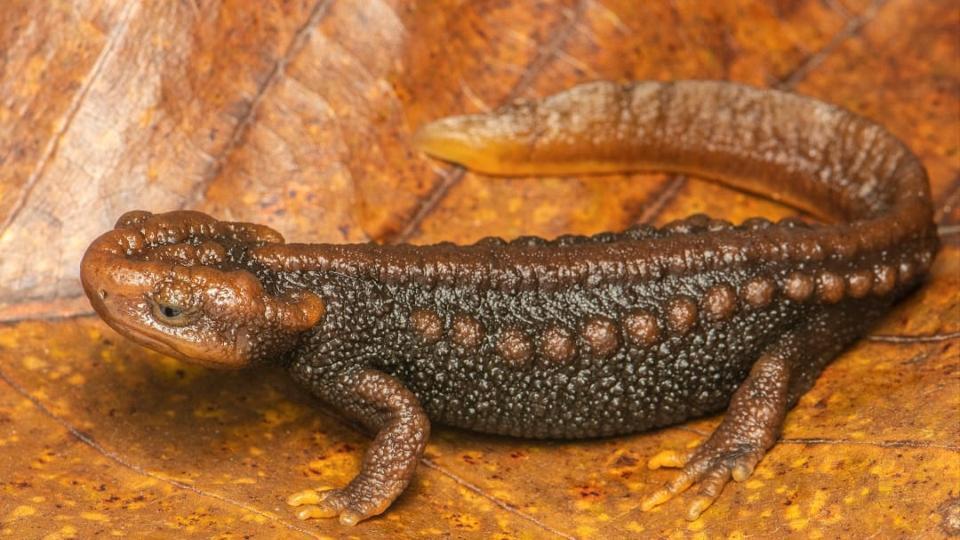
The newfound species — Tylototriton zaimeng — was mistaken for its close relatives T. himalayanus and T. verrucosus until now. However, researchers uncovered fresh insights into its characteristics and ecological significance by merging molecular and morphological evidence.
“Cryptic means those different species which look very similar and cannot easily be distinguished from related species,” said HT Lalremsanga, professor of zoology at Mizoram University, who is among the nine scientists involved in the discovery.
The new species has been named after Zaimeng, a mountain lake located at 2,215m above sea level atop the Khongtheng mountain range in Kangpokpi district of the state. Zaimeng in the dialect spoken by Liangmai people, a Naga tribe residing both in Nagaland and Manipur, means a ‘Puzzle Lake’ or ‘Mystery Lake’.
The team of scientists found several samples of the new species from three locations with mountain lakes and swamps in Manipur during field surveys conducted in 2022.
“Our goal was to uncover the hidden mysteries of the Tylototriton verrucosus species group, whose members had long kept their identities concealed, confusing even the most experienced herpetologists.” said Lalremsanga.
The team noticed that the specimens of the medium-sized salamander they had collected were unlike any other. The Tylototriton zaimeng had distinct characteristics that set it apart from its close relatives.
Its head was massive and wide, with a rounded snout and protruding supratemporal bony ridges, while a well-developed sagittal ridge adorned its crown. The creature’s limbs, short and elegantly formed, did not overlap when adpressed along its body.
“A wide and unsegmented vertebral ridge ran along its back, accompanied by 13–14 pairs of rib nodules, marking a clear distinction from its kin. Tylototriton zaimeng displayed a stunning brown coloration, embellished with dull orange to yellowish-brown markings on its head, vertebral ridge, rib nodules, palms, soles, vent, and ventral tail ridge. Vomerine teeth, elegantly organised in two distinctly curved bell-shaped series, further differentiated this mysterious creature,” the study mentioned.
Apart from morphological revelations, DNA tests of the specimens confirmed that this cryptic species belonged to Clade I of the subgenus Tylototriton, and it emerged as a sister species to T. panwaensis and T. houi. The genetic divergence underscored the uniqueness of this newly uncovered species, it added.
Scientists found that the habitat of Tylototriton zaimeng is confined to the Khongtheng mountain range in Manipur.
Due to its isolation and limited distribution, the scientists have advocated inclusion of the new species in the IUCN (International Union for Conservation of Nature) Red List as a vulnerable (VU) species, emphasising the need for conservation efforts to protect this enigmatic creature and its fragile habitat.