E-Paper



Odisha criminal who fled hospital finally arrested in Telangana
Hyder was travelling on a bike in Sangareddy district on Thursday evening when the motorcycle-bound police team of Cuttack district, with the help of Telangana police, intercepted him.


Five days after 60-year-old gangster Sk Hyder, serving a life sentence in a case of murder, escaped from a government medical college cum hospital in Odisha after drugging the policeman in charge of his security, a team of Odisha cops, with the help of Telangana Police, arrested him from a place 200 kilometres away from Hyderabad city on Thursday evening, police officials said.
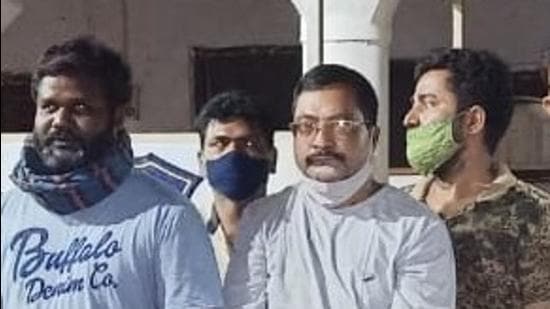
“An inspector from Cuttack who knew Hyder very well apprehended him. The entire operation was a combined success of human intelligence as well as technical intelligence. We thought we had almost lost him,” Bhubaneswar-Cuttack commissioner of police Soumendra Priyadarshi said.
The Odisha police on Friday produced the gangster before a court in Cuttack which granted it 7 days remand for further interrogation in his case of escape. The gangster, convicted in two murder cases, also faces trial in about a dozen other cases of extortion.
Last Saturday, Hyder, who is serving a life sentence in a case of murder of a businessman, had fled from his cabin at the surgery ward of Sriram Chandra Bhanja (SCB) Medical College and Hospital in Cuttack after intoxicating the lone security guard on duty. The gangster was brought from Sambalpur circle jail for hydrocele surgery 18 days prior to that but used the opportunity to flee.
On Saturday afternoon, a nurse at the hospital who was supposed to give a jab to the gangster first reported his disappearance. The lone armed sentry sent by the Sambalpur police to guard him was found intoxicated and disoriented. “When I arrived at the bed at 5.30 pm, I found the sentry sleeping. Hyder was not there on his bed,” said the nurse.
Though initially it was suspected that the lone sentry was fed biryani spiked with some intoxicants, senior officials said the policeman may have been given water or some drink spiked with drugs. However, they admitted that there was clear laxity in the handling of the gangster’s security.
Priyadarshi said Hyder was travelling on a bike in Sangareddy district on Thursday evening when the motorcycle-bound police team of Cuttack district, with the help of Telangana police, intercepted him.
Senior police officials said some doctors in VIMSAR Burla as well as SCB Medical College appeared to have given exaggerated reports about the gangster’s ailments though he suffered just from hydrocele. While there were reports that he was to be operated on his gallbladder, there are contradictory reports of him having different health issues. “The role of doctors in the entire episode needs to probed,” said an official.
People privy to the development said Hyder’s escape from the hospital was a result of a well-planned criminal conspiracy hatched by around 10 persons including his two sons- Azharuddin and Chuni. Yakub, one of his aides, spilt the beans about Hyder after his arrest. During the investigation, police suspected that he had moved either to Andhra Pradesh or Telangana.
“During the probe, we almost zeroed down that Haider had moved to Telangana via Andhra by road. Based on information from the technical surveillance team under the supervision of Cuttack DCP, we tried to track his locations and with help of Hyderabad and Telangana police teams, we kept a close vigil on his movement. Based on police inputs about his presence at a particular place in Sangareddy district, we intercepted Haider who was riding a motorcycle. The team led by Badambadi IIC caught him on the way at around 6.00 pm on Thursday,” Priyadarshi told at the press meet.
Though it is difficult to imagine the portly Hyder as a gangster, he was a renowned name in Odisha’s underworld in the late 90s due to his ability to execute crimes. In the 1980s, Hyder was earning a living by pulling a rickshaw in Kendrapara town and later worked as a truck driver. Police officials in Kendrapara say, Hyder soon got involved in petty thefts and formed a gang with two other criminals Syed Usman Ali alias Tito and Suleiman.
“They sometimes worked as a gang, but also fell out with each other over small issues. Their main business was extortion, felony and tender fixing. They were often hired by contractors who did not wish rivals to get the contract for a particular civil work,” said a police officer in Kendrapara. In 2005, he became a known name in the underworld after killing Sk Chuna, brother of his friend-turned-foe Suleiman. He was arrested from Nagpur for the murder and was awarded life imprisonment in 2011. However, he got out on parole and with the help of Tito, he got Suleiman, the most educated among the three, shot dead on a road in 2012. Hyder and Tito however soon fell out and bayed for each other’s blood.
Hyder was again arrested and later sentenced to life in 2015 over kidnapping and murder of mines trader Rashmi Ranjan Mahapatra. Though he was in jail, police officials said he was known to plan and execute crimes from inside the jail.
In June 2017, Tito was arrested by the Crime Branch Special Task Force (STF) and since then has been living in solitary confinement.
Former state DGP and BJP leader Prakash Mishra who has seen the rise of Hyder and his criminal gang over the years said that the escape of the gangster could not have been possible without the active collusion of police, jail and hospital officials. “Was the gangster’s escape planned in a manner to allow him enough time to slip past highway check gates before police issued emergency lookout orders? Some influential powers are surely behind the conspiracy,” he alleged.