
Sign in

Odisha man brings exhumed sister’s remains to bank to withdraw savings

After her death, Jeetu visited the bank with her passbook seeking to withdraw money from the account but reportedly did not inform bank officials that his sister had died

Published on: Apr 28, 2026, 12:52:31 IST
By
Share
Share via
  • facebook
  • twitter
  • linkedin
  • whatsapp
Copy link
  • copy link

A tribal man brought his dead sister’s skeleton and staged a protest in front of a rural bank believing her presence was required to withdraw money from her account, police said.The incident took place in Mallipasi village on Monday afternoon.
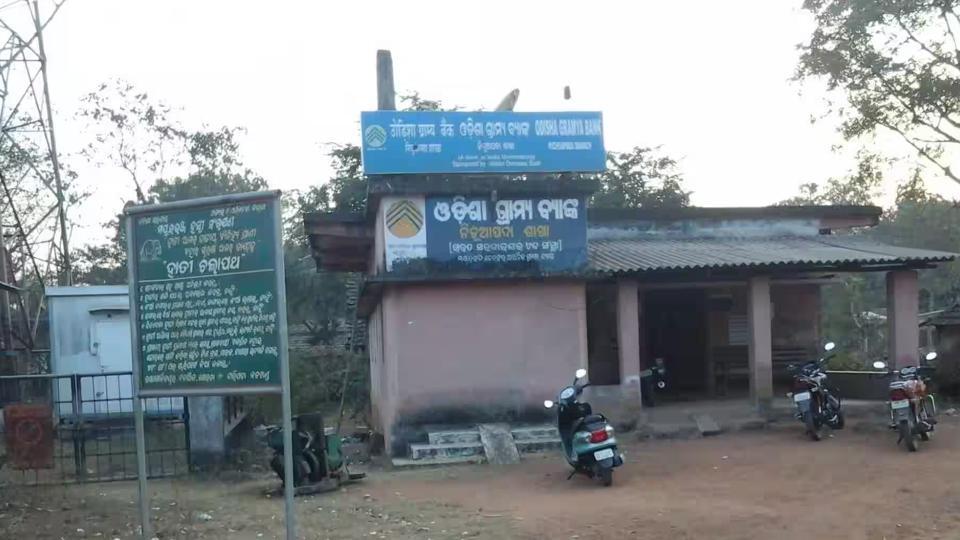
A team led by the inspector-in-charge of Patna police station, Kiran Prasad Sahu, arrived at the scene and cajoled the man. (Image sourced fro JustDial | Representative)

Jeetu Munda, 42, from Dianali village in Keonjhar district, reached the Odisha Grameen Bank branch at Mallipashi around 3pm with the mummified remains of his sister slung over his shoulder. Jeetu’s sister had returned to her parental place after losing her husband and her only son. She had opened a savings account at the branch and regularly deposited money into it before her death about two months ago. Her family had performed her last rites and buried her near their home in Dianali village.

After her death, Jeetu visited the bank with her passbook seeking to withdraw money from the account but reportedly did not inform bank officials that his sister had died. He made multiple visits but was unable to access the funds.

During one such visit, a bank official told him he would be able to withdraw the money only if the account holder was present.

Also Read:Man stabbed to death over money dispute in Prayagraj village

“We had asked him to get the documents to prove that he was the legal heir of his sister,” said a bank official.

Believing he needed to physically produce his sister to complete the withdrawal, Jeetu returned to his village, exhumed her body, placed the remains in a plastic sack and carried it to the bank.

Bank staff noticed the body placed on the branch verandah and alerted local police. A team led by the inspector-in-charge of Patna police station, Kiran Prasad Sahu, arrived at the scene and cajoled the man.

Police and bank officials persuaded Jeetu to take the remains back to his village, assuring him that the required documentation will be arranged to enable withdrawal of the money from his sister’s account, Sahu said.

Following the assurances, Jeetu returned to Dianali village and reburied his sister’s remains at the same location, the police officer added.

  • Debabrata Mohanty
    ABOUT THE AUTHOR
    Debabrata Mohanty

    Debabrata Mohanty is a senior assistant editor of Hindustan Times who works as state correspondent from Odisha covering the state's politics, governance, public policy, natural disasters, environment and its society for close to three decades. With his long years of reporting from the state capital of Bhubaneswar, Mohanty has been known as one of the most experienced and credible journalists covering Odisha for the national English dailies. His reporting combines on-ground detail with deep institutional knowledge detailing the state's changing politics, governance issues, administrative reforms and the functioning of its public institutions. He has regularly reported on issues ranging from legislative developments and public policy implementation. Politics is his core areas of expertise as he closely tracks Odisha's political landscape, including the rise and transformation of the Bharatiya Janata Party (BJP), the Biju Janata Dal (BJD), the two principal political parties in Odisha. His long association with the state's political establishment enables him to write on contemporary developments in a larger political context. Mohanty takes a deep interest in writing human interest stories, environmental issues and documenting the impact of cyclones, floods, heatwaves, and other climate-related events in one of the most disaster-prone states. His coverage extends to public health, governance reforms and stories on accountability of government institutions. Before joining Hindustan Times, Mohanty worked with The Indian Express, Mail Today, and The Telegraph, where he covered at least six general elections and as many assembly elections. In 2007, he was selected for the prestigious Chevening Young Indian Print Journalist Programme at the University of Lincoln, United Kingdom, where he received advanced training in print journalism. In 2009 he won the Press Institute of India-International Committee of Red Cross award on conflict reporting for his on-ground reportage of 2008 Kandhamal riots.Read More