E-Paper



Everyday explained: Why are objects in the rear-view mirror closer than they appear?

 Prefer HTon Google


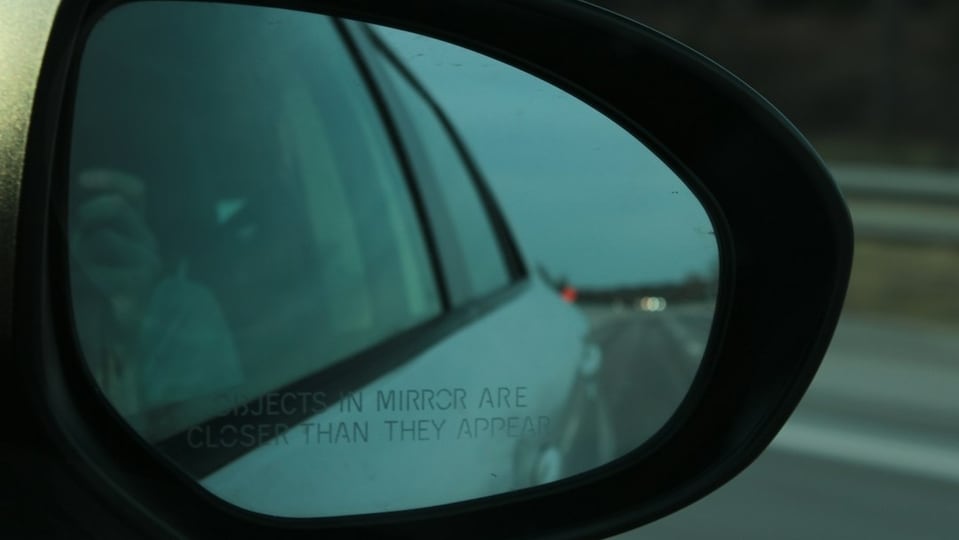
The rear-view mirrors of cars and motorcycles have the cautionary statement etched on them. The reason lies in the type of mirrors that are used to make them.
Anyone who has observed a car or a motorcycle’s rear-view mirror has undoubtedly seen the sentence “Objects in the mirror are closer than they appear” scrawled at the bottom of the reflective surface. Today’s Everyday Explained dives into why that is always the case.
Also Read | Everyday explained: Why your door has that little metal plate
Why are objects in the mirror closer than they appear?
We know that for a plane mirror, the image formed inside the mirror is as far from the mirror as the object is in front of it. But that is not the case with rear-view mirrors, as all driving instructors make sure to point out.
This is because the mirrors used on the side of cars and motorbikes are not plane, but curved mirrors. More specifically, they are convex mirrors, where the reflective surface bulges outwards towards the source. It is also known as a diverging mirror, as the light rays after reflection spread outwards instead of coming together at a point.

As a result of the design, the rear-view mirror covers a much larger area than it would have if it were made of a plane mirror. It gives the drivers a wider field of vision, allowing them to see more potential hazards. The images formed are also vertically upright, which works in favour of the driver.
However, the convex shape of the rear-view mirror distorts the reflected light rays in a way that the image formed is diminished, or smaller in size, and further away from the mirror than they actually are. This presents a safety issue if the driver or motorcycle rider is unaware of this effect.
If a car behind a driver looks far away in the rear view mirror and they decide to suddenly switch lanes, there might not be enough safe distance for the manoeuvre if the driver is unaware of the distortion of the image by the mirror. Thus, the warning “objects in the mirror are closer than they appear” is often etched as a permanent reminder to be cautious on the road.
Is there a mirror with minimal distortion?
There have been attempts to minimise the distortion in rear-view mirrors while keeping the field of vision wide. In 2012, Dr R Andrew Hicks, a professor of mathematics at Pennsylvania’s Drexel University, patented a design in the United States that he created using an algorithm, which resulted in a mirror that had a 45-degree field of view but minimal distortion.
“Imagine that the mirror’s surface is made of many smaller mirrors turned to different angles, like a disco ball,” Hicks explained at the time. “The algorithm is a set of calculations to manipulate the direction of each face of the metaphorical disco ball so that each ray of light bouncing off the mirror shows the driver a wide, but not-too-distorted, picture of the scene behind him.”