E-Paper



Odisha starts tagging of horseshoe crabs to track their population, habitat
India is home to two species of horseshoe crabs — Tachypleus gigas and Carcinoscorpius rotundicauda (mangrove).

 Prefer HTon Google


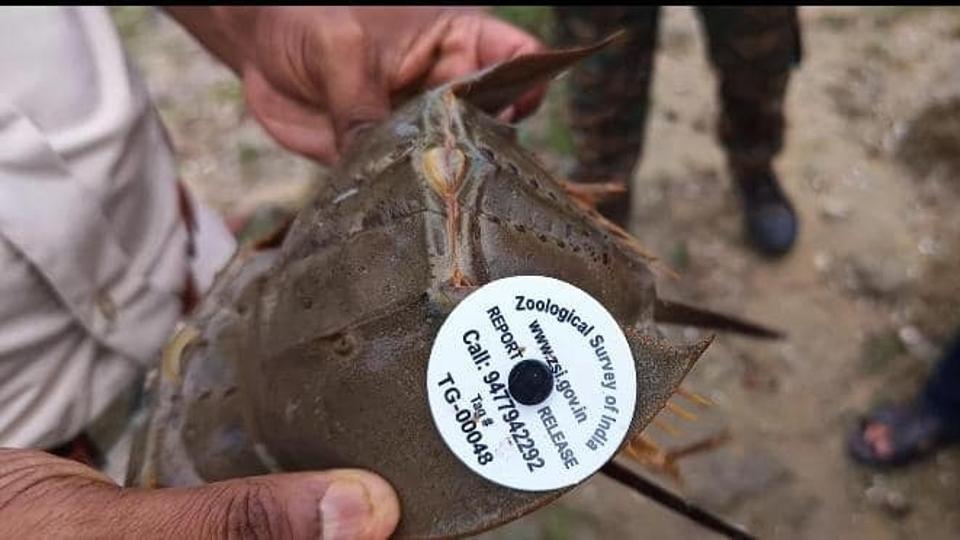
The Zoological Survey of India (ZSI) and the Odisha forest department have tagged horseshoe crabs along the state’s coastline to understand their population and habitat utilisation for conservation and management.
The population of horseshoe crabs, known for its medicinal quality, has dwindled in the country due to habitat loss due to fishing and its illegal harvesting for bio-medical testing. The blue blood of crabs can clot in the presence of bacteria, rendering them harmless. Their clotting ability has been extensively utilised in testing injectable medicines, vaccines, and sterile medical equipment. The outer layer of horseshoe crabs consists of chitin that enhances wound healing and serves as a crucial component in treating burn wounds.
Horseshoe crabs are one of oldest living creatures on the Earth. Although there are no estimates of their population decline, scientists in Odisha say in the 1990s and early 2000, the population was high — around 40 specimens in 200 square meters and now one can hardly see them. There are only a few estuaries left in Odisha, including one in Balasore where horseshoe crabs can be found.
Twelve horseshoe crabs were tagged for the first time in the Khandia muhan estuary of the Balasore coast.
“India is home to two species of horseshoe crabs — Tachypleus gigas and Carcinoscorpius rotundicauda (mangrove) — and both the species are found along the northeastern coast of India, especially along Odisha and West Bengal. This is an extremely important species, and we need to come up with a conservation plan,” ZSI director Dhriti Banerjee said, adding that scientists will tag horseshoe crabs over the next three years in collaboration with the Odisha forest department.
ZSI senior scientist Basudev Tripathy said the plan involved tagging hundreds of crabs to determine their population pattern, and threats to them.
“All the tags are marked with a serial number, mobile number and has ZSI mentioned. The tags will help us track the migratory routes of the marine species,” said Tripathy, scientist, ZSI at western regional centre in Pune.
“Destructive fishing practices are major threats to horseshoe crabs, and there are reports of illegal smuggling of the species from the Odisha and West Bengal coasts. Horseshoe crabs are a Schedule 2 species under the Wildlife Protection Act, 1972,” Tripathy added.
BC Chaudhury, former wildlife biologist and scientific adviser of Wildlife Trust of India, said six pairs of tagged horseshoe crabs were released in the sea.
“Tagging is most often conducted to obtain information on reproductive biology, movement and growth rate. It will help us study its migratory route and areas of foraging. Tagging data will also prove interconnection of horseshoe crab population in Odisha coast,” Chaudhury said.
A ZSI official said the organisation plans to propose to the Union ministry of environment, forest and climate change to conduct advanced research using modern techniques, such as satellite telemetry, to gather more information about these creatures.