E-Paper



Refrain from making statements on Odisha matters: BJD slams Chhattisgarh Governor
Referring to the ongoing controversy on the Scheduled Tribes people being allowed to transfer their land to non-tribals, Chhattisgarh Governor Biswabhusan Harichandan had said tribal people’s rights should be protected


Amid the debate on the controversial role of Governors in opposition-ruled states, the Biju Janata Dal (BJD) in Odisha on Friday said the statements made by Chhattisgarh Governor Biswabhusan Harichandan on various issues of Odisha were a matter of concern.
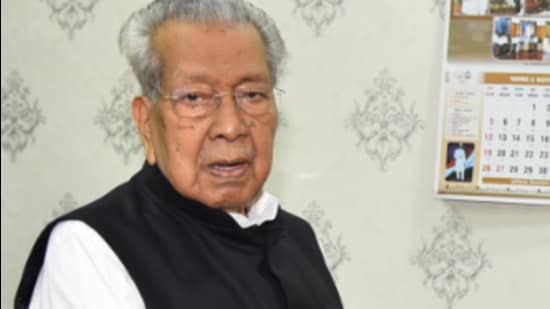
Harichandan, who is in Odisha, had expressed his concern over the recent decision by the Odisha government on the sale and transfer of tribal, which was later withdrawn on Friday. The Chhattisgarh Governor also expressed displeasure over crowd mismanagement at Shree Jagannath temple in Puri.
Criticising Harichandan for his recent remarks on Odisha, the BJD on Friday asked him to refrain from making statements on Odisha matters urging him to uphold the dignity of his office.
Referring to the comments of Harichandan, BJD MP Sasmit Patra said the Constitution has prescribed a definite role for the governors to be an ‘impartial’ head of a state.
“It is an apolitical post. While holding the post also, he is expected to maintain the dignity and honour of the post. Of late, Harichandan has been found issuing statements on the political affairs of Odisha, which is unexpected of him. We can understand that he wants a political role for his son. But he should refrain from issuing the statements till he holds the post of Governor of any state,” said Patra, addressing reporters.
The Chhattisgarh Governor, a former Odisha minister and senior BJP leader during his recent visit to the state stated that tribals in Odisha are neglected a lot. Harichandan also wrote an article in a local newspaper expressing his concern.
Referring to the ongoing controversy on the Scheduled Tribes people being allowed to transfer their land to non-tribals, Harichandan had said tribal people’s rights should be protected.
Over the last 76 years of Indian independence, Governors have played a very important and impartial role in the strengthening of democracy, the BJD leader said, adding, they always become happy when an Odia has been elevated to the post of Governor of a state; whether it was Janaki Ballav Patnaik as Governor of Assam, Droupadi Murmu as Governor of Jharkhand and Biswabhusan Harichandan as Governor of Andhra Pradesh; and presently Governor of Chattisgarh.
Patra said Article 153 to 162 of the Indian Constitution has laid down the specific powers and conditions of service for Governors.
Constitutionally, Governors have been expected to be neutral and impartial. “We do understand that he is desperate to find a politically relevant position for his son, who has never won an election in his life and also lost a Ward member election of Councillor in a Municipal election. We hope Governor Shri Harichandan would not lower the dignity and respect of his office by expressing views on various subjects on Odisha which is not expected of him,” he added.
The Odisha government on Friday decided to review its decision to allow members of the ST community to transfer their tribal land to non-tribals in scheduled areas amid severe protests.
A scheduled area refers to a place dominated by the tribals. In Odisha, it covers about 44.70% area of the state and comprises 68% of the tribal population.
On November 14, the Odisha cabinet decided to amend the Orissa Scheduled Areas Transfer of Immovable Property (by Scheduled Tribes) Regulation, 1956, to enable tribals to mortgage or sell part of their landholdings to non-tribals. The decision evoked sharp criticisms, prompting the government to withhold the same three days later.
In 1956, the state government passed the Orissa Scheduled Area Transfer of Immovable Property (by Scheduled Tribes) Regulation to stop the transfer of tribal land to non-tribals in Schedule V areas, but the law proved to be ineffective as it allowed the transfer of land patta from tribals to non-tribals after obtaining permission from revenue authorities.
In 2002, the Naveen Patnaik government amended the law and imposed a complete ban on the transfer of patta land from tribals to non-tribals.