
 E-Paper



Stuck in a web of laws, police unable to pursue traffic violators in Lucknow
Police officials reveal that e-challans are automatically referred to court within three days of penalisation, depriving the police of the jurisdiction to take direct action against violators.


LUCKNOW: In India, traffic challans serve as a mechanism to regulate traffic, monitor violations, and alleviate congestion. However, the implementation of e-challans through the Integrated Traffic Management System (ITMS) has left city police entangled in legal complexities, hindering their ability to recover penalised amounts from traffic violators.
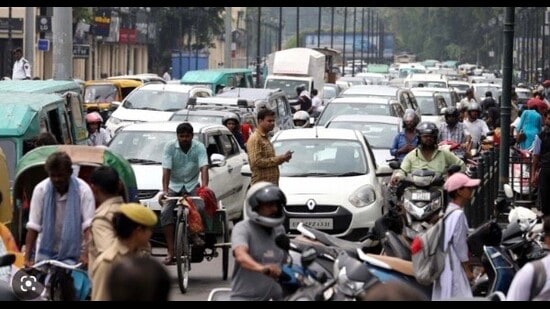
Police officials reveal that e-challans are automatically referred to court within three days of penalisation, depriving the police of the jurisdiction to take direct action against violators. Consequently, a sense of fear associated with challans has diminished among the public.
A letter dated June 15, 2023, from the Lucknow Police Commissioner’s office to the Director of Traffic Department, obtained by HT, outlines the challenges faced by the city police in collecting penalised amounts from habitual traffic violators. The letter cites the automatic referral of e-challans through ITMS to the court as a major obstacle in taking timely action against violators. Additionally, the letter identifies the top 10 traffic violators in the city, each having committed over 50 violations, with the highest offender accumulating 86 violations and penalties in lakhs.
Fear fading as courts settle with low fees
KM Singh, an advocate at the high court, explains, “Challans issued by the traffic police are sent to the court within three days. After the court disposes of the challan, the vehicle owner pays the fine and submits the receipt to the traffic police office. Subsequently, the challan is removed from the portal.”
Joint Commissioner of Police, Law and Order, Upendra Agrawal, points out the flaw in the system, saying, “The Motor Vehicles Act sets the challan portal amounts as maximum, not minimum. Although the police recover the maximum amount, the court settles the challan with a minimal compounding fee. This results in diminished fear of challans, allowing violators to evade consequences and continue rule violations.”
Challans failing to curb repeat traffic offences
Agrawal adds, “The traffic police have identified vehicles committing the highest number of violations, indicating that many vehicles repeatedly violate rules throughout the year with little impact. Top 10 violators escape effective action as challans are automatically sent to court, leaving the resolution in the hands of the judiciary.” He further notes that the Lucknow police has begun registering FIRs for overspeeding, recognizing the limited impact of online challans on enforcing traffic rules.
Traffic laws obstructing police
The letter, undersigned by the police commissioner of Lucknow, highlighted several rules, regulations, and the lack of sufficient measures and suggestions.
Based on the decision passed in the Writ Petition No. 287807/19, Ashok Kumar Yadav vs. State Government in the High Court, Allahabad, under the system implemented by the circular DG 40/19 of the Director General of Police, Uttar Pradesh, the challan can be issued by the traffic police within three days, and it is then sent to the Court.
Currently, no records are submitted during e-challan, causing no inconvenience to the vehicle owner and driver, and the challan amount is not deposited in cash.
Due to the non-fixation of a minimum amount, the fine is imposed at the discretion of the court, rendering the maximum amount insignificant. Therefore, instead of paying the fine to the traffic police, violators get away with a very small amount determined by the court.
Challans are continuously issued on vehicles for the violation of traffic rules, and the amount keeps increasing. The vehicle owner is not affected until attempting to sell it, as the NOC is provided by the RTO at the time of sale, and only then must pending payments be settled.
Registration of vehicles is for 16 years; in this case, the person remains registered for 15 years.
What can be done:
It is noteworthy that in the year 1995, Section 195 of the MV Act was omitted, which provided for a minimum fine, at least in some circumstances. The minimum amount must be determined in all sections, and there should be a provision for increasing the fine by a certain minimum amount for every subsequent violation. This would allow cases to be compounded by the court only on the minimum amount.
If the fine on any vehicle exceeds ₹10,000, the right to automatically impound that vehicle should be given. The fine can then be released on the orders of the court only when all pending liabilities are paid.
If the amount pending on the vehicle exceeds the value of the vehicle, the vehicle owner should be given notice and the right to seize the vehicle.
It should also be provided that if any vehicle or driver violates the provisions of the MV Act 15 times in a year, there should be a provision to suspend the driving license of such a vehicle and driver for the next one year.


