
 E-Paper



Public transit use likely to fall sharply after lockdown: Study
The ongoing study shows that before the nationwide lockdown imposed on March 25 to slow the spread of the coronavirus disease , as much as 37% of Delhi’s commuters used the Metro, 28%, personal vehicles and 7%, public buses.

 Prefer HTon Google


Fewer residents of the National Capital Region will use public transport over the next six months for fear of contracting Covid-19, and many will use personal vehicles according to a study by research and advocacy organisation Centre for Science and Environment (CSE).
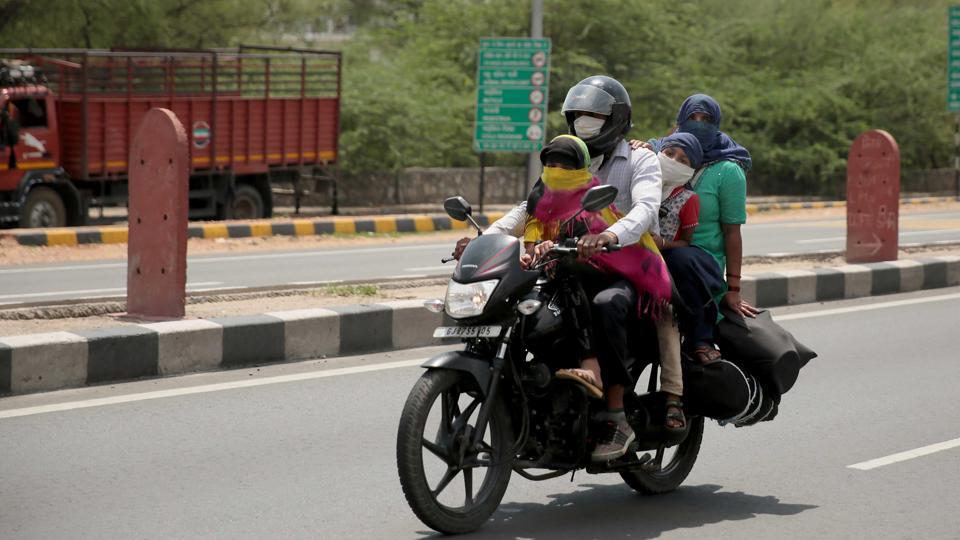
The ongoing study shows that before the nationwide lockdown imposed on March 25 to slow the spread of the coronavirus disease , as much as 37% of Delhi’s commuters used the Metro, 28%, personal vehicles and 7%, public buses. CSE researchers say these choices are likely to shift after the lockdown comes to a close and public transport services resume completely.
In the next six months, the proportion of commuters using the metro is expected to fall to 16%, and buses, just 1%. The dependence on private vehicles, on the other hand, will increase significantly, from 28% to as much as 38%. Delhi government data shows that the Capital has a little over 11 million registered vehicles, of which 3.3 million are cars.
The study is based only on the commuting patterns and preferences of middle and upper middle-class commuters. Researchers said that over 400 residents from Delhi-NCR have already been surveyed and more will be surveyed in the coming days to assess commuting patterns after the lockdown ends.
CSE officials said upper middle-class and middle-class households are being targeted in the current because people from this strata have the option to switch from public transport to private vehicles and may have the disposable income to afford a second vehicle.
The CSE is also conducting another study with a focus on commuters from lower income groups in the city.
The findings also show that low contact modes of travel, such as walking and cycling are likely to emerge as preferred modes among residents to cover shorter distances. Before the lockdown 4% commuters walked or cycled , a figure which is expected to grow to 12% in the coming months, the CSE report said.
Anumita Roychowdhury, executive director (research and advocacy), CSE, said this shift in commuting preferences can be attributed to peoples’ health concerns. She said that with the present state of the public transport system in the national capital, people are not confident that social distancing can be maintained while travelling on buses or the Metro.
“The future and the ‘new normal’ that we will be faced with post-lockdown will demand steps to rebuild confidence in mass transit systems while also improving them. Apart from this, steps will also be taken by the governments to improve infrastructure for contact-free modes such as walking and cycling, and come up with measures to cut unnecessary travel to reduce pressure on already-stressed transport systems,” Roychowdhury said.
As Delhi government relaxed movement restrictions in the fourth phase of the lockdown starting May 18, nearly 2,000 DTC and cluster buses were allowed to operate in the city to ferry commuters with an occupancy limit of 20 passengers in each bus. However, despite the government allowing private companies to resume work with complete staff strength, several establishments are still encouraging employees to work from home, which has hit bus ridership.
Data compiled by the transport department shows that since operations resumed, the daily ridership in buses has remained nearly 100,000 passengers a day, as against the daily ridership of four million before the lockdown. The Delhi Metro is yet to begin operations.
“If looked at from the service capacity perspective, to regain the original service capacity level pre-lockdown, the city needs an additional fleet of 13,243 buses,” CSE said. Or their efficiency needs to be increased. “Only if protected bus lanes are introduced immediately, the same fleet can provide more kilometres of service and reduce the additional requirement,” CSE’s report added.
Delhi currently has 6,847 buses.
Experts said that a similar shift towards private vehicles is also being witnessed in cities across the world. Sewa Ram, professor at School of Planning and Architecture (SPA), said that it has been observed that in cities that have opened up after lockdowns and movement restrictions, the preferred mode of transportation has been private vehicles. But he cautioned that the switch to private vehicles would not only increase traffic but also contribute to increased pollution levels.
“Public transportation is likely to be used only by those who cannot afford personal vehicles. The policy work that was being done to control the use of private vehicles for all these years will surely be impacted. The fear around this disease is likely to change commuter preferences. Governments will have to bounce back from its impact,” Ram said.


