
 E-Paper



Brick kiln children in Pune eager to study but have no one to teach
PUNE Kirtan swiftly recites all multiplication tables up to 30 when prompted by Ashutosh Shirolkar, volunteer-teacher and founder of NGO Arise Vishwa Society, that has a project called MILAPH Rights of Child


PUNE Kirtan swiftly recites all multiplication tables up to 30 when prompted by Ashutosh Shirolkar, volunteer-teacher and founder of NGO Arise Vishwa Society, that has a project called MILAPH Rights of Child. Kirtan, a Class 7 student, is one of the many children of brick kiln workers near Bopdev ghat, Khadi machine chowk, who awaits his classes with Shirolkar on Sundays. There are around 60 such children in the age group of 4 to 16 years; all eager to learn.
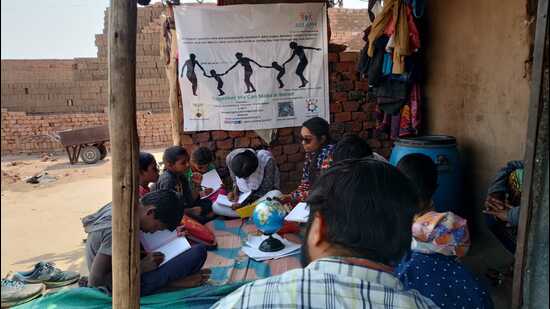
“The Covid-19 lockdown has been tough on all children, but tougher on the children of brick kiln workers as they’ve followed their parents to their workplaces and eventually forgotten about learning at school. It takes time to bring them back to the learning fold,” said Shirolkar, who once failed in Class 12 but now holds an M. Phil in Economics.
Shirolkar met these children while they were working or playing at the brick kiln during a survey for his NGO and realised that they were bright kids who simply did not have any access to education. Prior to that, while encouraging the children living in the slums near Kothrud to finish their education, he found that by the time they reached Class 7 or 8, they lost interest in education and were eager to join various gangs or get involved in everyday squabbles instead. In 2014, he spent several months understanding these children and their problems, and succeeded in getting four of them back to studies. “These kids came from dysfunctional families, with either a single parent or a parent in jail or in some cases from institutions but they showed an eagerness to learn. Slowly, I began teaching them and some of them have now even completed their HSC exams,” said Shirolkar.
It was tough seven months ago when he approached the owner of the brick kiln to allow the children to learn. “Initially, I faced opposition from the owner for the children would often help their parents in pushing wheel barrows or in odd jobs, but once I convinced the owner about the children’s keenness to learn, he allowed me an hour on Sunday to help them learn,” he said.
However, it wasn’t easy to draw their attention to books so he began by playing simple games for physical and mental strength such as carom and chess, getting them to focus. Slowly he began bringing maps to these sessions, getting them interested in Geography, English, Marathi and Mathematics. “Some of them have studied in villages in Nanded and in some part of Karnataka so it takes time to get them on the same page as others but it is a work in progress,” he said.
Rani, a Class 6 student, finds time for an hour from her responsibility of looking after four brothers. “I love Geography and want to go to school. I used to go to school in the village but then I had to come here to take care of my brothers as both of my parents work.”
Shirolkar is currently looking for volunteers to help him teach these children for an hour on Sunday and has appealed for help on social media.


