
 E-Paper



“Chill Baba! Do we have to do all these assignments?”
The last 12 months has forced educators to innovate and one exciting new discovery is that food is a good way to keep children occupied. One can indeed teach a lot of physics, chemistry, design, and art through cooking, says blogger and author Sanjay Mukherjee


The post-Covid world is different. But, that’s not why I cook. I cook because I love cooking. Because I like listening to the ingredients talking to each other, watching the chemical reactions, anticipating the transformation of energy, predicting the tastes that will emerge from the combination of ingredients … and the uncertainty of the outcome.
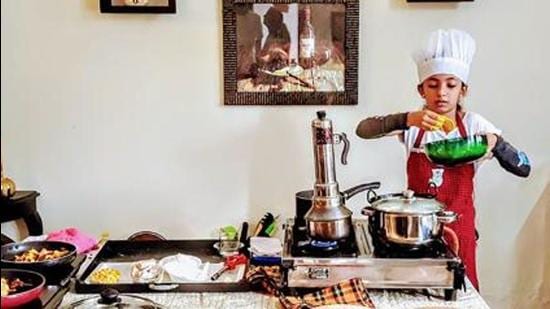
Our children love the spectacle, sometimes joining in to help with the washing, sorting and cutting of ingredients, sometimes stirring the pot, or taking one component of the meal right through by themselves. Now this does not happen all the time, because they are children: they love cooking, but not necessarily enough to stop playing Minecraft or abandoning Troll Hunters in the middle of an episode.
The last 12 months has forced educators to innovate and one exciting new discovery is that food is a good way to keep children occupied. One can indeed teach a lot of physics, chemistry, design, and art through cooking. But, should one? Apparently yes, and so I find schools incorporating cooking into curriculum.
I think someone should ask children what they think of new activities before they introduce them. Our children don’t wait to be asked, they are quite good with dishing out opinions. After the third food assignment in a month, mine decided to have a conversation with me.
“Baba, do we have to do all these assignments?”
“Why don’t you want to do it?”
“It’s stupid stuff. Cutting food photos. Colouring exercises. It’s for babies,” said the youngest who’s in Grade 1 and cooks fish curry from scratch.
“Writing a recipe for Szchewan stir-fry noodles is a waste of my time. If they want to know if I can cook, they should ask me to make it,” piped our fourth grader.
“I am supposed to create a ‘healthy’ menu and they have told us what is healthy and what isn’t. You cannot construct a menu with stereotypes,” said our eldest who’s in Grade 8.
“I thought you guys liked cooking.”
“We enjoy cooking because we cook with you guys. We learn how to use a knife, how to cut quarters and cubes, to stir, to watch for how food changes during cooking, how to wash ingredients properly, the feel … it’s exciting. Writing random recipes for a task, or giving my opinion on a food topic, or using food items for science experiments - that doesn’t teach me anything, except wasting food and how to keep my mouth shut and getting it done to get a grade,” the eldest stated his case.
Makes perfect sense to me.
Learning is an intuitive, individual, internal journey. Forcing an external context is what takes the learning out of the learning experience. And what kind of example would I set as a parent by asking them to do things for the sake of doing it? Yep, the post-Covid world is a different world, but the rules of engagement with children are still the same. It starts exactly where it always has: talking with and listening to them.
Now all this wisdom didn’t just come to me. I had to work for it. And since all my work wasn’t amounting to much, my kids told me: “You have to listen to us, don’t just pretend to pay attention and nod your head, and then tell us we have to do the assignments anyway!”
I think often times I tend to forget that they are children. And yes children are resilient, but do I have to test that resilience every hour, every day? To be honest, I had initially thought it was great that the school was introducing some food … till I saw the assignments. I get it. It’s difficult for everyone. But, children are children and it’s much more difficult for them. The last thing they need is for us to pass on our difficulties, or lack of ideas on to them and make it impossible for them to be children.
In the end, it was what our fourth grader said to me: “I am a kid. I am going to play. Why do you want me to work hard at everything like you do? Chill a little Baba.”
I am going to print that. Bold, 100-point font size.
Mukherjee, a former journalist, is a blogger and author, and dad to three children


