
 E-Paper



Civic Sanskriti: Nature’s summer glory paints neighbourhood in a golden hue
Harvest festivals like Vishu give even city dwellers an opportunity to connect with nature and thank her for the gifts that make our lives possible and beautiful

 Prefer HTon Google


There’s an Amaltas (Indian Laburnum, and Bahava in Marathi,) tree near my house. Come summer, and its golden glory lights up our neighbourhood.
My daughter has had a special relationship with it, as her grandmother would assign her the task of fetching a sprig of flowers for the Vishukani, or decoration for Vishu. Vishu is the harvest festival in Kerala and the decorations include many “golden” items like the yellow cucumber, lemon, and mango. If the tree near our house does not flower in time, then another tree must be located.
Harvest festivals like Vishu give even city dwellers an opportunity to connect with nature and thank her for the gifts that make our lives possible and beautiful.
Observing nature in the neighbourhood can be rewarding for children and their teachers, care-givers and parents, whether its school holidays or studying (or even working) from home.
Some favourite activities for exploring trees are by observing the variety of shapes, sizes and colour of leaves and bark, and touching and feeling the textures.
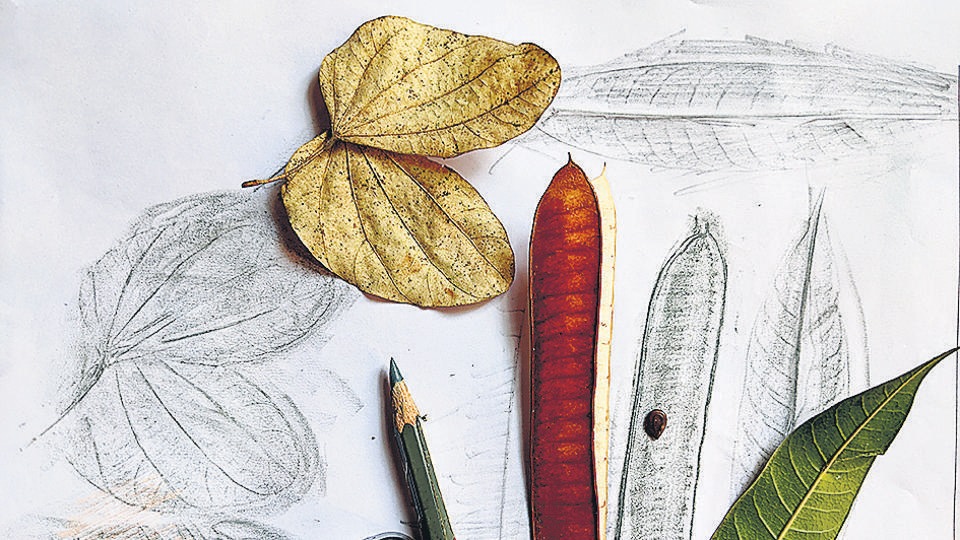
The most fun activity is taking “leaf autographs” – put a leaf under a sheet of paper and run your pencil over it to reveal its shape and ridges.
Nature painting and drawing by looking at real flowers and leaves is another wonderful way to improve children’s (and adults’) observation skills. It can be calming and satisfying.
A fun practical trigonometry exercise is to measure the height of a tree. You don’t need to climb it, you just need a stick or pencil (see box).
Certain trees are “keystone” species, meaning many other living beings are dependent on them, and without their presence, nature in that neighnourhood or ecosystem would be quite different. The banyan tree, for example, is a keystone species and a habitat in itself. It plays host to many types of insects including ants, bees, and butterflies, as well as spiders, lizards, birds, little mammals like squirrels and bats. Just watch the antics and interactions of these creatures.
But today, we have to look for some flowering Amaltas trees for our Vishukani. . Our neighbourhood Amaltas is a little late in flowering this year. I wonder if the peak of the profuse abundant flowering of Amaltas occurs in Pune at least a couple of weeks later than in Kerala?
I have enrolled in SeasonWatch, an India-wide programme that studies the changing seasons by monitoring the annual cycles of flowering, fruiting and leaf-flush of common trees. This long-running citizens’ science initiative has a website and an app. Students and anyone interested can join it. The organisers suggest that the observations of citizen scientists from different parts of India could help understand the impacts of climate change on nature.
I plan to observe my neighbourhood bahava and contribute my observations.
Wish you a Happy Baisakhi and Vishu!
Pencil-rotation method to measure the height of a tree
1.Hold pencil at arm’s length vertically
2.Move toward or away from the tree to be measured until the base of the tree is aligned visually with the top of the hand at the base of the pencil, and the top of the tree is aligned with the top of the pencil
3.Without moving the arm up or down rotate the pencil until it is horizontal and parallel to the ground. The base of the pencil should still be aligned with the base of the tree.
4.Ask your friend to stand at the spot on the ground that aligns with the top of the pencil. If alone, pick a distinctive point on the ground to mark this point. The distance from the base of the tree to this point is equal to the height of the tree.


