
 E-Paper



Our estimated death toll for this year’s wildfires
The blazes in North America have claimed 10-80 times as many lives as those in Europe so far


 Prefer HTon Google


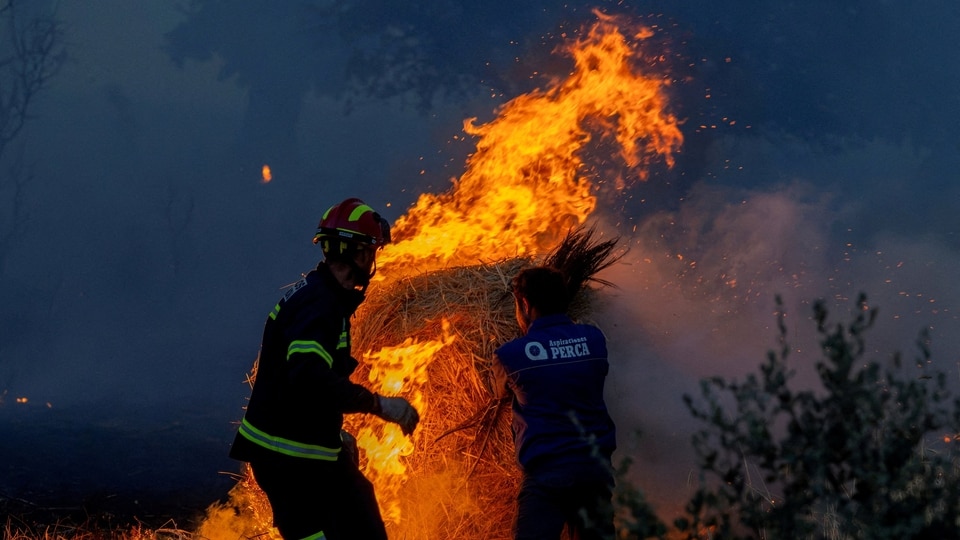
FRANCE’S INTERIOR minister said it was probably the country’s largest civilian evacuation outside wartime. Hundreds of thousands of people have left their homes; wildfires have burned through 116,000 hectares. Across the Pyrenees, Spain has suffered its largest and third-largest fires on record. In Canada, meanwhile, Ontario has also had a record fire season that dwarfs Europe’s. Firefighters have struggled to contain almost 900 active fires since the middle of July—fires that darkened skies as far away as Virginia.
The effect on health depends most on how much smoke there is and where it ends up. Wildfires are to natural disasters what ballistic missiles are to human weaponry—able to kill from hundreds or thousands of kilometres away. The heat that they generate lofts smoke high into the atmosphere, where the winds can carry it across a continent. The smoke contains particles of varying sizes, including ones 2.5 microns or less in diameter (PM2.5). This is the form of air pollution that poses the greatest threat to public health; the tiny particles increase the risk of strokes, heart disease and a range of respiratory illnesses.
To estimate the death toll from the July fires, The Economist used AI tools to combine recent data on wildfire smoke with mortality models from two academic studies published last year.
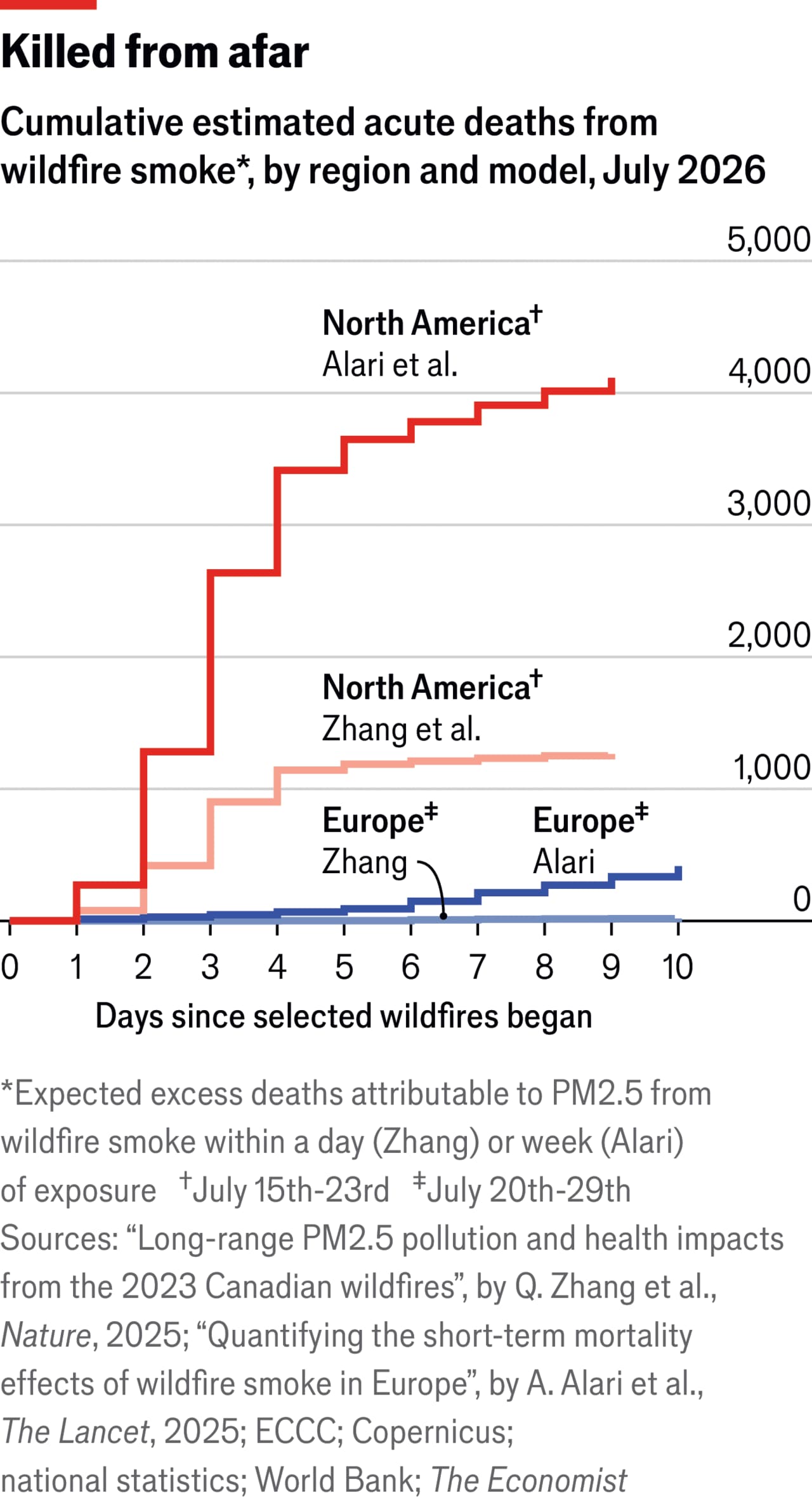
The first study, by Qiang Zhang of Tsinghua University in Beijing and other authors, examined Canada’s wildfire season in 2023. It only included places where pollution was dangerously high and mostly caused by wildfires, and then used an established link between PM2.5 exposure and same-day mortality to estimate extra deaths. Applying its equations to the latest data suggests that North America’s fires over the past month have caused around 1,400 additional acute deaths (ie, predicted excess deaths on the day of the exposure). Applying the same method to Europe produces an estimate of just 18 deaths so far.
The second study, by Anna Alari of Pompeu Fabra University in Barcelona and co-authors, focused on European wildfires in 2004-22. Its method was broader. It counted levels of PM2.5 below the threshold used in the first paper, and calculated excess deaths both on the day of exposure and during the following week. That approach yields higher absolute numbers but a similar trend for July: more than 4,000 acute deaths in North America and around 415 in Europe.
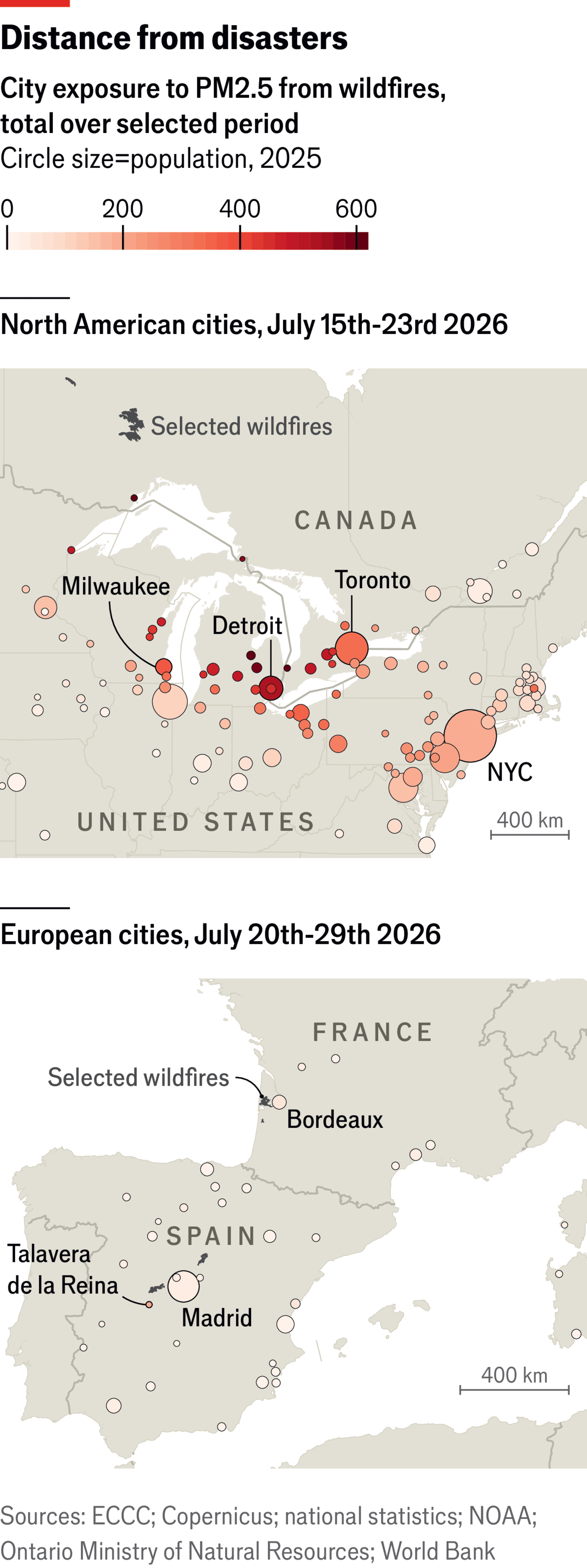
The two large fire complexes that tore through western Ontario between July 11th and 20th released a massive 365,000 tonnes (402,000 American tons) of PM2.5—the weight of 40 Eiffel Towers. The plume of smoke drifted east and south, descending to blanket the densely populated regions of the Great Lakes and America’s north-east between July 15th and 20th. Our estimates suggest that the toxic air led to at least 200 excess deaths in New York over that period, the highest death toll of any city in our analysis.
The four fires in France and Spain we looked at, though big by regional standards, are smaller and have produced less smoke. So far they have released about 82,000 tonnes of PM2.5. And the smoke has largely spared Europe’s big cities. Some of the smoke from south-western France blew west into the Atlantic, and much of the smoke that headed east towards Greece has so far been too high in the atmosphere to affect people on the ground. Madrid and Bordeaux have both suffered bouts of dangerously dirty air, but not to the extent of heavily populated areas in North America.
The eventual toll will probably be higher. Dr Zhang found that chronic deaths (ie, those linked to prolonged exposure to PM2.5) were roughly eight times higher than acute ones. Although the European figures are modest for now, fires in France and Spain have not abated: our acute-mortality estimate increased by around 20% on July 29th alone. As they continue to burn—and particularly if the wind starts to blow towards the north-east—the mortality gap between the two continents will narrow.


