
 E-Paper



Galaxies in the early Universe primarily made up of neutral Hydrogen gas: Study
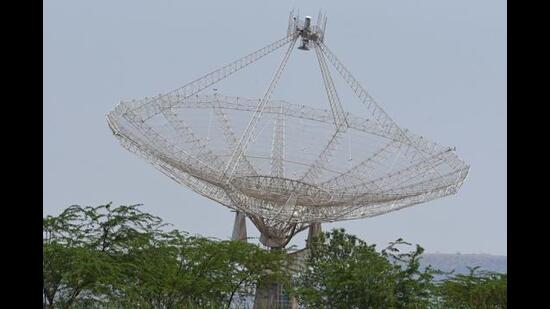
Research conducted by a team of astronomers from the National Centre for Radio Astrophysics (NCRA-TIFR) Pune using the Giant Metrewave Radio Telescope (GMRT) has found that star-forming galaxies nine billion years ago were primarily made up of neutral hydrogen gas unlike galaxies today that have most of their mass in stars


Research conducted by a team of astronomers from the National Centre for Radio Astrophysics (NCRA-TIFR) Pune using the Giant Metrewave Radio Telescope (GMRT) has found that star-forming galaxies nine billion years ago were primarily made up of neutral hydrogen gas unlike galaxies today that have most of their mass in stars. The research was carried out by Aditya Chowdhury, a Ph.D. student at NCRA-TIFR and lead author of the study; Nissim Kanekar, an astronomer at NCRA-TIFR and co-author of the study; and Jayaram Chengalur, astronomer at NCRA-TIFR and co-author of the study, using data from the 510 hour GMRT-CATz1 survey. The results have been published in the August 10 issue of ‘The Astrophysical Journal Letters’.
The ordinary (baryonic) matter in galaxies is mostly in the form of atomic or molecular hydrogen and stars. Over the lifetime of a galaxy, atomic hydrogen cools and gets converted into molecular hydrogen which further collapses to form stars. “If we consider a typical galaxy today, we know that nearly two-thirds of its total baryonic matter is in the stars, with one-third in atomic gas, and only about 6% in molecular form. Most of the ordinary matter in nearby galaxies is thus in stars. But the situation in the early galaxies has been a mystery, despite many efforts to address this question,” Chowdhury said.
“The GMRT detection of the average 21 cm line signal allowed us to directly measure the average atomic gas mass of the target galaxies, and to compare this average atomic gas mass to their average molecular gas mass and average stellar mass. We found that galaxies in the early Universe, 9 billion years ago, had a dramatically different composition from galaxies today! Most of the mass of the early galaxies namely about 70% is in the form of atomic gas, with only around 16% of the mass in the stars!” Chowdhury said.
For nearby galaxies, a spectral line in the hydrogen atom, at a wavelength of roughly 21 cm, is routinely used to measure the atomic gas mass. However, this 21 cm line is very weak and it is extremely difficult to directly detect the line from the distant galaxies in the early Universe. The NCRA-TIFR team carried out deep GMRT observations of selected regions of the sky in the ‘GMRT Cold-HI AT z≈1’ (GMRT-CATz1) survey, and combined the 21 cm signals of thousands of galaxies in the early Universe to detect their average 21 cm line emission.
Kanekar said, “Recent observations of molecular gas in the early galaxies have shown that the molecular gas is comparable to the stars in mass, providing the first hints that these galaxies are very different from galaxies today. However until now, the critical missing piece of the puzzle has been the atomic gas mass in these galaxies, which is very hard to measure with today’s telescopes.”
While Chengalur said, “The current study settles a long-standing debate about the early galaxies, providing a complete picture of what these galaxies were made of. We now know that galaxies in the early Universe were mostly made up of neutral gas. Over the past nine billion years, this large reservoir of gas in the galaxies was converted into stars, producing galaxies like our Milky Way whose mass is dominated by stars.”


