
 E-Paper



Global Village Idiot: Farewell to the accessible humane prince, and long live the emperor’s work
I saw him once, fleetingly, at an award function in the 1990s, as I was picking up empty glasses discreetly in my black and white uniform. He had looked into my eyes for a brief second and smiled to acknowledge the existence of a waiter. I never forget that moment, because it taught me that he was an earnest and accomplished artiste because he was an earnest and considerate human being first


Honest, earnest, hard-working and loyal. That’s the kind of people I grew up with. That’s also the kind of people I watched in movies. Real, down-to-earth people with lives I could relate to, with struggles I knew were plausible, and with little joys and triumphs that weren’t exaggerated or far-fetched. Like Shankar and Krishna’s story in Naya Daur.
In Bombay of the 1970s, movies were something we watched on a cloth “screen” stretched across the road between two buildings near our society’s community hall. Everybody sat on the road and watched whatever was up. Dilip Kumar and Raj Kapoor movies were a big draw, movies from the 1950s and 1960s. Occasionally, we got an Amitabh Bachchan movie that was relatively recent. Sometimes of a Sunday, we went to a neighbour’s house to watch the black and white movies broadcast by Doordarshan - very few had a television back then. Prithviraj Kapoor, Sohrab Modi and Dilip Kumar movies were frequent Sunday treats.
In 1978 we got our own Dynora black and white television and from then on we would not just watch, but also invite neighbours and friends over (which was the whole point at that time, what one had, one shared); equally important, we could discuss the movies at home. The significance was that we got first-hand insight into characters and circumstances, since my father and my uncles and aunts grew up in Banaras (Varanasi) and Delhi in the same time period, and in similar economic strata as portrayed by many of the movies.
Our family circle in Bombay comprised getting-to-middle class families from Maharashtra, Tamil Nadu, Bihar, Uttar Pradesh, Bengal, Assam, among other states and thus, the movies meant something to me, as if the stories were related to the struggles and aspirations of my family’s previous generations and of the people around me. Most importantly, the values reflected by the characters Dilip Kumar played, resonated with us.
Naya Daur was an extraordinary movie in many ways and of course, the writer and director were instrumental in crafting that. And I remember the movie as much for the stories of Krishna and Shankar, as for Rajni and Manju.
The impact of the movie was that I used to watch it every time it came on TV and since YouTube came into the scene, I watch specific clips on demand - I watched the final race scene earlier this week.
Earlier this week, I originally searched for two bhajans penned by Rajinder Krishan and sung by Mahendra Kapoor (Ramchandra kaha gaye Siya se) and Mohammad Rafi (Sukh ke sab saathi, dukh mein na koi). Both were part of the movie Gopi, portrayed on screen by Dilip Kumar (who played Gopi). Again, it is the values and relationships that were the hook, but also an underlying method of education about family and social interaction. This was a masterclass performance in the middle years of his career and all this happened before I was even born, but relevant enough to have an influence on me and my siblings and friends, as I discovered later in life.
Dilip Kumar was of course the screen name of actor Muhammed Yusuf Khan. My father greatly admired the craft of Yusuf Khan and one day in the mid-1980s, when we were in Delhi and had relatives over (many of them his colleagues from theatre), there was a debate on actors and their techniques, and he said in exasperation: “To understand how great an actor he is, you must watch Sagina Mahato. Then you’ll understand that the others you watch are actors, because you can’t look beyond them; but Sagina is Sagina, not Dilip Kumar. That’s an honest performance.”
He was referring to the 1970 Bengali film by Tapan Sinha about the labour movement wherein, Dilip Kumar played the central protagonist.
As an earnest listener to a similar debate in our house, I discovered Yehudi (starring Dilip Kumar and Sohrab Modi), which was a Bimal Roy remake of a Premankur Atorthy movie, which in turn was a screen adaptation of an Urdu/Hindi play about persecution of Jews in the Roman Empire.
Dilip Kumar served as a more pragmatic reference in my life in the late teens, since my parents used to frequently remind me, “Of course you have a crush, but don’t become Devdas and waste your life!” This was because Dilip Kumar’s Devdas was frequently watched and discussed in our house, especially every time a young family member found themselves down romance lane.
I saw him once, fleetingly, at an award function in the 1990s, as I was picking up empty glasses discreetly in my black and white uniform. He had looked into my eyes for a brief second and smiled to acknowledge the existence of a waiter. I never forget that moment, because it taught me that he was an earnest and accomplished artiste because he was an earnest and considerate human being first.
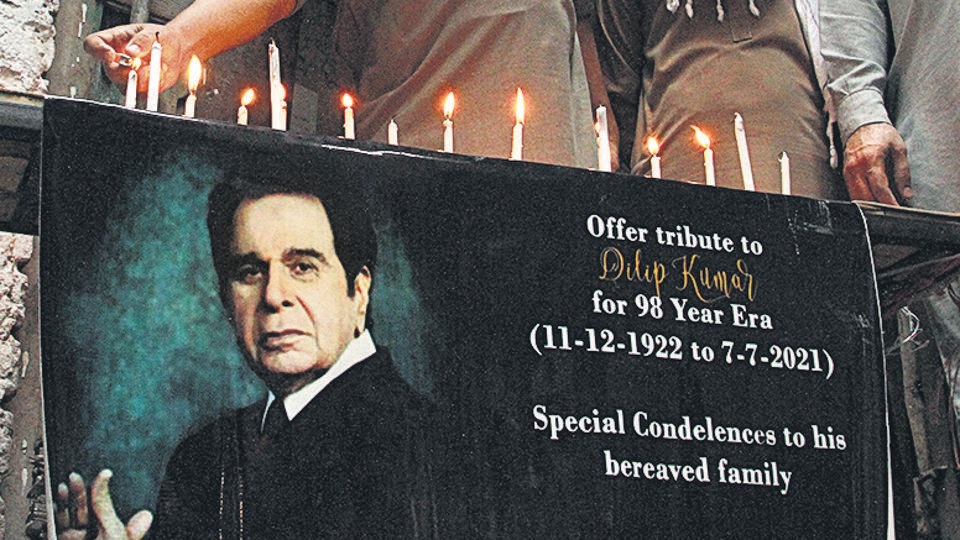
Yusuf (Dilip Kumar) Khan’s career spanned six decades; he acted in more than 60 films, won numerous industry awards and several civilian honours, including the Padma Bhushan, Dadasaheb Phalke Award and Padma Vibhushan. But, his legacy lies far beyond the accolades and numbers. If there was ever an actor whose work was art and not entertainment, I would aver it was Dilip Kumar. His singular purpose as an actor seemed to have been to help others experience what the world may be like for different people, in different circumstances, and to achieve a sense of oneness through a universal experience. He portrayed the life of human beings in their many facets, efficiently underlining the palpable struggle between an individual’s personal emotions, moral callings and social responsibility.
Farewell to the accessible humane prince then, and long live the emperor’s work.


