E-Paper



Indian-led team discovers two dead stars spiralling inward at record speed
The discovery could provide an important target for future Space-based gravitational wave observatories

 Prefer HTon Google


An international team led by astronomers from the Inter-University Centre for Astronomy and Astrophysics (IUCAA) Pune, has identified an extraordinarily compact pair of white dwarfs that orbit each other once every six minutes and are spiralling towards one another at a rate faster than almost any other known system of the kind. The discovery could provide an important target for future Space-based gravitational wave observatories.
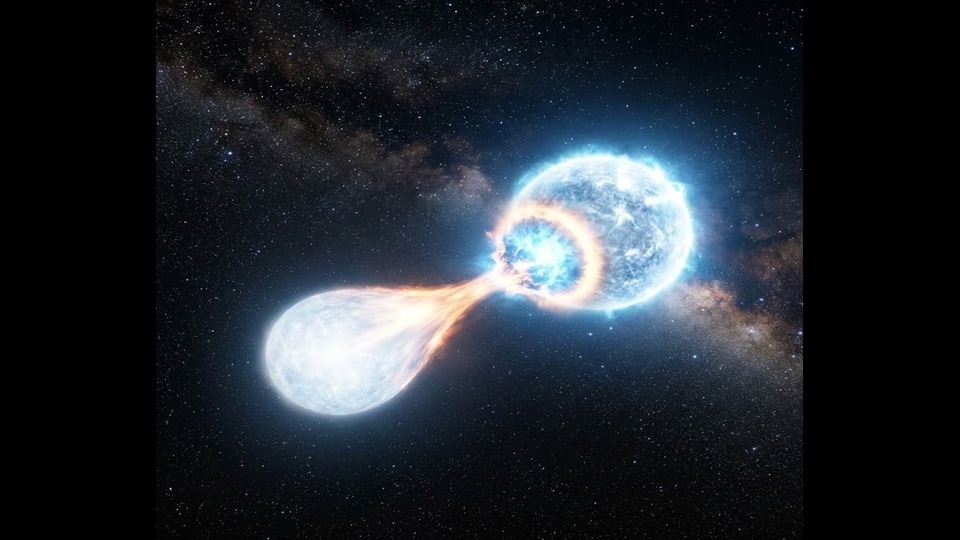
The system known as eRASSU J060839.5-704014 (eRASSU J0608) was originally discovered through the SRG eROSITA all-sky survey. The latest study, led by Rahul Sharma and professor Chandreyee Maitra, used observations from the Chinese-led Einstein Probe mission and NASA’s NICER telescope along with earlier observations from the XMM-Newton observatory to track the binary’s orbital evolution over three-and-a-half years. The study was recently published on August 10 in The Astrophysical Journal Letters.
Two stellar remnants locked in a six-minute orbit
White dwarfs are dense, burnt-out cores left behind when Sun-like stars exhaust their nuclear fuel and shed their outer layers. Although roughly the size of Earth, a white dwarf can contain a substantial fraction of the mass of a star. In eRASSU J0608, two such stellar remnants are locked in an ultracompact binary system, completing an orbit in just 374 seconds or about six minutes. Such extremely short-period double white dwarf systems are among the most compact binaries known and are believed to represent a brief and important stage of stellar evolution.
Astronomers believe the two white dwarfs are so close that material from one star may be flowing directly onto the surface of its companion instead of first forming a conventional accretion disc. This process, known as direct-impact accretion, heats the receiving star’s surface to temperatures exceeding one million degrees Celsius producing a bright, pulsing X-ray signal that repeats every 374 seconds.
Orbit shrinking rapidly
The team found that the system’s orbit is shrinking exceptionally rapidly. Its measured rate of orbital decay is greater than that observed in two other well-known ultracompact white dwarf binaries, HM Cnc and V407 Vul.
The rapid loss of orbital energy and angular momentum is most likely being driven primarily by gravitational waves ripples in Spacetime produced by the motion of massive objects. As the system loses energy through gravitational radiation, the two stars move closer together causing them to orbit each other increasingly faster.
Also Read | Science of total solar eclipse: What happens when moon blots out the sun & why India must wait its turn
The measured rate of orbital decay also allowed the researchers to estimate the system’s combined chirp mass, a quantity that determines the strength of its gravitational wave signal. The estimated chirp mass is about 0.43 times the mass of the Sun, placing eRASSU J0608 among the higher mass systems known in this class.
Potential target for LISA
The rapid and predictable evolution of eRASSU J0608 makes it a particularly promising source for future gravitational wave observations.
The European Space Agency’s planned Laser Interferometer Space Antenna (LISA) mission, expected to launch in the next decade, is designed to detect low-frequency gravitational waves from compact systems such as these. Binaries whose gravitational wave signals can be predicted in advance are particularly valuable because they serve as ‘verification sources’ for Space-based gravitational wave observatories.
Rahul Sharma, lead author of the study and a post-doctoral fellow at IUCAA, said, “The system is spiralling inward exceptionally quickly even compared with other extreme binaries, making such systems important laboratories for studying a fleeting phase in the evolution of compact stellar binaries”.
Prof Chandreyee Maitra said, “The observations indicate that eRASSU J0608 may be among the most massive and rapidly evolving ultracompact white dwarf binaries currently known. Its rapid orbital evolution, that makes it a promising verification source for future Space-based gravitational wave observatories such as LISA”.
The researchers plan to continue monitoring the system using X-ray telescopes and search for a visible light counterpart. Such observations could help determine its distance and masses more precisely and improve predictions of the gravitational wave signal that future missions may detect.