
 E-Paper



Sawai: Tranquil rhythms, wholesomeness set the mood of mehfil’s last day
The 69th edition of Sawai Gandharva Bhimsen Mahotsav concluded with Kaushiki Chakraborty's magical voice captivating the audience in Pune.


Pune: The 69th edition of Sawai Gandharva Bhimsen Mahotsav concluded on a high note on Sunday. Thousands gathered to listen to the magical voice of Kaushiki Chakraborty at Maharashtriya Mandal Krida Sankul at Mukundnagar.
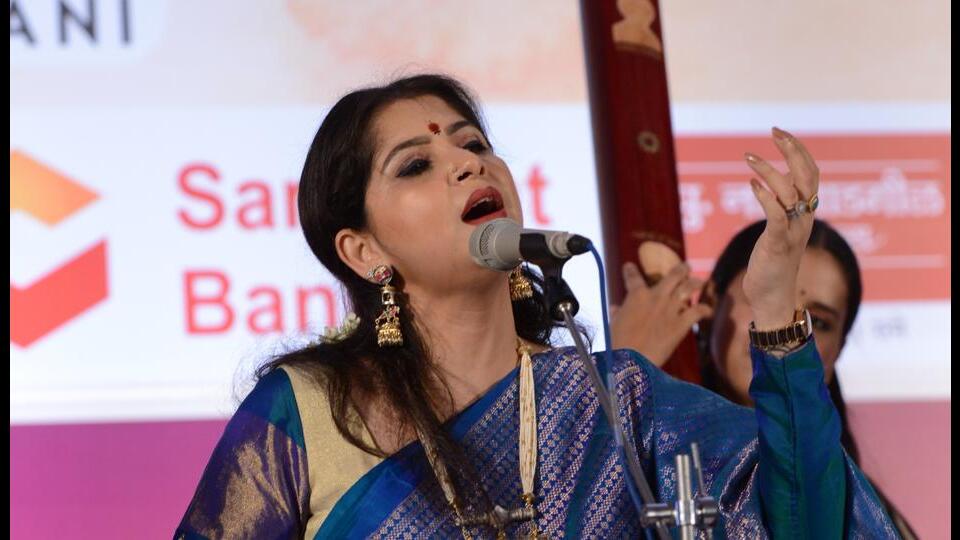
Kaushiki is an illustrious vocalist of the Patiala Gharana and the disciple-daughter of Pandit Ajoy Chakrabarty. Known for her pure classical khayal, dadra and thumri, she began her performance with a Vilambit Jhumra “Hovan Lagi Saanjh” in Raag Puriya Kalyan followed by “Sunlino Mori Sham” in Drut Taal.
She presented her much-loved performance of all time “Aadi Dev Mahadev” in Raag Yaman. Later, she mesmerised the audience with a thumri “Sajanwa Kab Aavoge” set in Taal Dadra and presented in Raag Pahadi and “Rangi Saari Gulabi Chunariya” in Raag Mishra Pahadi and Taal Dadra
She concluded her presentation with a bhajan “Hari Om Tatsat”, also in Raag Pahadi.
Sangeet Natak Akademi award winner flautist Pandit Ronu Majumdar played specially created “Shankh Bansuri”, a difficult note to play as compared to the regular flute.
He concluded his session with the famous rendition of “Baaje Re Muraliya Baaje” in Raag Patdeep blending into Raag Multani and a Kajari in Raag Mishr Pilu and Khemta Taal.
Earlier in the day, the inaugural sessions saw a noted vocalist and a debut artist’s soul-stirring performances.
The first session of the final day began with the renditions of Bharat Ratna Bhimsen Joshi’s son, Shrinivas Joshi. “This year, with the thought of presenting something different than usual, I will be performing compositions that my father Pandit Bhimsen Joshi sung, but their roots are not of the Kirana Gharana,” said Shrinivas.
He started with a Bandish — “Sundar Kanchan Barse” in Raag Shuddha Sarang made famous by Pandit Shivrambuva Vaze of the Gwalior Gharana. Next, he performed a Bandish “Ab Mori Baat” in Teentaal, followed by a Natyasangeet “Prem Seva Sharan” in Jhaptaal. The Natyasangeet was sung many times by Ustad Abdul Karim Khan and Bharat Ratna Pandit Bhimsen Joshi, but is rarely heard these days. He concluded his performance with a bhajan “Tum Bin Mori Kaun Khabar Li”. Shrinivas was accompanied by Avinash Dighe on harmonium, Pandurang Pawar on tabla, Vaishali Kuber and Neeta Dixit on tanpura, and Mauli Takalkar on taal and Viraj Joshi for vocals.
The second session started with Agra Gharana’s exponent and the disciple of Pandit Babanrao Haldankar, Dr Pournima Dhumale’s enlightening renditions. Her Guru Maa Usha Haldankar and Guru Pandit Vivek Joshi were also present on the occasion. She started with Agra Gharana’s most famous Raag Barwa with the traditional “Nom-Tom”. She then picked up the pace with a Madhya Laya Ektaal Bandish followed by a composition “Ayo Re Saavan Maas” of Ustad Khadim Hussain Khan in Teentaal.
She performed a Bandish “Bandha Sama” in Raag Khat, which is said to be a mixture of six different ragas. Her concluding performance included a Bandish ki Thumri “Na Manungi Unke Manaye Bina” in Raag Khamaj. She was accompanied by Suyog Kundalkar on harmonium, Sanjay Deshpande on tabla, Kirti Kasture and Gauri Patil on tanpura.
In the third session of the fifth day, Pandit Suhas Vyas paid tribute to his father and Guru Pandit CR Vyas to mark his birth centenary year by presenting some of his compositions.
With a Vilambit Ektaal Bandish “Sab Mil Gaaye” in Raag Dhani, Pandit Suhas initiated his performance. He performed bandish “Sun Le Araj Mori” in Jhaptaal and “Saanjh Ki Ber” in Taal Teental, both in Raag Shree. He concluded with a bhajan of Sant Chokhoba “Johar Maybap Johar” in Bhajani Taal. He was accompanied by Bharat Kamat on tabla, Shrinivas Acharya on harmonium, Kedar Kelkar on tanpura, Aditya Vyas for vocals.
The fourth performance was by “Atma Ensemble” who embodied the universal language of music. Renowned Carnatic music artist Aishwarya Venkatraman and associates began with a soul-stirring performance “Pallavi” in Raag Shankara Bharanam in a 19 beat (matra) taal. The taal is an original composition of Shankarji tuned into 19 beats by Aishwarya’s father and Guru Vinod Venkataraman. Lightheartedly he called the Taal -Covid 19 Taal to remind us of all of the music legends that Covid took away from us. To this taal, Aishwarya played the raag in two rounds and AV Krishnan on Ghatam demonstrated how to count the taal in two halves, the Purvangam with 10.5 beats and the Uttarangam in 8.5 beats (matras). They concluded with a special performance in Deergh Shankara Bharanam in dadra (three cycle note).
“Atma Ensemble” is a band of “Alliance for Tradition in Musical Arts” devoted to the passionate expression of the legacy of rich Hindustani classical music and explores the soul of other musical traditions and cultures through collaborations.
Aishwarya Venkatraman as the lead violinist who effortlessly executed exceptional tonal finesse was accompanied by mridangam percussionist and her Guru Vinod Venkataraman, Paul Livingstone on fretless guitar, drummer Ray Belli, Vinayak Koli on tanpura and AV Krishnan on ghatam.
Aishwarya, a child prodigy, is now one of the most virtuosic interpreters of South Indian music in the world. She has the distinction of being the youngest graduate from Berklee School of Music with a BA in jazz performance. She also earned a Bachelor of Science in Biology at Stanford University. Whilst continuing her musical education and public performances, Aishwarya continued at Baylor College and earned an MD in neuroscience.


