
 E-Paper



Startup Mantra: Digi-tech dispensing valve for liquids to upscale biz
The innovation can be used for process control, automatic formulation batching, bottling, liquid filling


Satish Pathak, a seasoned techpreneur, has successfully engineered an innovative solution “Digitally Controlled Precise Dispensing Valve for Liquids” from his technology demonstration unit at Paschimanagari Society in Kothrud.
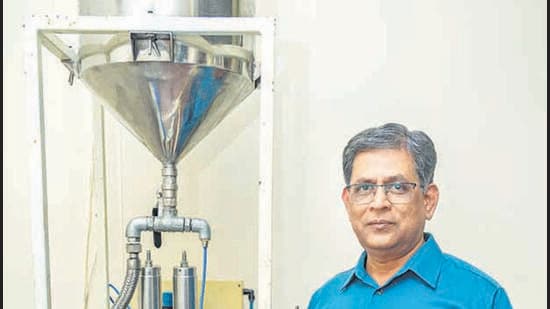
The groundbreaking creation finds applications across various industries, offering a globally applicable solution for liquid dispensing. Satish, the founder of Samiep Technology Innovations established in May 2017, illustrates its practicality through a common scenario: fuel dispensing pumps at refuelling stations.
The disruptive nature of Satish’s invention lies in the incorporation of industrial valves that are not only versatile and configurable, but also precise in their digital control. The transformative technology has the potential to optimise the amount of fuel dispensed into vehicles, showcasing its real-world implications for efficiency and precision.
The first step
Satish, an instrumentation engineer of 1987-88 batch from Mumbai, began his professional career at a large process industry where he worked on component-level basis and root-level instrumentation. After four years into the job, Satish completed a did a course in microprocessor-based automation and another in PC-based automation and control from IIT Bombay.
“I got an opportunity to work on a small project related to PC-based automation in those days which opened several other opportunities for me since I had industrial automation experience also. I provided innovative solution for effluent treatment chemical industry. I was passionate about innovating solutions, but did not want to start a typical MSME kind of business,” he said.
“In 1996, I designed the first computerised announcement system for Mumbai suburban railways. The uniqueness of the project was that we had to operate the computer without keyboard or mouse, which was unthinkable in those days. Although, I did not have any radio communication background, I used the cordless phone and tapped all the signals. I found the point where I can really get my signal to dial that cordless phone and interface it to the computer. With that I made a small project where I had 10 lamps mounted on the wall, did some wiring and then with my programme dialled numbers to put the lamps on and off. With my innovative and sincere approach, I bagged the contract for maintenance of 54 computers for PC-based announcement systems in Mumbai division,” Satish said.
Satish claims he later bagged another project from the railways for surface-mounted LED display systems to be used for suburban locals. “I was the lowest bidder for the tender. In the 26/11 attacks these displays were damaged, but we replaced the physically damaged modules free of cost. These projects helped me derive other byproducts like large scale displays, weighing scale displays and remote display systems,” he said.
Turning point
Satish got another problem statement from an industry through his friend, which later proved to be a turning point in his entrepreneurial journey.
Satish said, “While solving the initial problem statement, I also noticed that there were gross errors in the valve designs. Changing the designs and replacing entire system was a costly matter, and hence I suggested the management to create a new product. However, I had insisted that the intellectual property rights would remain with me. After the company agreed to my terms, I went to almost 12 valve manufacturers in Mumbai and Pune. While checking for rangeability, no manufacturer could satisfy my requirements. It was a heated argument with one of these manufacturers that really spurred me to design my own valve with highest possible rangeability.”
“Although I was not a mechanical engineer, I was confident enough to take up the task. I took some technicians with me to work on it, and we made a successful prototype. However, the company for whom I was making the product, tried to poach some technicians by luring them with better job offers. That proved to be trigger for further disagreements and eventually the project was stalled. I had not patented the new design and lost precious time in arguments. It was a big lesson for me as an innovator and entrepreneur,” Satish said.
ISA recognition
Satish did not give up easily and applied for a central government grant. After qualifying for it, Satish bought some equipment and decided to set up his lab at his home. Upon completion of successful trials, Satish demonstrated his product to a few industry persons. One of those well-wishers recommended Satish’s name to the International Society of Automation (ISA) for “Global Award for Technology Invention” nomination.
Satish said, “In 2014, I shifted to Pune from Mumbai and became a member of ISA Pune Chapter. The award I was recommended for is given to individuals whose innovations or inventions have the potential to make global industry impact. In 2016, I became the first Indian to receive the award. After the news broke out, I also got a chance to demonstrate my innovative product at Sriharikota before some scientists from the Indian Space Research Organisation (ISRO). They wanted to explore improving efficiency of the rocket fuel blending process. They also gave me a letter of satisfactory demo.”
Closer to perfection
Satish met an importer at an event in Maharashtra. The importer wanted to import lubricant additives but was worried about outsourcing the bottling requirements. Satish offered him a demo of his new product which could help in the precision bottling services. Buoyed by the success, Satish decided to scale up through different business models.
Satish said, “Sameep, in Sanskrit, means being in close vicinity or close to something. No scientific or technology person would claim to be perfect, but we want to get as close to perfection as we can. We also want to be close to our stakeholders in business. This was the thought behind finalising the company name Samiep Technology Innovations. Industry experts and others are visiting our setup in Pune. We want to take it forward with the network of system integrators and OEMs.”
Digital control
Explaining the problems faced by industry, Satish said, “The cumulative losses observed today on global level are to the tune of ₹1 lakh crore per annum. Samiep-designed valves can reduce these losses along with capital and operational expenditures by at least 50 per cent. The material consumption, bottling or packaging savings are also huge. Samiep valves come with minimal capex, maximum versatility, and highest accuracy.”
It is a digitally controlled mechanical valve with pneumatic activation, said Satish, adding, “these valves can be adapted to a given site and configured it according to the industry requirements. Industries can build profiles with the help of specially developed digital controller. The profile can be selected with a drop-down menu and any combination and quantity of liquid dispensation can be achieved. We can retrofit the valves in existing setups of industries. In some use cases, it would even replace the flow meters, as it can dispense based on the feedback loop. The valves can be used for process control, automatic formulation batching, bottling, liquid filling, etc. From food to pharma grade to hazardous chemicals, we can use the valve which can also be mass-produced and configured for variety of applications.”
Hyperlocal DAD units
“Decentralised Automated Distribution” (DAD) is another business model where small industry units can focus on hyperlocal markets. Satish said, “When industries want to expand their capabilities and capacities in specific geographies, resources like raw material, skilled workforce and other natural resources are in demand. Hyperlocal DAD units can take of such specific geography’s sans heavy investment in resource mobilisation and allocation. Samiep will facilitate such DAD unit operations and further franchise holders can have revenue-sharing business model with us.”
“Hyperlocal units will mitigate the supply chain disruption risks and bring high efficiency in global value chain. These units can be lucrative to startups and consultants who do not have the facilities and capacity to manufacture at scale. Hyperlocal DAD units work just-in-time and hence can be used in industrial and consumer goods market areas. MSME and large-scale industries can save a lot on their stockist-dealer-distributor network, while these units can also serve as a good backend support for e-marketplaces and supermarkets,” he said.
Other applications
The technology finds multiple applications irrespective of scale of manufacturing from pharma, application programming interface, biotechnology along with all industry verticals, defence, aerospace, nuclear power plants and commercially useful instant vending applications. It is a low carbon technology which promotes sustainability and circular economy. Discussing about sustainable applications, Satish mentions that big brands can have their authorised product refilling centres at different locations.
“Liquid detergent, edible oils or any liquid product brands can eliminate external risks of adulteration, reduce the use of plastic and also generate local employment through the refilling centres operations,” he said.
“When we import some products in finished good form, the import duties levied are more than as compared to component level sourcing. Hyperlocal DAD units can import critical components and source other components locally. This will reduce the logistics cost and carbon footprint too,” Satish said.


