
 E-Paper



Startup Mantra: Maximising HR potential with HCMS
‘HR Neeti,’ founded by Annada Ranade (62), is helping organisations to undertake a transformation journey


Still young at heart-Annada Ranade (62), a school teacher turned HR professional and now a founder of ‘HR Neeti’, a startup, is transforming human resources (HR) for small, medium, and large enterprises with the help of its Human Capital Management System (HCMS) software. What differentiates ‘HR Neeti’ from other HR tech startups is that it is not just a software provider helping digitise records, but enables the organisation to undertake a transformation journey to move up the HR maturity curve by maximising human capital.
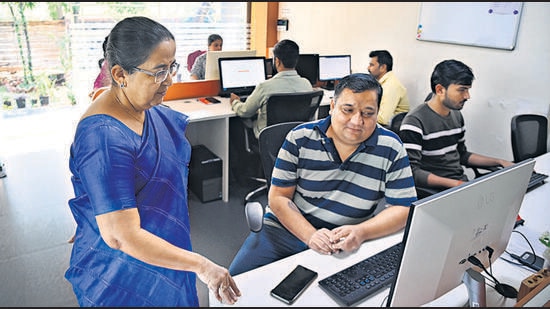
Beyond transaction
After working as a school teacher for eight years and heading an organisation ‘Outdoor Learners’, Ranade did her Management from Symbiosis Institute of Business Management. ‘Career was never planned for me’ she says. Armed with management knowledge, she then moved to the corporate world and worked in several organisations in general management and HR domains, with the last two organisations in the capacity of the corporate head HR.
Garnering an experience of 12 years in corporate, she moved to head the HR consulting vertical at Kirtane Pandit Consulting and did assignments in India and Dubai. This inspired her to develop her own consulting model with ownership of implementing the consulting solutions, under the banner HR Mantrana in 2011. After undertaking HR transformation assignments for clients from various industries for four years, her consulting needed a platform for sustainability and so she established HR Neeti Pvt Ltd – a startup in 2016.
Says Ranade, “I genuinely feel that every employee wants to give his best, but we should define what is ‘best.’ In most organisations, this definition of ‘best performance’ is not in place. Even large organisations’ management has no clarity on what HR should do. The role of HR from my perspective, based on my earlier experience, is that HR can give direction to any organisation beyond transactional work like recruitment, payroll, statutory compliances, union talks, etc. HR personnel should work towards it and the change should start from the top management and then employees will follow.”
Overcoming resistance
Going beyond transactional work, giving direction, and ensuring transformation happen in an organisation is easier said than done. For example, after every appraisal, employees often complain about not being evaluated in a ‘fair’ manner. Ranade feels this happens because employees and bosses are not aligned in terms of the ‘performance criteria’ despite the employee wanting to give his best.
Ranade said, “These were genuine things I had learnt on the job. If the performance criteria are aligned, then the entire dialogue changes. We did not go by any theories and instead changed job descriptions, and performance parameters. We were a team of only three persons in 2010 when we got an award for best HR practices from a multinational automobile company, whose dealership worked with me. The responsibility I had taken on as a consultant, to transform the organisation, was very challenging, as everybody has some vested interests. Therefore, I thought of coming up with software in which the system will guide me beyond the transactional work.”
HR software
With a focus on transformation, Ranade included payroll and performance management features in 2018 to make the software a comprehensive system. This journey led her to eventually create a robust and holistic HCM platform with tightly integrated modules to resolve management, HR, IT, accounts, and employee challenges alike. Ranade then pivoted the business model from being an HR consulting firm to becoming a SaaS provider of an ‘on Cloud HCM system.’
Ranade added, “When we looked for ready software in the market, we realised they were designed by IT people and most of the actual HR work needed to be done outside the system. I had kept aside a budget to develop my own software. Coincidentally we were introduced to a bright student from Nanded who stayed at our home and designed the first version of HCM system. The idea was to use the software for internal purposes. We had no vision of letting access to other users or selling the software. We realised this as a potential business model when one of our clients requested to give access to the software to their HR personnel.”
“Later we worked on improving the UI/UX for the system. We used the software as a supporting tool for all of our clients for 3 years. Then the Covid-19 pandemic struck and we lost two clients. That’s when we realised that if consulting business model does not work then this tool can work. We had a very good product and hence decided to upgrade the UI/UX further and launch it as ‘software-as-a-service’ (SaaS),” she stated.
Product – Market fit
Ranade says, HR Neeti has achieved its product-market fit and has now turned into a very comprehensive software. When asked about the differentiating factor for HR Neeti, Ranade says, “I believe that for any entrepreneur to conduct a successful business, they should have clarity about their organisational structure, departments, groupings, and establish ownership for every person in the supervisory hierarchy. There are many HR software options available in the market. What HR Neeti offers in a unique manner is the governance framework and performance management module which we have designed.”
“If HR department does not understand business, then they cannot add value to it. There has been ‘glorification’ of HR in the recent past under the name of employee engagement. Fundamental HR processes and functions will remain, but apart from that what differentiates us is the transparency in operations. The principle behind our application is that we should have absolute transparency and make all possible information available to the concerned employee. The next thing is how to assess or evaluate performances right from MD, and CEO to the staff. We even define the source of data to bring clarity to the process, which in turn avoids any future conflicts. In most cases, we source this data directly from the system instead of asking employees to enter it, to avoid any bias or incorrect information. All these efforts lead to achieving good employee-retention ratios,” Ranade said.
Governance framework and PMS
Study of an organisation is very important says Ranade. “Surprisingly, in most organisations, there is no clarity regarding the governance framework. The governance framework structure is important to give direction to any organisation. Defining this structure ensures that the entire organisation will operate within it. It may not be perfect at the beginning, but once documented, it can be modified and upgraded. It is a continuous improvement process. Similarly, for a performance management system (PMS), we must first define what one wants to achieve in their organisation. What every employee including HRs, role would be in the governance structure defined. We have mapped 27 parameters for every position level.”
HR maturity curve
Ranade claims the auto-generation of the payable desk is the biggest differentiator factor for HR Neeti’s software. “Organisation’s policy must be comprehensive to arrive at the payable desk functioning. We have put in the learnings of my 30-year experience to get this done. Most organisations give us a 4-lines policy which we turn into a comprehensive one to avoid any ambiguities right from job descriptions to asset allocations and to defining questions position-wise for personal interviews, appraisals, and exit interviews in the complete employee lifecycle. Since everything is position-driven, we could eliminate paperwork completely,” she stated.
“Even for appraisals through the PMS, weightage can be assigned for questions to eliminate any bias and arrive at a score directly with transparency. Our increment model is unique with manpower cost ratio calculation features. We can map contractual employees or gig workers and consultants as well. Our objective is to take organisations up the HR maturity curve. If you take good care of people, your business is going to thrive. We also give HR support for full-time or half day in which HR Neeti team works in close association with the company in-house HR team,” Ranade added.
Future plans
On the next move and plans ahead, Ranade says, “We have achieved the PMF very well. Our product is stable, we have the necessary IT infrastructure in place along with all statutory compliances and processes in place. Now we are identifying people for scaling up the business. We would hire a sales and marketing team very soon. We aim to achieve at least 3x or 4x revenues in the next financial year.”


