
 E-Paper



Startup Mantra: On top gear to place EV facility on fast track
Here’s the story of two mechanical engineers turned entrepreneurs who are now raising their Series B round of $30 million ( ₹232 crore) amidst the ‘winter’ of startup funding


Pune: Maxson Lewis and Darryl Dias, co-founders of Magenta, describe their startup ‘Magenta’ as an infratech company providing a spectrum of services in the electric vehicle (EV) value chain from in-house developed charging hardware and software, charging services (ChargeGrid) and last mile delivery services using electric mobility (EVET). The duo is in no rush to become ‘unicorn’ and like to call themselves as the ‘camel’ of startup ecosystem which are real survivors in the harshest of the situation. Here’s the story of two mechanical engineers turned entrepreneurs who are now raising their Series B round of $30 million ( ₹232 crore) amidst the ‘winter’ of startup funding.
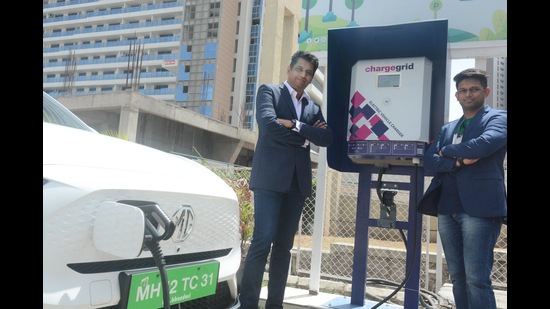
Cousin co-founders
With five-year experience in automotive sector and 15-year experience in power sector, Maxson leads the design, development and daily operations of Magenta’s products and systems. Co-founder Darryl, born and brought up in Dubai, is focused on diverse business operations with competency in strategic planning, business development, etc. He plays an instrumental role in executing the company’s last mile delivery and charging network setup, operations and growth.
While working in the corporate, Maxson thought about starting Magenta in 2017. He recalls, “I had sent a SMS to Darryl who was in Dubai that time. Next day, I received his reply saying that he had quit his job in Dubai and he returned to India to begin the entrepreneurial journey.”
“In Magenta, we are two businessmen who implicitly trust each other. I know him as my kid cousin brother and the relationship angle has only allowed us to trust each other. Beyond that it has been an amazing relationship as two entrepreneurs,” said Maxson.
EV expressway
Maxson and Darryl started working on Magenta since 2017, but the real work began in 2018. Since both had worked in global companies, they were aware that the EV age is coming. However, in India, there was no awareness then.
Says Maxson, “We wanted to make a difference, but we soon realised that we need an ecosystem for that to happen. There were multiple problems to solve. One of them was the EV charging challenges. We developed a software and then hardware for EV charging solutions. While designing it, we were aware that we can’t just cut, copy and paste international solutions in our country. In India, there are four aspects – Heat, Humidity, Harmonics and Humans – that need to be taken into consideration. Everybody understands heat and humidity. Harmonics is the power systems and humans mean the way we interface with the public infrastructure. We needed to solve the Indian problem in Indian way. So, we invested heavily into research and development and set up an office in Navi Mumbai. We started developing hardware specific for India.”
Design improvement
Explaining the need of software in charging infrastructure, Darryl said, “The European chargers had nice touch screens and it takes 10 to 15 seconds after pressing the button to actually start the charging. During these 15 seconds Indian users would tap and bang the machine for several times. That’s when we decided to design the hardware in such a way that users are away from the charging interface. The software ensures that the user does not have to come towards a charger to turn it on or off. The software adheres to Open Charge Point Protocols (OCPP) international standards.”
“We set up a solar-powered EV charging station on June 13, 2018 to showcase that EVs also need to be powered by clean energy. Within next two months, we set up a public charging station on Pune-Mumbai Expressway at Lonavla. This charger was equipped with software mobile application ChargeGrid. Meanwhile, the government had also implemented EV tariff and we too set up an EV tariff billing meter in September 2018,” said Maxson.
Pune survey
Magenta did a survey of 1,000 locations in and around Pune city to put up charging infrastructure in 2018. Maxson says, “While we had begun installing chargers, we had the understanding that people will charge their electric vehicles not only on roads but largely at residential societies. We were quite ahead of the times.”
“The survey findings were surprising. Not everyone has a parking lot in a society. We realised that the bigger challenge is not about setting up public charging stations. Community charging, a term which had coined then, is the biggest challenge and so we had to solve it. We set up 100 private and community (societies) charging points in Pune, including some IT parks, which are still operational,” he said.
Founders compatibility
Magenta was invited by Hindustan Petroleum Corporation Limited (HPCL) under the Invest India Programme in 2019. Magenta received their first seed fund from HPCL.
Darryl said, “We were not aware of the programme. However, we got a call from one Sanjay Kumar from Invest India team and he asked us to participate in it. We were one of last participants and waiting in the queue since 7am. When we got a chance to present it was 7:30 pm. Everybody was tired and bored. They wanted to understand the compatibility between the founders and hence they asked us to introduce the other founder.”
“Since we both knew each other well and had a good chemistry between us, we got selected for the programme. HPCL is not only an investor now but we have a very close relationship with them. We set up charging stations for them across India, including Pune and Delhi. Later in 2019, Shell also incubated us and helped us develop as a company. In 2020 we had Microsoft startup programme,” Maxson added.
Solving infra issues
Magenta installed the streetlight integrated EV charger ‘ChargeGrid Flare’ at HPCL. While charger installation process is simple, there are complexities around setting it up.
Maxson says, “We want people to participate in putting up the charging infrastructure. Most of us think charger is a challenge, however, in reality the ability to have the charger active all the time and the backend infrastructure is the real challenge. Backend infrastructure includes telecommunication, application and lot of other things apart from electricity. The quality of power is bit good in most residential areas of Indian cities. Charging stations on highways and remote locations face a lot of problem like overvoltage, undervoltage, overcurrent, undercurrent, neutral, earthing, etc.”
“Earthing is one such real challenge which people don’t realise. Charger would get spoiled, MCB would trip or something would burn because of the over-fluctuations. We realised we should come up with some safety standards and safety equipment inside the charger. We focus on safety, quality and ethics at Magenta and hence for our chargers to operate we have an earthing sensor. If there’s no earthing it will not charge. Even on the software side we have the entire payment gateway enabled, user profiling, etc,” he said.
Darryl says, “EVET platform is designed for last mile and urban freight transportation in a clean way. It’s a technology platform in which electric vehicles, charging solutions, driver and asset management, monetisation is provided together. We offer this whole ecosystem to our clients. EVET is our fastest growing business vertical.”
Maxson said, “EV is a complete technology shift. The drivers need to understand how to use these electric vehicles and our platform provides driver training, driver management, tracking and tracing driving behaviours along with driver report card generation. We have driver ranking too. This helps the FMCG, Pharma, e-commerce companies to transition to EVs.”
EVpreneurs
Magenta has a driver micro entrepreneurs called ‘EVpreneurs’, said Darryl. “We enable and facilitate drivers to adopt an electric vehicle, give them charging and technology support, etc. We are helping them overcome the fear of unknown and transition to EVs.”
New launches
Magenta is planning to launch some new solutions in EV charging space. Maxson said, “Electricity is the new oil, but it is a controlled and regulated business in India. We work closely with power distribution companies (discoms). Our ability to serve customers depends on the availability of the electricity and there is no guarantee of it. Now we are working on models where we will eliminate the dependency on discoms. These companies will become a support entity. We have designed a storage and dispensing model. ChargeGrid will give the guarantee of charging. We will launch this model in coming three quarters.”
“We are also soon launching a charging point partners (CPP) model in which we are looking for partners who will come on to our platform, including EVET. We are also launching a solution which will allow for the same infrastructure to be used by different people in a community. This new service will include load management and time management features in residential chargers,” he said.
“India offers the world’s largest untapped EV market. Several automakers are rolling out electric vehicles at a rapid pace, yet the current state is far from the desired level. We are impressed by the speed and execution capabilities of Magenta’s team, with reputed global family offices investing, Magenta will continue to travel its growth trajectory in even faster pace and tap the huge EV Industry,” said Madhu Lunawat, co-founder, Pantomath Capital Advisors Private Limited, fund manager (India Inflection Opportunity Fund) and financial advisor to Magenta.
Untapped market
Magenta is planning to launch new solutions in EV charging space
On offer are three business verticals
Charger-as-a-Product
Charging-as-a-Service
Electric Vehicle Enabled Transport (EVET) platform
ChargeGrid EV charging solutions
ChargeGrid Penta – for residential and destination charging
ChargeGrid Poly – for fleet charging
ChargeGrid Flare – for public charging
Pricing
Private charger – ₹25,000 (wiring and other charges additional)
₹8,000 (Reduction expected by July end)
Charger-as-a-Service – ₹20 per unit (basis other amenities and real-estate cost, the per unit costing changes location, city and state-wise)
EVET – ₹1,400 for 8-hour operation with charging included along with vehicle and driver partner (varies as per distance, delivery and load capacity)
Onboarding
Magenta chargers start charging in one thumb three clicks
First-time users can call toll free number for assistance
An EV is essentially a smartphone with 4 wheels, and talks with the charger
Magenta chargers receive information typically about the type of vehicle, how much charging has happened, etc.
Central control room in Mumbai tracks all chargers across India (Location, live status of charging station, Availability, Photograph, Pre-booking)
Chargers of other companies are also hosted on Magenta platform
For Individuals
Toll-free number and email id to reach out
Understand use case – is it for personal, public or pseudo public use or community use
Site survey and assessment (wiring)
Load enhancement assessment is done
Charger Installation (Earthing and other checks done)
Charger is dispatched
Installation time
Private or residential chargers
24 hours: Wiring and installation in safe place
72 hours: Testing, earthing checks, etc
Public chargers
120 to 240 hours (Shade, ingress, egress; social interference, water logging spot checks)
Revenue and sales
FY 2021-22: $1 Million ( ₹6.5 crore)
FY 2022-23 (expected): $8 Million ( ₹52 crore)
Business Vertical: Revenue share:
EVET: 40 per cent
Charger-as-a-Product: 30 per cent
Charging-as-a-Service: 30 per cent
Private Chargers – 4,500
Public chargers – 1,000+ chargers in 34 cities across India (4,800 expected by end of 2022)
For HPCL – 1,000 chargers are being installed (work underway)
Setting up Bluetooth-based 30,000 chargers in Delhi
EVET platform – 400 vehicles in Bengaluru, 600 to be deployed in Pune with major ecommerce, FMCG, pharma and logistics companies
Daily active users
Fleet charging – 350
Public charging – 150
Funding
₹1 crore – Seed funded by HPCL in 2018
₹100 crore – Pre-Series A fund round in 2020 with JITO Angel Network and LetsVenture and Series A round with Indian-American cardiologist, and serial entrepreneur Dr Kiran Patel
₹232 crore ($30 Million) – Series B round (50 per cent already committed)
Future plans
Expansion in international market especially South East Asia and Africa
Setting up 4,800 additional chargers over and above existing infrastructure
Launching 4 new charger products soon
600 e-vehicles to be deployed in Pune under EVET business vertical
Pune EV Market
Adoption of new technology is much faster
People are more receptive to new and green ideas
Pune is also the erstwhile automotive technology hub
Pune will transition to EV hub, if it doesn’t then it will lose
Companies looking at EV manufacturing setup in and around Chakan area


