
 E-Paper



Startup mantra: Speak, play & make friends on Frnd
Two IIT graduates launched Frnd, an online platform in multiple regional languages, to connect and make friends

 Prefer HTon Google


Why would anyone want to set up a communication platform much like the ubiquitous Facebook? However, as Al Reis, the marketing guru, has long argued, success does not always come from being first; it comes from being different. And that is what Bhanu Pratap Singh Tanwar and Harshvardhan Chhangani, both from IIT Kanpur, set out to do in 2019. Their online platform, Frnd, is designed to help people connect, but it is built on a completely different premise.
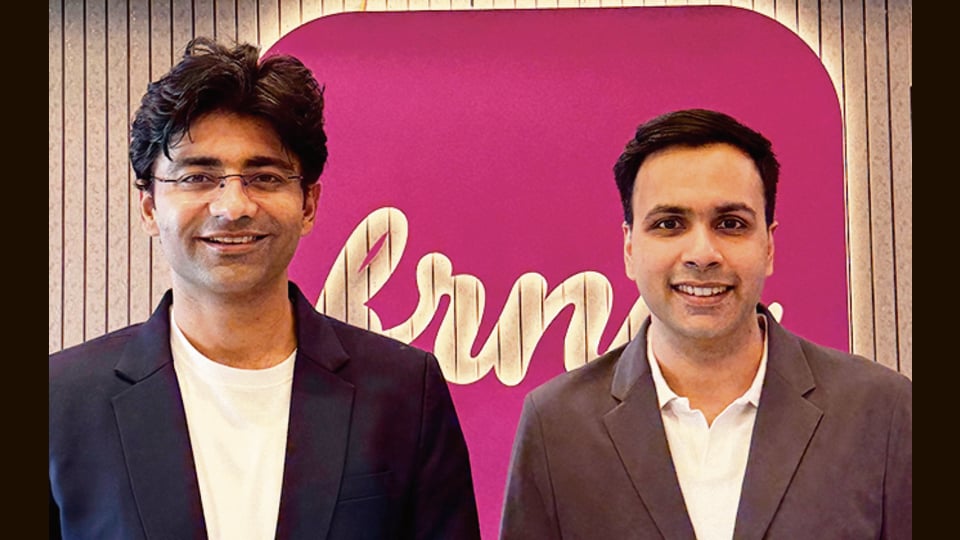
Says Bhanu Pratap, “I come from Kota, where the social structure is very different from big cities like Mumbai, Bengaluru or Delhi. In such small towns, the internet came in 2015, and people are still not very free to express themselves while using it.
“Most conversations happen when guys meet at the nukkad, and where females cannot hang out late. When we were young, my older cousins would use Yahoo, Rediff or Orkut to chat, but now we have Facebook. But the conversations on Facebook are content-driven. People put out a post, and others comment on it. And for someone who is not fluent in English or not comfortable expressing themselves in that language, it becomes almost redundant.” Seems rather unfortunate that in this day and age, youngsters from small towns are not free to communicate on such platforms. And that is what drove these two friends to launch Frnd.
About the app
Frnd was essentially created for people between the ages of 18 and 35 who live in tier 2, 3, 4 towns and need a platform to share their views. Unlike Facebook, this is not a content-driven platform. It is a place where you can have a discussion and share in a conversation in your own language. Says Bhanu Pratap, “Humans intrinsically want to interact with each other, and content is secondary to it. They want to talk about their job in a new city, or gender roles impacting their lives, safety and so on. You won’t find such topics on the traditional media apps. We thought that our platform should give them that space.”
The app was built as the country’s first avatar-based audio social discovery platform that enables empathetic connections through an open social network. It operates in ten Indian languages, which include Hindi, Punjabi, Marathi, Bengali, Gujarati, Odia, Tamil, Telugu, Kannada and Malayalam.
But why was this avatar-based? Says Bhanu Pratap, “When we were doing this, we saw that not everyone was comfortable putting their photos on the internet, especially women. They would not put up their real face and show something else instead. They used their own photos only with their contacts. And we realised that for a platform to be successful, we needed the participation of all genders. So we created a democratic version of it – an avatar. Here, anyone can be free to be present at any time. We shifted the focus from face to voice. Your voice would be your identity.
Evolving solution
In the early days, Frnd was a text app meant to help youngsters in small towns. Says Bhanu Pratap, “In those days, we didn’t know in which direction the user behaviour was moving. We set up a simple chat room. You press a button and get matched with someone, and then communicate via text. Early on, we realised that to create an interesting platform, text would not do. People love speaking to someone in their own language. A Tamilian would love to speak in Tamil, and a Gujarati would love to chat with someone in Gujarati. But at that time, we didn’t know this. So we set up an AB testing model and would test different features with different groups. The ones that were most liked would stay, and the ones not, discarded. Soon, we moved to voice. We also observed that WhatsApp, which is a communication tool, was also evolving to voice messages. It was clear that people found it better to communicate in voice.”
Verifying users
From the outset, Bhanu Pratap and Harshvardhan wanted their platform to be a clean space for real communication. This meant that they had to filter out undesirable characters. With the platform moving to voice and avatar, they used voice to verify gender. “We gave them a short movie dialogue in their other tongue to read, and through that could identify their gender.”
But more was to come. Early on, they had chat rooms where people could ‘meet’ to talk about different topics. However, soon they realised that people from small towns were not too forthcoming to start a conversation. Says Bhanu Pratap, “That is when we realised that we needed a moderator who could initiate conversations and guide it in ways that got everyone talking. Also, these moderators acted as chaperones who had the admin right to remove a person from the chat room.”
They have installed paywalls at certain places that help weed out bad actors who come just to fool around. From our end, we are very proactive; we have a team of 100 moderators who also patrol the site and report on such persons. About one to two per cent of the users generally are unworthy, and I think setting the tone right helps others to behave correctly.
During such chats, the duo also realised that people often like to give others virtual gifts. Says Bhanu Pratap, “This turned out to be a good revenue source for us. The most common ‘gifts’ are a yellow rose, a cup of chai, and we also have the Burj Khalifa, which one can gift. These are micro transactions built on the back of UPI and cost anywhere from ₹1 to ₹5. We’ve noticed that 30-35% of users do virtual gifting.” In a bid to promote this, they also offer game winners free virtual gifts, and that takes the numbers up to 45 per cent.
Features on Frnd
Frnd has what they call connect rooms. These rooms enable one-on-one audio and video calls between two users connected via the algorithm. These users can talk to each other and play social games (cricket, bottle shoot, blazing blades and ludo). The feature also comes with a prompt function called ‘guess me’ that helps in ice-breaking between these two new users. Once a user clicks on it, it opens a list of generic questions (favourite food/hobby/education); these help the users get to know each other better.
Then there’s celeb connect - a few active users on the platform are akin to influencers or celebrities. If a user wants to connect with them via audio/video calls, they can use this feature and talk to them. These users display their profile pictures. Besides rooms to discuss topics moderated by a chaperone, Frnd also offers users virtual games like dumsharas, as well as games rooted in Indian cultures across the states. Says Bhanu Pratap, “Rajasthan has a game called Raja-Rani Chor-Sipahi, which is much like a version of the Mafia. We are in the process of building this and will soon offer different games from different regions. Games help people interact with each other freely and reduce the onus on them to speak, per se.”
Investment
In the early days, the duo built the basic framework of Frnd themselves. Says Bhanu Pratap, “We started with three founders, but one left in 2023. Our early team of engineers and product managers was seven.”
They raised a seed round of capital from India Quotient in 2019 of ₹1 crore. The same year, they raised another round of USD 2 million from Elevation Capital and India Quotient. In 2022, they raised USD 6.5 million led by Krafton, India Quotient and Elevation Capital. Says Bhanu Pratap, “We have been profitable since 2023 and have no need to raise more capital. Last year we had a revenue of ₹200 crore.”
Future plans
Says Bhanu Pratap, “Our platform has expanded to international markets like the US, UK, Malaysia and Australia. Today, we are India’s largest audio social discovery platform with $50 million annual recurring revenue (ARR) and foraying into adjacent spaces of social gaming, interaction entertainment, AI companion and expert consultation. We place female users at the centre of our technology via our AI tools. We aren’t just looking at user needs for now, but being futuristic and solving for their needs that will arise in the next ten years.”
“Our ambition is to connect people across every part of India while accelerating our presence in key international markets. The focus is on expanding our paying user base, strengthening engagement, and scaling our business metrics predictably and sustainably. And our strategy to achieve this is by building a portfolio of interactive entertainment products, in various languages across diverse geographies.”


