
 E-Paper



State panel scrutinises Nizam-era documents to establish Kunbi connection
In September this year, the Shinde government set up a 5-member committee to examine documents pre-dating 1947 of Maratha families


In the heat of the Maratha agitations that have gripped Maharashtra, 5 men are racing against time to ameliorate the community’s heightened emotions, and to find an imaginative solution to the reservation impasse.
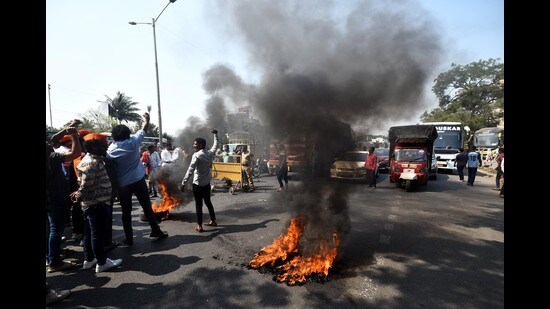
The agitation for reservation for Marathas under Other Backward Communities has become politically contentious as they constitute 37 per cent of the state’s population and are a politically powerful force. From YB Chavan to Sharad Pawar and Prithviraj Chavan to Eknath Shinde, most chief ministers in the state have been Marathas. Following a Supreme Court judgment, reservation in Maharashtra was frozen at 52 per cent. The only way to consider their demand is if the Marathas can be enveloped within the fold of the Kunbi community, a sub-caste of the Marathas, and which already has reservation under OBC category.
Who is Kunbi then? And how can that be determined?
In September this year, the Shinde government set up a 5-member committee to examine documents pre-dating 1947 of Maratha families that might help determine the rightful beneficiaries of these age-old claims. In little over a month since, the 5 men, led by retired high court judge Sandeep Shinde, have examined 1.73 crore documents of which only 11,500 prove the holders’ Kunbi ancestry.
Most documents of families in Marathwada, where the committee is focussed, date back to the days of the Nizamshahi and a majority of them are in Urdu, Persian and more critically, in an arcane script called Modi which none of them can read.
Even as the committee members move across Marathwada’s eight districts meeting claimants, a team of 9 archivists from Modi Jankar Karmachari Seva Sanchalak and the Directorate of Archives, and another team of 11 Urdu and Persian scholars work alongside them to decode each document. Each document has to be matched with poorly-maintained, revenue parchments from archives in Hyderabad to ensure there’s no forgery or contested claim.
The Marathwada region was part of the erstwhile Hyderabad state under the Nizam’s rule before it became part of Maharashtra in 1960. The Nizam’s rule recognised the rights of the Kunbis, mainly an agricultural sub caste within the Maratha community. Post-independence, many of the Kunbis began calling themselves Marathas in an effort to seek upward social mobility.
But now, family after family in the region, is seeking out the committee with old documents offering proof of genealogy, revenue agreements signed during the Nizamshahi to stake claim to their Kunbi origins. On Tuesday the Maharashtra government accepted the claims of 11,530 families who will be issued fresh caste certificates.
According to Justice Shinde, who has been on the road continuously since the committee was formed on September 7, the committee is scrutinising 14 types of documents including jail records, census records and Sanads maintained with the government.
Their biggest problem at present, said Madhukar Ardad, the Sambhajinagar divisional commissioner who is also on the committee, was the lack of time. “This is painstaking work. Many documents in the government archive are crumbling and hard to read and scrutinize.” The other problem that the team found when they went to the archives in Hyderabad was that the documents ran into hundreds and thousands of pages which had to be scanned and then put in the public domain so anyone could access them and check their ancestral details. “This way, people can get a copy of the particular document and apply for the certificate,” said Justice Shinde.
With the first deadline given to the committee already elapsing there is also the realisation that the more cumbersome process of authenticating these documents with the records of the Telangana government is still incomplete. This will now get further delayed because of the impending elections in Telangana and the code of conduct that’s in place. The committee has been given an extension till December 24, 2023. But that extension too may be short for this mammoth bureaucratic undertaking.


