
 E-Paper



Taste of life: How an Italian barfi became a pop cultural icon in the Puneri peths
In India, the Italian confectioners were never a part of large or small local communities, hence, they were able to fully reproduce the food of their motherland


Around 1880, Federico Peliti, renowned Italian pastry chef and caterer living in India, went on a trip with a group of Italian friends to the island of Elephanta, a few miles from the coast of Mumbai. Known for his ability to serve a perfect lunch anywhere, he had brought with him everything he needed to prepare a grand feast on the island.
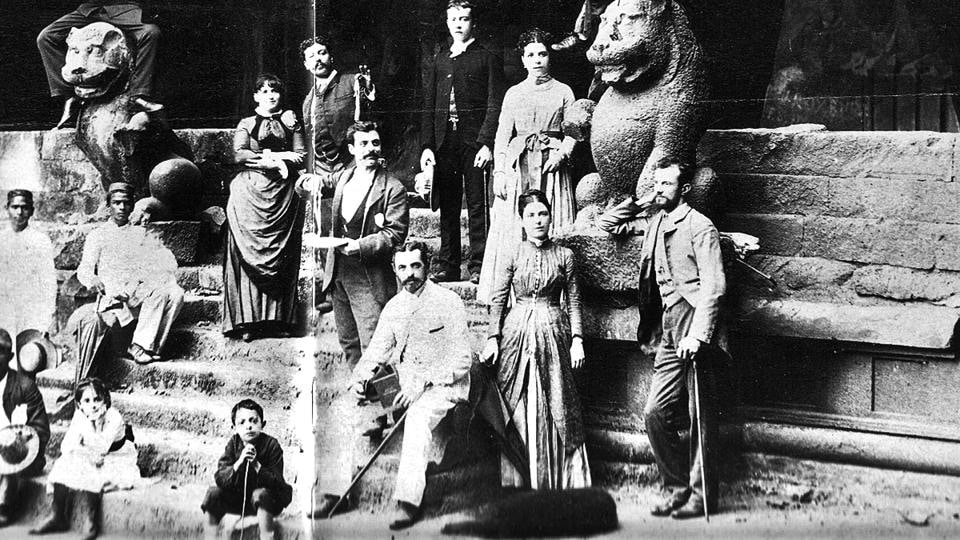
He took a photograph which portrayed him in the company of his wife, his guests and some of the Indian servants against the backdrop of the island’s rupestrian temples. The element that strikes the most in this photograph is the presence of two male figures in the centre mimicking the typical Neapolitan gesture of eating spaghetti, pulling it up with their hands.
Before the nineteenth century, the stereotype of Italians eating pasta was already widespread outside Italy. The stereotype, as it normally happens, was constructed by non-Italians, to identify and in some way mock the newcomers and their “strange” eating habits.
However, the situation of the Italians in India was poles apart from that of their compatriots who immigrated to, say, America. In Anglo-Indian society, Italians were associated with a completely different food – sweets. And they were well aware that they were often identified with their pastry shops in Calcutta, Bombay and Poona.
Therefore, a choice of pasta as a metaphor for Italian identity, as can be seen from the photograph by Peliti, can be attributed to the perception that Italians had of themselves and of their food culture, and to the desire to represent themselves and therefore, stand out through it, in India.
Food acts as an essential cultural symbol on an individual as well as collective level. In India, the Italian confectioners were never a part of large or small local communities, hence, they were able to fully reproduce the food of their motherland. Since their clientele mostly comprised Europeans and the Indian elite, they and their pastry shops and restaurants were largely unknown to the natives.
An exception to this was Enrico Muratore. While several celebrities like V Shantaram, Vishram Bedekar, PK Atre would regularly dine at Muratore’s, it was out of bounds for most of the population of Poona living in the peths. Still, Muratore and his pastries became part of the local pop culture in the first half of the 20th century.
Muratore was an Italian migrant who started his confectionery and bakery on Main Street in Camp around 1898. He soon expanded his business to start a restaurant on the same premises and later shifted to East Street where Kwality restaurant and Kayani bakery are located today.
Muratore was of course known for his confections and these confections became a symbol of “liberal, progressive, Western, and hence anti-religion and anti-national values”, as perceived by the locals.
“Usha”, a Marathi magazine published from Mumbai, carried a short story written by one “Balwant Gopal” in February, 1932. The hero of this story travels to Germany to study. Upon his return to Poona after spending a few years in Berlin, his father insists that he travel to Nashik and perform certain religious rituals to “purify” himself. His wife refuses to talk to him till he seeks atonement (crossing the ocean, eating non-vegetarian food being the sins!).
Our hero refuses. He quotes GG Agarkar and MG Ranade, the early Indian progressives. His father, a staunch follower of Tilak, reminds him of the virtues of “true Indian values”. He is finally made to leave his house when his father finds out that his son has been secretly dining at Muratore’s twice a week. The story ends by cautioning the readers about the perils of “Western” education and popularity of European and Irani restaurants.
While a few other stories published in Marathi magazines like “Kirloskar”, “Mouj” and “Vasudha” mentioned Muratore and linked it with “liberal and Western” values, the real claim to fame (or notoriety!) was the mention of “Muratorechi barfi” (Muratore’s pastry) in songs specially composed for Ganeshotsav in Poona.
The famed Ganesh festival in the early part of the last century was also known for its several song and dance troupes, known as Ganpati Mele. Children and young men who were part of these groups would sing songs and dance during the ten days of the festival.
The songs were meant to inculcate patriotism and valour in the hearts and minds of the young and the old and make them aware of certain social issues. The songs often ridiculed and denigrated women who sought education, young men who frequented clubs and restaurants, widows who remarried, and progressive, liberal leaders like GK Gokhale and Pherozeshah Mehta.
I have come across six songs sung by Shilimkar mela, Navtarun mela and Gopal mela which chided youth for embracing “modern” values. The youth in these songs all had a thing for “Muratorechi barfi’”. As the songs suggested, these young men espoused liberal values and hence, were anti-national. That the pastry baked by an Italian confectioner would be called by an indigenous name (barfi) and would symbolise values which went against popular, conservative beliefs is truly interesting.
But, this is not the only interesting story about E Muratore and his restaurant. The Second World War triggered a chain of events that resulted in Muratore shutting down a few years after India gained independence. That story is for next week.


