
 E-Paper



‘Two-wheeler capital of India’ finally gets Metro
It was five years ago that the Pune Municipal Corporation, in collaboration with the Maha Metro, began work on the two corridors (totaling a distance of 31km) of the metro rail project, of which the first part was launched

 Prefer HTon Google


PUNE: While Pune has developed keeping pace with the rapid urbanisation that India is witnessing, the lack of mass transport has inconvenienced Punekars for years now even as the city has everything else to offer. That gap was finally bridged on Sunday with the inauguration of the metro at the hands of Prime Minister Narendra Modi.
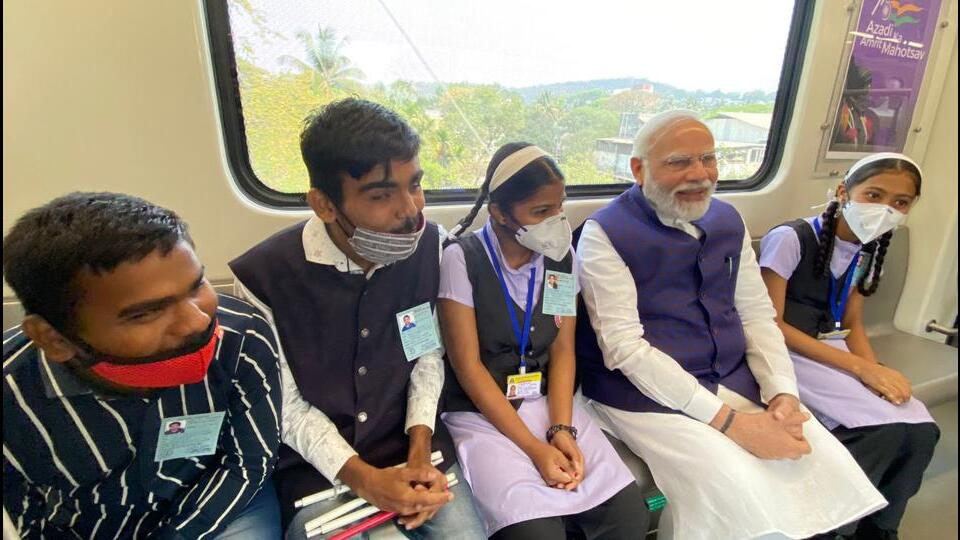
The Prime Minister took a metro ride from Garware college to Anand nagar by paying the ticket fare through his mobile phone at a nearby kiosk. During the ride, he interacted with specially-abled youths. Thereafter, two priority stretches totaling a distance of 12km – the elevated 5km Vanaz to Garware college stretch with five stations on the Ramwadi route, and the elevated 7km Pimpri-Chinchwad Municipal Corporation (PCMC) to Phugewadi stretch also with five stations on the Chinchwad-Swargate route – were thrown open to the public at 3pm. From Monday, the metro will operate from 8am to 9pm every day.
Speaking at the inauguration ceremony, Modi said, “The metro will make mobility easy in Pune and it will give relief from traffic jams and pollution, and increase the ease of living of the people of Pune. I appeal to all the elites that whatever status you achieve in life - make a habit of using the metro. I also want people from all classes in the country to use the metro wherever the facility is available.”
His government’s priority is improving mass transportation, including metro rail connectivity, Modi said.
Emphasising on mass transport, the PM said, “In 2014, the metro was only available in Delhi but now there are two dozen cities where metro is operational or will be operational in the coming days. Maharashtra has quite a significant share of this expansion if we look at Mumbai, Thane, Nagpur, Pimpri-Chinchwad and Pune.”
“Pune has also continuously strengthened its identity in the fields of education, research and development, IT and automobile. In such a situation, modern facilities are the need of the people of Pune and our government is working, keeping this need of the people of Pune in mind. I would like to thank all the stakeholders who have taken efforts to build this project and your efforts will help all the citizens, professors, professionals and students from Pune a lot,” the Prime Minister said.
It was five years ago that the Pune Municipal Corporation (PMC), in collaboration with the Maha Metro, began work on the two corridors (totaling a distance of 31km) of the metro rail project, of which the first part was launched. In 2016, Modi visited Pune to lay the foundation stone of the metro. The second part of the two corridors is expected to be completed by December 2022. The entire cost of the project is estimated to be Rs11,400 crore.
As per the 2011 census, the population of Pune and Pimpri-Chinchwad has crossed over 50 lakhs. However, the absence of strong public transport has led to a sharp increase in private vehicles, with the city earning the sobriquet of the ‘two-wheeler capital of India’. As per RTO figures, there are around 40lakh vehicles in Pune. The metro, as the global experience goes, hopes to encourage people to shun private vehicles and use mass transport instead. Maha Metro is using solar power for the operation of the Pune metro, which is expected to reduce the emission of carbon dioxide by 25,000 tonne in a year.


