
 E-Paper



Unchained melodies: Notes of change in Haryana prisons
Prisons are not usually associated with music or melody, but bringing a change in that perception are three prisons of Haryana—they have brought music into the lives


Prisons are not usually associated with music or melody, but bringing a change in that perception are three prisons of Haryana—they have brought music into the lives of their inmates and made fine musicians of a few.
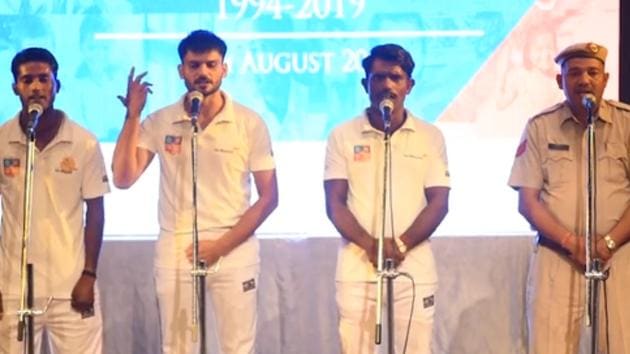
Last month, on August 31, five inmates and one former inmate performed at the packed Air Force auditorium in Subroto Park, New Delhi. Listening to their powerful, trained voices and masterful control over musical instruments, one could hardly believe that they were twitching with nervousness a few seconds before the performance began because this was their first time on stage.
These inmates had been trained in music in jail for the last three years. But the story of how music became a part of inmates’ lives begins much earlier. It all started in 2013, when a few prisoners in Bhondsi jail in Gurugram, out of sheer boredom, started singing raginis. Raginis are a form of Haryanvi folk music wherein tales of valour, bravery, love, harvest and daily life are sung of as part of a theatrical performance. Singing these folk songs would remind the prisoners of their homes and lives before prison. As the prison authorities started noticing and taking an interest in these prisoners and their raginis, they asked jail authorities and NGO officials who interacted with them to give them ghadas (earthen pots) and harmoniums. India Vision Foundation (IVF), an NGO, brought them the harmonium and ghada. Soon, raginis in rustic Haryanvi accents echoed within the walls of Bhondsi jail, accompanied by strains of music.
WATCH | Creating melodies in prison: Haryana inmates find hope, confidence in music
Music worked its magic and soon more inmates joined these ragini sessions. An IVF official says, “These impromptu sessions began taking the shape of a joyful celebration.”
Seeing the enthusiasm among the Bhondsi inmates, and the effect music had on them, music workshops in three jails across Haryana (Bhondsi, Rohtak, and Ambala) were launched. Trained professionals came in to mentor prisoners in vocals and musical instruments. Over 1,200 prisoners in jails across Haryana began learning music in earnest. In 2018, Project Dhun, an ambitious project to tap the potential of jail inmates and turn them into proper musicians was launched by IVF, in collaboration with Sony Entertainment Limited.
Under its aegis, auditions were held and 120 of the 1,200 prisoners were selected to be trained by industry experts and known music gurus. The objective was to sharpen their skills and enable them to find alternative sources of employment.
“The day I met my guru for the first time is etched in my mind,” 30-year-old Rabin, a vocalist and Rohtak inmate, says.
For 29-year-old Tilak Rao from Ambala, it was a childhood dream come true. “I had always wanted to learn music, especially the dholak, but had never thought the dream would come to fruition in a jail.”
Dhun, which means tune, slowly began to change prisoners’ lives. Ashish Puniya, project coordinator at Rohtak jail, says, “There was a gradual change in the behaviour of the prisoners. They had become much more confident and positive. They spent hours practising, laughing and practising again.”
Talking of the commitment and drive of the jail inmates, Monica Dhawan, director, IVF, speaks of how the music workshops were initially started as therapeutic and corrective measures, but seeing the passion and commitment of the inmates, the programme was adapted to impart them professional skills.
“One could see anger, frustration and loneliness lessen in a lot of inmates as they began to spend more time with the music. The inmates themselves started encouraging each other to do better, try harder,” Dhawan says.
Sanjay, a daily wage labourer in Mewat who had been in Rohtak jail since 2012, says, “It was like taking birth again. After spending so many years in jail, I had sunk into depression and loathed myself. Then one day the project coordinator asked us if anyone wanted to learn music. That changed my life.”
Sanjay, a vocalist, would always be the first one to arrive at all the music training sessions. “I would get to class at 9am and practise what the teacher had taught constantly till 4pm,” an emotional Sanjay says.
Noting his transformed behaviour and positivity, authorities released him early from Rohtak jail—three months ago. He is a daily wage earner in Mewat now, who takes care of his family.
There are several stories of triumph and tears like Sanjay’s in the Haryana jails that are part of Project Dhun. While music enthusiasts continue to train in different musical forms, inter-jail competitions and music shows organized by IVF have helped inmates perform in front of audiences and become more confident.
But the event organised last month was one-of-its-kind. Never in the history of Haryana jails had inmates been left unbound amid such a large crowd.
After grilling music sessions and tough auditions, five inmates were chosen to perform. The inmates, who belonged to different jails, were all brought together in Rohtak jail one-and-a-half month before the event. Serious sessions and long hours of practice became standard for the five musicians during these 45 days. Among the five, Rabin, Amit Chand and Dharamveer were from Rohtak jail, while Tilak Rao was moved in from Ambala jail and Dharmendra was moved from Bhondsi jail.
Rabin was the lead vocalist, Tilak Rao was on the dholak, Dharmendra was on the tabla, Amit Chand played the keyboard and Dharamveer was part of the chorus, along with prison wardens Pardip and Jiyalal. Ashish Puniya, the project coordinator who worked with the team closely during this period, speaks of the effort put in by all of the inmates. He narrates an anecdote about Rabin, the lead vocalist who had become everyone’s favourite singer.
“When Rabin first enrolled under Dhun, and the trainers wanted him to sing Sufi melodies or Vande Mataram, he would just not be able to do so. He had a thick Haryanvi accent and words like ‘sujalam, sufalam’ in that accent sounded hilarious. But he didn’t give up and practised diligently every day,” Puniya says.
Puniya then goes on to talk of how the inmates could hear Rabin practice till 2am nearly everyday. In a week, his progress was evident and the teachers were very happy with him. Rabin says that being in the music studio amid the instruments had been akin to stepping into an alternate universe.
He says, “I would have a bath everyday around 9 am, reach the music room, start with the alankar riyaaz, practice the different ragas taught to us and then start singing songs.”
Music taught him to believe, think and dream. With a twinkle in his eye, he says, “People like my singing now, maybe I will sing in Bollywood some day.”
Like Rabin, Sanjay too found hope and purpose again through music. “Suddenly, I felt like I had a reason to live— there was more to me than just being called a criminal as people started appreciating my singing.”
Though Sanjay was released from jail, when he was asked to come back to Rohtak jail for ten days and practice with his former inmates for the Dhun music show as a vocalist , he immediately agreed. “Music and Dhun have given me everything—a new life. I can never say no to Dhun,” Sanjay says, even though it meant losing ten days of wages and staying away from his then-pregnant wife. In a cruel twist of fate, in those ten days, Sanjay’s wife fell ill and suffered a miscarriage, he went home to be with her, but came back to practice for the event—such was his commitment.
On August 31, as the event commemorating a year of Project Dhun and 25 years of IVF began at the Air Force auditorium, sounds of the Gayatri Mantra and Vande Mataram, Dama Dam Mast Kalandar in deep baritones and the throbbing beat of the dholak enthralled the audience. As the show ended, the musicians bowed to a cheering audience. But Sanjay broke down on stage, recalling his journey of being introduced to music, coming out of jail, finding a purpose in life, leading a life of domestic bliss and then tragically losing his baby before its birth.
Music, the prisoners say, has ushered in new hope and energy in their lives. Alleviating their feelings of defeat and worthlessness, it has given them purpose. K Selvaraj, director general (prisons) sums up how music has touched and transformed these inmates’ lives. He says, “There is a remarkable difference in the behaviour and attitudes of the inmates. I am impressed to see their dedication towards music that has diverted their attention from their crimes and the past and given them a chance to pull themselves out of this dark world. Any form of creativity always makes a positive difference in human beings and in these inmates too, I can see that change.”
So the music continues in the jails of Haryana. Sounds of unfiltered, rustic raginis echo within the prison walls, followed by alaaps and alankars, Sufi songs and qawwalis, dholaks and tablas. And hope.


