


 Live Score
 Cricket Teams
 Cricket Players
Confused, tentative India face the exit door in T20 World Cup
The eight-wicket defeat against New Zealand, after losing to arch-rivals Pakistan by 10 wickets, has exposed a lot of uncertainty in the Virat Kohli-led side.


Another Sunday evening and another India game. Minutes to go before India take first strike against New Zealand, and the traffic has come to a grinding halt in Dubai. Many spectators wearing Indian jerseys with tickets in their hands have left their cars, huffed and puffed their way through the adjacent service road breaking fences, to not miss out on Indian batting fireworks. So many of them had paid a bomb in the black market for a India-Pakistan ticket the previous weekend.
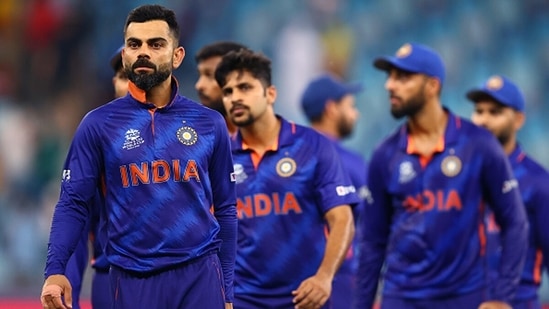
These diehard fans bring with them enormous energy that Virat Kohli feeds off. He generally rallies the crowd on his side from his fielding position. In this T20 World Cup, their expectations have weighed heavily on Kohli. After losses in their first two games, two Sundays apart, tournament favourites India are on the brink of elimination. A look at the points table would only give them a feeling of doom and gloom. Even if they win all their remaining encounters, Afghanistan are far ahead on net run-rate, having bulldozed past the Associates in the group. New Zealand, third in the group, play Afghanistan, Scotland and Namibia to play.
Also Read | Did Rohit Sharma's Test success lead to lukewarm returns in T20?
After the Pakistan match, Kohli and team mentor MS Dhoni took out some time to exchange notes with the Pakistan players. Following the loss to New Zealand, the mood in the change room turned more sombre. Kohli admitted after the game that his team had crumbled under expectations.
“Everyone who plays for India needs to embrace expectations and cope with it. We haven't done that in these two games, and that's why we haven't won,” he said. The Indian team choose to take a day off in their Dubai bio-bubble on Monday.
One can feel the 2007 ODI World Cup vibes all over again. Dhoni was there in that side. Three matches into the tournament, India - the much-hyped favourites with an even bigger stellar star cast - had crashed out. Pakistan coach Bob Woolmer’s death and knives out for Greg Chappell’s exit had made things even more tense in the Indian team hotel in Trinidad. Players remained locked in their rooms.
This time team spirit is not a problem, not yet. Neither skipper Kohli or head coach Ravi Shastri would have enjoyed Dhoni being parachuted days before the tournament to mentor the team, but they have publicly welcomed the move. But Shastri-Kohli - both will be giving up their respective roles after the World Cup - would have liked a final chance to be strategic masters of their own fate.
In the T20 series against England at home which India won, Ishan Kishan and Suryakumar Yadav had given first glimpse of their T20I credentials. Shastri is known to have believed at the time that Yadav could prove to be the game-changer, one reason he was summoned to be with the Test team in England; to train and learn with the Indian side. How far Shastri could go ahead with this belief, what strategic nuances Dhoni brought and whether the two have been thinking alike, one does not know.
Kohli had scored the most runs and batted with great urgency in that England series. As the year wore on, he struggled to keep up with the same strike rate. He was extremely slow off the blocks in the middle overs in IPL, and he would rather erase his 17-ball 9 against New Zealand off his memory. A loss in the World Test Championship final, subsequent debate around his captainship, his call to put an end date to his IPL and India T20 leadership roles - Kohli’s brain has had too much to process.
The Indian captain showed his edginess over the extended break between the two games, unhappy idling time, watching teams like Pakistan and England racing to strong positions. “A lot of time waiting and doing nothing,” he said a day before facing New Zealand. “It's ridiculous we are playing twice in 10 days,” he repeated at the toss.
Some of that anxiety to put a win on the points table and the fear of failure may have showed. Kohli spoke of “that little bit of hesitation, should you go for the shot or should you not.” In T20 cricket, that can be a recipe for disaster. On paper, India do have too many anchor batters. Their best in other formats, Kohli and Rohit Sharma are not free-flowing boundary strikers at start of their innings. Both have also had their share of struggles against leg-spin. Rishabh Pant, Kishan and Yadav can be explosive when given the licence to thrill, but were there too many cooks to decide the playing menu? The confusion in India’s tentative approach showed.
While Kohli spoke of batting hesitancy, Jasprit Bumrah in his post-match talk felt the batters exercised more attacking options to give the players extra cushion against dew. Too many shots or too few? A state of confusion is evident.
India’s opponents have shown them the mirror. Pakistan aced the India game through their quicks, striking crucial blows in the powerplay. They went on to win a tight game against Afghanistan with their lower order power-hitter Asif Ali playing his role to perfection, stealing the game with four late sixes. New Zealand struck early blows too, squeezed India’s runs through spin in the middle overs and then sprang a surprise by promoting the attacking Daryl Mitchell to open.
India may now be experiencing that sinking feeling, staring at the exit door. The International Cricket Council has learnt its lesson after the 2007 World Cup, guaranteeing five India games in the league phase. But so far as semi-final hopes go, the ray of light at the end of the tunnel is so feeble that India’s star-studded outfit could be struggling for motivation.


