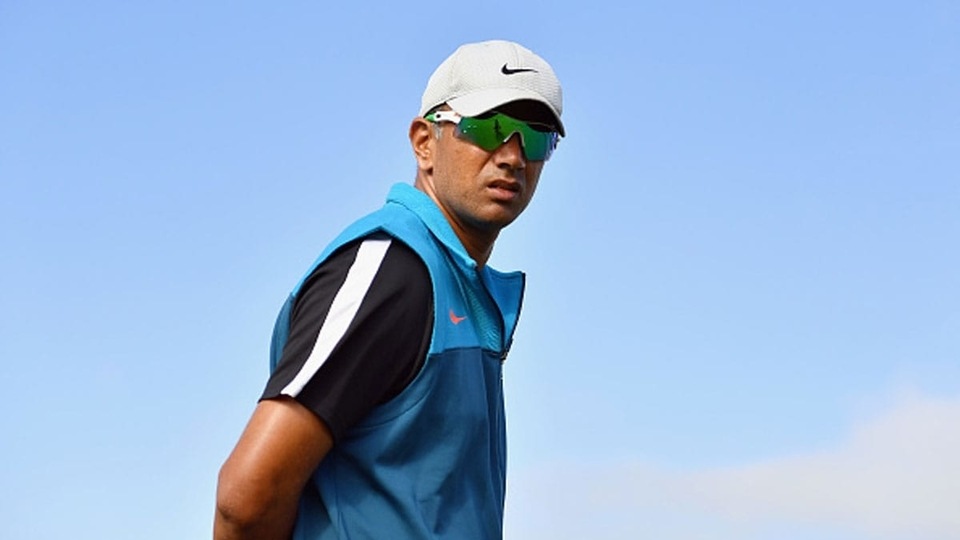
Two captains, multi-format pressures, young players who need nurturing, older players who need managing...India's new coach will have a lot on his plate. It's nothing he's not seen before
Updated on: Nov 16, 2021, 23:39:39 IST
By Sharda Ugra
Prefer HTon Google
Share via
Copy link
When Rahul Dravid steps onto the field for warm-ups in Jaipur before the first India v New Zealand T20I, look closely for two orbs on his person. One will be a halo around his head, the other a target on his back. The former is the result of the positive vibes radiating from his millions of fans, the latter the outcome of him being both Rahul Dravid and India coach.
Dravid: Halo on his head, target on his back (Getty)
His ascension to the job came accompanied by BCCI’s usual RLG (Rumour Leak Gossip) shenanigans. First, careful leaks on their approved choice of coach, then to assuage future litigants, an advert for the job, with a one-candidate interview duly conducted. Then much RLG around the waning of the Virat Kohli power-centre, two bad matches at the T20 World Cup, talk of bubble fatigue, culminating in the second coming of Dravid. To the headlines. As messiah.
Chances are Dravid will roll his eyes at all this. First of all, he could say, he’s never left Indian cricket. Post-retirement and IPL, he’s been with the under-19s, India-A and the NCA, doing the courses required, keeping and taking notes, having conversations. Whether he personally chose this moment to be coach, or whether it was chosen for him on the back of India players calling and asking him...for the love of God, please take the job...cannot be confirmed. What is certain is that he had been working hands-on with a generation of Indian players completely alien from his 1990s buddies--in game skills required and the social environment. This July, Dravid spent around a month as coach of the Indian white ball team on a six-match (W3L3) tour of Sri Lanka while the Test team was in England. Six of those players are in the T20I squad for the New Zealand series. Dravid has played alongside nine of the 16 named for the Tests.
This April, in a conversation which began as "Rahul Dravid’s guide for haters to enjoy the IPL", extended into talking around the demands on the modern Indian cricketer, T20 and the pressure of multi-formatting. All major factors that he will have to tackle as India coach. Plus, separate India captains in white and red-ball cricket appears a possibility, with Kohli stepping down from the T20 captaincy and Rohit Sharma taking it on. Workload management has found itself being reflected for real in changes to the Test squad announced against New Zealand without five front line players for the Tests.
As under-19, India-A and one time IPL coach, Dravid has run into and talked with many kinds of contemporary Indian cricketer – teenagers with their minds on franchise cricket, first-class hands struggling to deal with this new, multi-format reality, senior pros trying to keep their game sharp in the latter half of their careers. The Indian team that Dravid will coach all the way through to the 2023 World Cup will have a similar mix but with a harsher spotlight and social media to deal with. As will Dravid himself.
“There are younger guys not able to make it in a particular format, they will always have their doubts," Dravid had said in April. "A lot of Indian players who play very good first-class cricket or Ranji and they don’t make it into the IPL, don’t get picked by a franchise and it’s a bit of a disappointment for them.
“You have to tell them, look, you’ve got to keep working on some skills and sometimes it doesn’t happen because T20 is so unique…sometimes, you have to accept it, you tried your best, but probably you are more suited for one format. But that doesn’t mean you give up. You keep trying, you keep learning, you keep improving.”
For the U19s, the draw of T20 franchise cricket may lead them to prioritise on the shortest format, but Dravid said his push had always been "as much as possible to try and succeed in all formats of the game… that should be their number 1 goal.” The example of Warner, Kohli, Williamson or Steve Smith were cited as cricketers, “who have shown you can be successful in all three… It’s not easy but it’s certainly possible. You don’t want to take that dream and ambition from them too early... you want them (U19s) to be focusing on all their skills.”
What Dravid’s experience both as player and coach brings is the clarity of thought required to work with older players trying to balance formats.
“T20 requires six-hitting and variations on bowling. Now if you just practice variations, it’s not going to be easy in the four-day game when you need to bowl line and length, and need to hit top of off-stump," Dravid said. "You spend a lot of time doing that in Ranji Trophy. You probably won’t bowl that many slower ones and yorkers in Ranji, but at the end of the season you’ve got the T20 format to do well in.”
The absence of India players from domestic competition was not discussed with Dravid during the conversation in April. But it is unlikely that players like Prithvi Shaw, Shubhman Gill, Mohammed Siraj or Kuleep Yadav don’t have and therefore don’t work on their Test match ambitions. Or alternatively, that Mayank Agarwal doesn’t want a regular spot in the white ball team.
In April, Dravid had said, “Everyone is faced with the same problems and people need to find a way to deal with that and realise that I need to balance out the skills required in all of those and find a way to do it. It’s not impossible, it’s hard, it’s not easy, but it’s certainly possible."
Dravid will eventually be judged by his results with India. Yet, his role as full-time India coach–with a 360-degree view of the modern Indian game combined with a gigantic stature–could also encourage significant policy changes required particularly outside the elite player pyramid.


 Live Score
 Cricket Teams
 Cricket Players
 Prefer HTon Google