IPL 2022: Title holders Chennai Super Kings did what teams do to escape the dew effect - bowl first. A poor chase though saw Punjab Kings, whose bowlers were not affected by dew, to win easily.
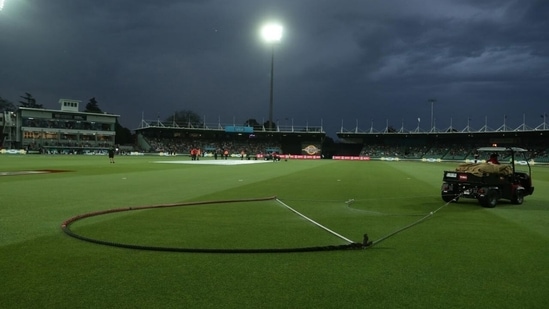
Ahead of the Chennai Super Kings-Punjab Kings IPL game on Sunday, commentator Matthew Hayden while doing his pre-match analysis from the Brabourne stadium here had picked a member of the ground staff as possible Player-of-the-Match. Hayden was referring to the anti-dew sprinkling work the ground staff was engaged in and how that could be game-changing.
Thanks to heavy dew presence, all teams are opting to chase in IPL 2022. (Twitter)
PBKS’ Liam Livingstone was named Player-of-the-Match, but the big all-rounder would have left a thank you note to the ground staff for allowing him to bowl largely in dew-free conditions late in the second innings. It was possible due to the sprinkling of APSA 80, an anti-dew agent, in the ground to prevent dew. APSA 80 is sold as a performance maximiser for farmers to increase crop yields. Cricket has seamlessly adopted the agri product for use in day-night matches in the sub-continent where a sharp change in day and night temperatures can lead to wet outfields under floodlights, with dew settling on the grass.
All previous IPL matches in Maharashtra had been affected by dew, particularly in the second innings. In seven of the first eight matches, the team batting first failed to defend totals. In the three matches that followed, captains have been reluctant to bat first at the toss. The outfield at the Brabourne stadium has been the most affected by dew under the lights. After CSK’s loss to Lucknow here on Thursday, failing to defend 210, coach Stephen Fleming sarcastically compared the amount of dew to the Niagara falls.
The anti-dew chemical spray has been used in India since the 2006 ICC Champions Trophy but using it in earlier IPL matches this season didn’t help. For Sunday’s match, the spraying was done closer to the start–5pm instead of 1pm. At the innings break, CSK seamer Chris Jordan was more complimentary of the playing conditions. “Very, very surprising. There was much less dew tonight. It’s just starting to get a little bit, now. Hopefully that will be good for us in the second innings,” he told the broadcaster.
As it turned out, it didn’t help CSK. The spray did the trick and the playing conditions remained mostly unchanged through the match. CSK’s powerplay implosion—they were 27/4 after the six overs—made it tough for them and they didn’t come close to chasing down the target of 181. “I didn’t play in the earlier matches. But yes, the dew was much lesser today. With the new ball, there was no dew at all,” said PBKS quick Vaibhav Arora, who rocked the CSK top order with two wickets.
Not just with the new ball, that the dew stayed away throughout was evident from PBKS’ use of spin till as late as the 18th over in CSK’s chase. Leg-spinners Liam Livingstone and Rahul Chahar were used by PBKS between overs 15-18 to exploit MS Dhoni’s limitations in hitting out against the turning ball. Not just keeping Dhoni in check, the two spinners spun out the CSK lower-order, picking up five wickets.
Dew-affected outfields have posed a constant problem in cricket, leading to a sharp imbalance, the bowlers as well as the team fielding second struggling. The problem is exacerbated in T20 cricket where the margins are narrow. “You can’t appreciate how wet that outfield was and the ball was,” Fleming had said after his side’s loss to LSG on Thursday. “You can’t get any aggressive play. We were playing death bowling or (bowling) defensively from about 10 overs onwards.”
Bowling second, CSK’s finger-spinners could not complete their quota of overs in the previous match. On Sunday with little dew Ravindra Jadeja bowled his full quota, and Jordan mostly bowled yorkers without the worry of missing the length due to a poor grip on the ball.
“It does not eliminate dew completely. But the spray is certainly helpful,” said Daljeet Singh, former chief curator, BCCI. “With the sea being close to the stadiums in Mumbai, and excess humidity, the local knowledge of the curators also comes in handy. On match day when they spray, they take a call whether to water the outfield less or do away with watering altogether.” From mops, hessian fabrics, boundary ropes and agri-sprays, cricket does all it takes to keep the contest even between bat and ball.
Rasesh Mandani loves a straight drive. He has been covering cricket, the governance and business side of sport for close to two decades. He writes and video blogs for HT.


 Live Score
 Cricket Teams
 Cricket Players