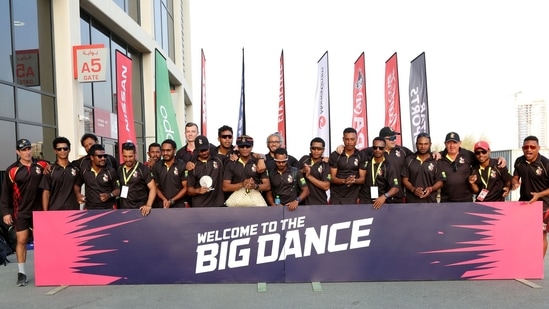
For all practical purposes, Super 12’s starting October 23 will kickstart the T20 World Cup proper. But for the five Associate nations looking to break into the big league, their tournament begins a week earlier with Round 1. That’s the only window they have to showcase their progress made over many years to cricket’s elite inner-circle.
Papua Guinea cricket team. (Cricket PNG twitter)
One of those trying to make the big stage are first timers Papua New Guinea. The southwestern Pacific island is essentially a rugby country. But they are a rare ICC Associate who have built their cricket team with a totally indigenous playing pool. With dearth of resources and means, adding weight to one’s side through immigrant cricketers or semi-retired international players of descent has been a common trend amongst Associate nations. But PNG has resisted that temptation barring one instance when former England wicket-keeper of PNG origin, Geraint Jones, played for them five years back.
The entire PNG national squad is a product of their school programs where cricket is played with plastic equipment. Their captain Assad Valla, a 34-year-old all-rounder, earlier worked as cricket coordinator in a grassroot program before getting a playing contract in 2014. “Cricket has given us a lot. Some of our boys would drop out of school,” he recalls over a Zoom call.
Today, 16 male, 13 female and 10 rookie PNG cricketers have national contracts. “The contract money is nowhere close to that of the top teams, but a lot better than your average pay doing another job in PNG,” says Greg Campbell, Cricket PNG CEO, also a former Australia international.
When Campbell first came to PNG, they had no turf wickets. Now, synthetic wickets are a thing of the past, at least for the national team. The World Cup bound team has all the basic support staff personnel from head coach, batting coach, bowling coach and physio. They have even hired a team chef.
A vast majority of people in PNG live a rural life; urbanization has been slow. Most in the PNG cricket team come from Hanuabada, a coastal village on the outskirts of capital Port Moresby. A few others live 3-and-half-hour drive away from where they train. “There are 23 provinces in PNG. We are in 11 of them where we now have 300,000 children playing cricket,” says Campbell. “Some places are hard to go as there are no roads in the highlands.”
PNG U19’s is ranked 15th in the world and have now played in 9 of the 10 World Cups. The women’s team is ranked 16th. Cricketers play rugby in the off season. Assad also played Aussie rules football when young. He credits his mother for turning him into a cricketer. “She wanted me to play cricket as it’s a non-contact sport. Mothers always want to take care of the child,” he says.
Assad bats left-handed and bowls off-spin. Almost everyone in the PNG side can bat and bowl. “We have fast medium bowlers, spinners and batters. They do everything,” Campbell points out. “It suits T20 cricket.”
With the team embarking on their first ever World Cup, the CEO’s focus is to make sure people back home can watch the national side live. “Pay TV is quite expensive for PNG people. We have been working with free stations, sometimes we pay them to get our games on TV,” he says. “The World Cup will be telecast. You may see 20 people in one house but they all will be cramming around to watch the World Cup.”
The pandemic has disrupted the best laid plans of most teams. But for PNG, they had fears it would undo all their hard work. “We had doubts if we were ever going to play our first World Cup,” says Assad. Covid disruptions were so acute for PNG that they went 760 odd days without playing a match. They lost their coaching staff including head coach Joe Dawes, formerly India’s bowling coach. Plans to play top league cricket with Australian domestic teams went for a toss due to travel restrictions.
But having overcome many obstacles to get here, they don’t want to complain. “We are under-prepared but best prepared with where we are,” says Campbell. “We have got two hashtags going for the World Cup. One says #backthebarras. And another one internally, which says #noexcuses.”
They hope to register a win in their Group comprising of Bangladesh, Scotland and Oman in Round 1. That would be one way to get their hashtags trending on the virtual world.
Rasesh Mandani loves a straight drive. He has been covering cricket, the governance and business side of sport for close to two decades. He writes and video blogs for HT.


 Live Score
 Cricket Teams
 Cricket Players