
 E-Paper



Delhi’s public buses are no match for its rain-hit roads
More DTC buses break down during monsoon than other months, yet the government has failed to find out a lasting solution to the problem.

 Prefer HTon Google


The relief it brings from the scorching heat notwithstanding, monsoon in Delhi often leaves a bitter taste in the mouth of those in transit.
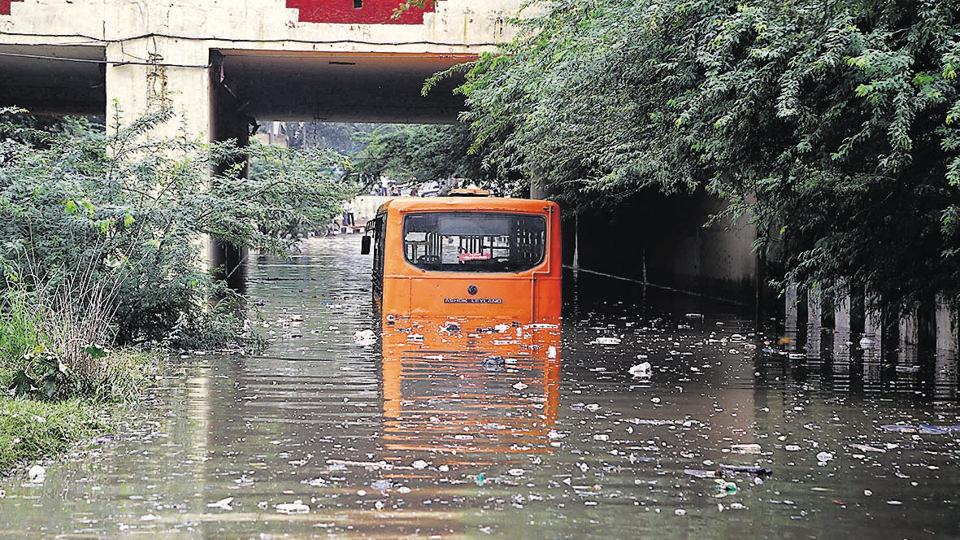
Worse hit are those who rely on public transport and intermediate para-transit modes like auto rickshaws. Ujjwal Rai, a state government employee, recalls one afternoon from July last year when he was stranded at the Minto Road underpass – a stretch which now is infamous for the knee-deep water it holds whenever it pours down heavy.
“The bus abruptly came to a halt right in the middle of the pool. After trying to start the engine a dozen times, the driver gave up and asked us to de-board. I had to wade through dirty water and reached office in the same clothes an hour and a half late,” Rai said.
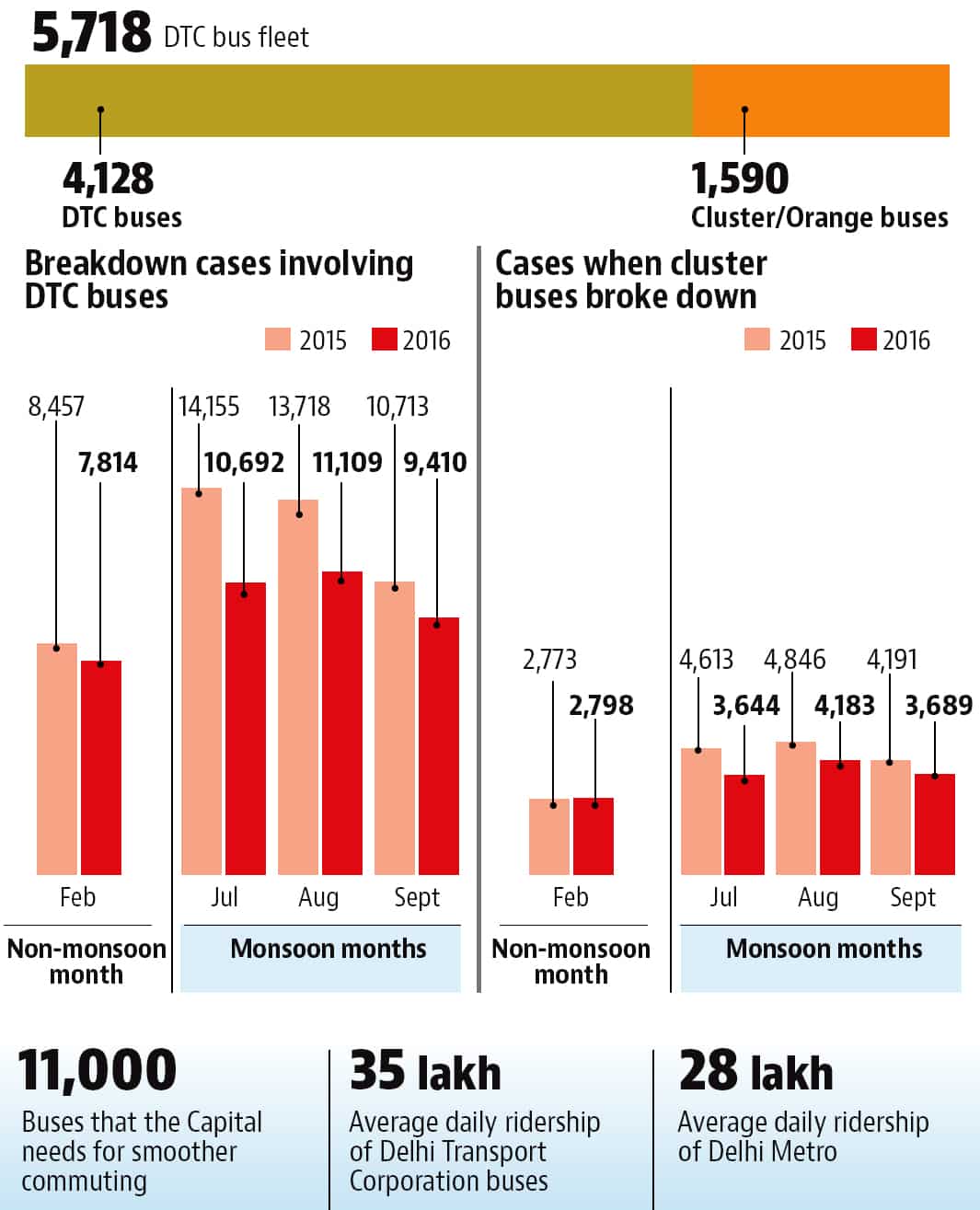
For the 35 lakh passengers who board government run buses in the Capital daily, the chances of being stuck in a bus due to a breakdown almost doubles during the rainy season as compared to the rest of the year. Data from the Delhi Transport Corporation (DTC) and the Delhi Integrated Multi-Modal Transit System (DIMTS) that run 5,718 buses in the city, suggests that breakdown cases spike in July and August - the peak monsoon months in Delhi.
Officials said while on an average around 250 buses report malfunction daily, the number can go up to over 700 on a rainy day.
In 2016, breakdowns of DTC buses (4,128) increased by 29% in the months of July, August and September, compared to that in January, February and March. The 1,590 cluster or orange buses run by DIMTS also face the same problem with its fleet of vehicles reporting a 50% increase in breakdown during the month of July as against February as recorded in 2015 and 2016.
Officials say that among the two types of buses — standard floor and low-floor — that are plying on city roads, the low-floor ones are more prone to breakdowns. “This is because the spark plug in low-floor buses is more prone to getting hit by water on the roads. In standard floor buses, the spark plug is located near the driver’s seat and is at a greater height,” a DTC official explained.
From April 2016 to March 2017, 91,221 low-floor buses reported breakdowns, while 14,308 standard floor buses had broken down during the same period. Similarly, during the same months in 2015-16, there were 1,05,430 incidents of malfunction in low-floor buses, which in standard floor buses was 24,867.
When asked about the steps taken for monsoon preparedness, a DTC official said, “Every year ahead of the monsoons our own teams check the brakes, batteries, wipers, lights and engines of every bus. If any repair is needed, the bus is taken off its route and sent to the workshop for immediate action.”
Also, the bus breakdowns often trigger massive traffic jams. As roads gets waterlogged leaving little space for the vehicles to negotiate, if a bus breaks down in the middle, it causes huge snarls.
Last mile connectivity too becomes patchy with auto-rickshaw drivers fearing to drive through waterlogged areas. “We cannot take our autos in water. The engine would stop working and repairing it would cost at least Rs 5,000. So, we have no option but to refuse passengers,” said Bikash Singh, an auto driver.


