E-Paper



Separated conjoined twins from Odisha improving after surgery at AIIMS
A team of specialists is constantly monitoring the condition of the twins who were joined at the head and were surgically separated at the All India Institute of Medical Sciences in New Delhi last week.

 Prefer HTon Google


Four days after they underwent an 18-hour-long surgery to separate them, the condition of conjoined twins -- Jaga and Kalia -- from Odisha was improving, say doctors at New Delhi’s All India Institute of Medical Sciences (AIIMS).
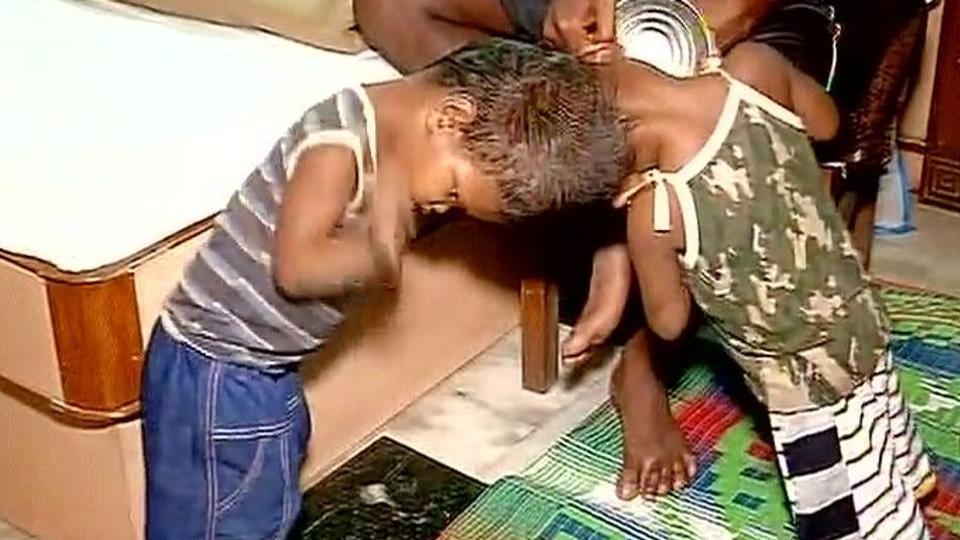
The twins were craniopagus (joined at the head). This was India’s first separation surgery on craniopagus twins.
“Both the twins are stable. Their statistics are better, and the fever has gone down in one of the babies. In the other, who was being given dialysis, the kidney function is improving,” said a doctor, requesting anonymity as he is not authorised to speak to media.
The 28-month-old twins are in an intensive care unit (ICU) of AIIMS after the surgery last Wednesday.
The twins were successfully separated after an 18-hour-long surgery that started at 9:00 am Wednesday and ended at 3:00 am Thursday.
They are being constantly monitored by a large team of experts and are on continuous blood transfusion.
A team of about 30 specialists from the institute’s neurosurgery, neuro-anaesthesia and plastic surgery departments performed the second phase of the surgery.
Read more: Condition of conjoined twins from Odisha critical: AIIMS doctor
The twins from Milipada village under Phiringia block in Kandhamal district in Odisha were admitted to AIIMS on July 13.
The first phase of the surgery was performed on August 28 when the doctors created venous bypass to separate the veins shared by the babies that returns blood to the heart from the brain.
Craniopagus conjoined twins are very rare. Dr AK Mahapatra, the chief of the neurosciences centre, had earlier said the twins suffered from the condition that afflicted one in 30 lakh children, of which 50% die either at birth or within 24 hours.