
 E-Paper



Timurid art on Delhi’s little known Subz Burj to get a revamp
For a century, the Timurid artwork on Subz Burj has remained buried under layers of chemicals used during its restoration in 1920s.

 Prefer HTon Google


Intricate artwork on the ceiling of Subz Burj — the double-domed octagonal tower on the roundabout next to Humayun’s tomb complex — will be visible after 100 years.
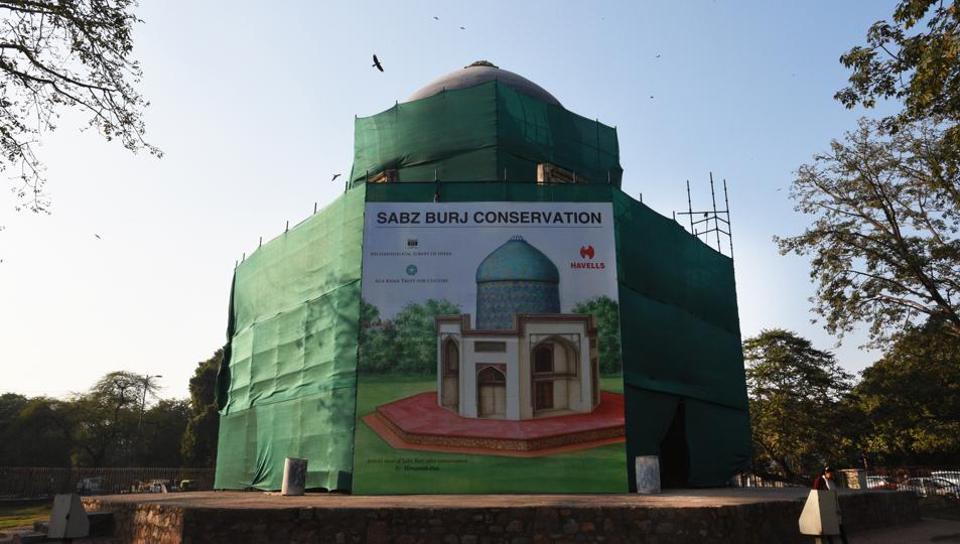
For a century, this Timurid artwork has remained buried under layers of chemicals used during its restoration in 1920s. The conservator, Aga Khan Trust for Culture (AKTC), has now decided to rope in foreign experts to rehabilitate the ceiling painting.
“This tomb has high domed ceiling bearing intricate artwork instead of incised plaster, which is rare in ancient structures that existed in Delhi. The ceiling has lost its lustre and paint patterns because of application of chemical layers in 1920s,” said Ratish Nanda, chief executive officer (CEO), AKTC, adding that International expertise has been sought to undertake repair and correct ceiling painting.
The Archaeological Survey of India (ASI) protected monument of pre-Mughal era was built shortly after the Mughal armies defeated the Lodi Afghan dynasty in AD 1526 though it is not known, who had commissioned it. It was built in the Timurid style of architecture from Central Asia.
“This must have been a tomb of a closed aide or favourite noble of the ruler of the time given its proximity to shrine of sufi-saint Hazrat Nizamuddin. Around 1904, this structure was converted into a police station,” Nanda said.
Originally, the structure dome had glazed green tiles thus deriving name — Subz Burj, which means ‘green tower’. However, the elongated neck was also covered with green, yellow and blue tiles. The original tiles were replaced with blue ones during its restoration held in the run up to Commonwealth Games in 2010. The conservators are now reinstalling tiles on its neck.
The restoration of this 500-year-old structure started in November, and is likely to be completed by the end of this year. The craftsmen have already removed inappropriate cement work from the wall, Nanda said.
The hole in the centre of the upper dome and presence of a broken wooden plank beneath suggest that the structure must have borne a finial, which is now missing.
The restoration work includes fixing of cracks in upper dome, foundation stabilisation, plinth protection, preservation of intricate incised plasterwork patterns on the façade, and reinstalling of missing sandstone lattice.


