
Sign in

Algae, new-age biofuel for green tomorrow

Move over jatropa and ethanol, an experiment by a DU professor claims a cleaner biofuel can be produced from the humble seaweed. Chetan Chauhan reports. Seaweed wonders | E-sensibilities laid to waste

Updated on: Jun 5, 2012, 01:21:25 IST
Hindustan Times | By , New Delhi
Share
Share via
  • facebook
  • twitter
  • linkedin
  • whatsapp
Copy link
  • copy link

Algae have emerged as a low cost tool to capture global warming causing carbon.
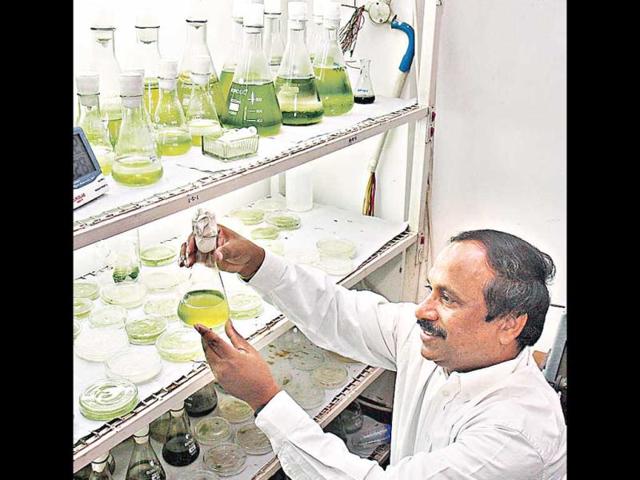
Dr-Dinabandhu-Sahoo-in-his-lab-at-the-department-of-botany-in-DU-Dr-Sahoo-claims-he-can-drive-the-car-with-algae-and-save-environment-and-petrol-HT-Sushil-Kumar

Algae, a latin word for seaweed, are a very large and diverse group of simple, typically tropical organisms. They are like plants but grow on water. They produce more than 71% of the Earth’s oxygen, as per estimates of some scientists. Carbon dioxide and water are the basic requirements for algae’s growth and this in turn releases oxygen as a by-product.

Article image

Since its clean credentials are established, algae is become a solution for capturing carbon from vehicular emissions, for providing oxygen to solders in high peaks and for reducing oceanic acidification, algae is providing possible answers to increasing carbon emissions across the globe.

The latest in the spree of innovators in Professor Dinabandhu Sahoo of Department of Biology of Delhi University, who has developed algae based apparatus for carbon capturing and reusing the same as bio-fuel.

Sahoo, who tested over 1,000 algae strains, found a few strains that can capture carbon from vehicle’s tail pipe and around 40 % of the total fluid generated can be processed into a bio-fuel or other oils for different industries.

“The initial cost Rs 20,000 to Rs 25,000 can be recovered in three to four years,” Sahoo told HT at his laboratory in DU.

Sahoo installed a tank on his Maruti 800 car and filled it half with water having algae. The car’s emission pipe was connected to the tank. As he drove around Delhi, the carbon dioxide from his car was being captured by algae, resulting in less toxic emissions into Capital’s air.

Member of the global association of algae scientists, Sahoo, believes his experiment can work wonders if the government or oil companies promote algae for capturing dirty emissions. “It requires a complete supply chain mechanism where the used algae can be brought and processed to produce bio-fuels,” he said.

He believes that investing in algae based solutions make sense as India imports 70% of fuel oil and its dependence on imported fuel would increase in coming years. Algae also have advantage over jatropa as it can be grown in any temperature and in varied environmental conditions.

Orissa appears to have taken a clue and launched Rs 95 lakh project to grow algae around polluting thermal power plants in Angul district of the state.

Such are the benefits of algae that the Defence Research and Development Organisation (DRDO) has decided to use them to provide oxygen to solders in high altitudes in Ladakh in J&K.

Although India is now waking up to wonders of algae, countries like US, China, South Korea, Canada have invested heavily on technologies to capture carbon with help of algae and produce bio-fuels.

E-sensibilities laid to waste

  • Chetan Chauhan
    ABOUT THE AUTHOR
    Chetan Chauhan

    Chetan Chauhan is the National Affairs Editor looking into all aspects of news and features from across India. A Chevening scholar with over three decades of experience in reporting and news management, Chetan has extensively covered all important aspects of the social sector, political economy, environment and climate change nationally and internationally. He did a journalism course at the Reuters Institute of Journalism in Oxford and Digital Media training at Nanyang Technological University in Singapore. He started as a reporter with The Statesman in 1996 and joined the Hindustan Times in 2000 in the metro bureau covering environment, crime and Delhi politics. He covered hot local news, from the Jessica Lal murder case to the rebellion of Delhi Congress MLAs against then Chief Minister Sheila Dikshit, to the replacement of toxic vehicle fuel with cleaner compressed natural gas (CNG) in the national capital. Some of his stories on air pollution became part of the Supreme Court’s landmark MC Mehta versus Government of India case in the National Capital Region (NCR), forcing the government to take corrective measures. As part of the national political bureau since 2004, he covered important central sectors such as environment, education, social justice, labour, rural development, water resources, renewable energy, agriculture, broadcasting and the Planning Commission for more than a decade producing several exclusive and investigative breaking stories. His specialisation is the environment, having covered at least a dozen United Nations global conferences on climate change, biodiversity and wildlife including climate summits in Paris, Copenhagen and Bali. He also covered India’s two five-year plans ---11th and 12th and reported on drafting and execution of right based laws such as Right to Education, Right to Information and rural job guarantee law, MG-NREGA, now being introduced in new format as VG-RAM-G Act. He has in-depth knowledge of social sector issues. He was one of the first to report on tigers vanishing from Sariska and Panna wildlife reserves in 2004 and 2008, respectively, leading to the setting up of the National Tiger Conservation Authority (NTCA) and the introduction of stringent penal provisions for poaching. He has written extensively on the rising human-animal conflict in India and the degradation of India’s biodiversity hotspots because of mining and other activities. Since 2004, Chetan has covered Parliament comprehensively and participated in training on the nuanced coverage of Parliament proceedings. He has travelled extensively across India to cover national and provincial elections since 1998, especially in the Hindi heartland states, considered India’s road to power. He writes a regular column for Hindustan Times, Ecostani, on important national politics, economy, Himalayan ecology and environmental issues. His other responsibilities include providing inputs for edits and edit page articles for the publication, apart from managing news flow from across India.Read More

Catch every big hit, every wicket with Crickit, a one stop destination for Live Scores, Match Stats, Infographics & much more. Explore now!

Stay updated with all top Cities including, Bengaluru, Delhi, Mumbai and more across India. Stay informed on the latest happenings in World News along with Delhi Election 2025 and Delhi Election Result 2025 Live, New Delhi Election Result Live, Kalkaji Election Result Live at Hindustan Times.