
 E-Paper



Getting bill on futures passed to be a real test
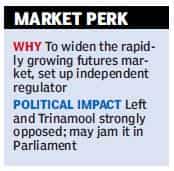
Among a slew of reform-oriented steps announced Thursday, the cabinet cleared a bill to amend the Forward Contracts (Regulation) Act to strengthen the futures market, a move opposed by the Left and Trinamool Congress.


Among a slew of reform-oriented steps announced Thursday, the cabinet cleared a bill to amend the Forward Contracts (Regulation) Act to strengthen the futures market, a move opposed by the Left and Trinamool Congress.

When signed into law, the bill will enhance the Forwards Markets Commission into an independent regulator, apart from widening India's rapidly growing futures markets.
The Forward Contracts (Regulation) Amendment Bill-2010 was brought before the cabinet for a final go-ahead after it was scrutinised by a parliamentary panel, as is required under law-making. It was introduced in Parliament in 2010.
A “futures contract”, the market for which is rapidly growing in India, is an agreement to buy or sell goods, such as food commodities or metals, on a future date but at an agreed price that is set at present.
For example, a wholesaler in January could set up a contract to buy 100 kg of potatoes from a farmer at R1500 to be delivered when the harvest is ready in April. This enables better price discovery. Both the buyer and seller will get to transact the commodity at that price, regardless of whether the market price of potatoes changes or not later.
An efficient futures market, therefore, is said to curb price volatility or sudden changes in prices. A futures contract also acts as a hedge against adverse market conditions.
The amendment bill seeks to introduce “options”, which are insured contracts, and gives protection against falling prices through a mechanism called “put”, and rising prices through a device called “call”.
However, speculators operating in futures markets are often blamed for inflation. Without a strong regulator, speculators can swing prices one way or the other. A speculator, for instance, could offer higher prices for oil futures, prompting oil producers to cut current supply so that they can sell it in the futures market. This will drive up both current and future prices.
But the Abhijit Sen-led committee, set up by the government, did not find any link between futures trading and inflation. India had banned rice, urad, tur futures and suspended sugar futures till in 2009, after a severe drought pushed food prices up.
India allows 113 commodities for futures trading, of which 50 are actively traded in five national and 16 commodity-specific exchanges, including farm commodities.
Stay updated with all top Cities including, Bengaluru, Delhi, Mumbai and more across India. Stay informed on the latest happenings in World News along with Delhi Election 2025 and Delhi Election Result 2025 Live, New Delhi Election Result Live, Kalkaji Election Result Live at Hindustan Times.


