
 E-Paper



Yamuna a dead river, says report, even as focus on Clean Ganga
The Yamuna is almost dead, the Central Pollution Control Board (CPCB) has said, even as the government single-mindedly pushes to clean the Ganga and overlooks the filthy river at its doorstep. It’s not just the Yamuna, whose water quality is as bad as sewage, but many rivers across the country are reeling under an unprecedented load of urban waste and industrial effluents, says a CPCB report.


The Yamuna is almost dead, the Central Pollution Control Board (CPCB) has said, even as the government single-mindedly pushes to clean the Ganga and overlooks the filthy river at its doorstep. It’s not just the Yamuna, whose water quality is as bad as sewage, but many rivers across the country are reeling under an unprecedented load of urban waste and industrial effluents, says a CPCB report.
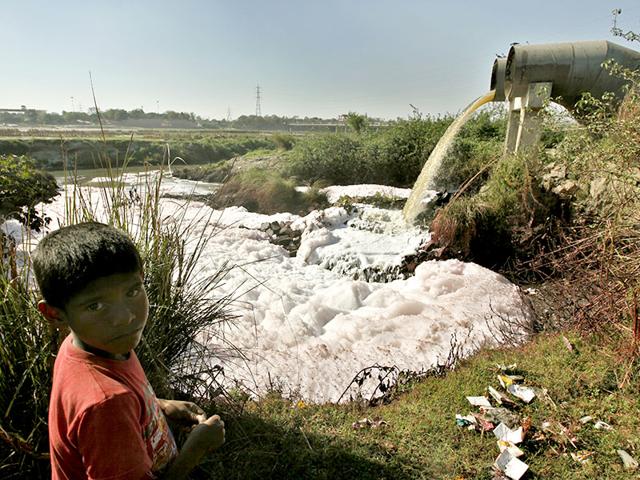
“These rivers are getting polluted because of the increasing flow of untreated waste water from cities,” said Shashi Shekhar, pollution board chairman and special secretary in the environment ministry.
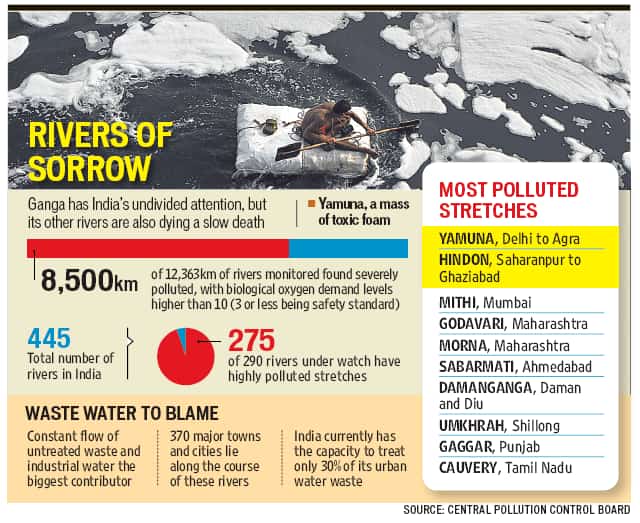
About 66% of stretches monitored during a three-year study of water in 290 rivers have high organic pollution, measured in terms of biological oxygen demand (BOD). The decline in the quantity and quality of water flow has reduced the productivity of many terrestrial, aquatic, and coastal zone ecosystems and led to loss of biodiversity, the report says.
This means, 8,400km of these rivers are badly polluted and not fit to support aquatic life.
The bad news goes much beyond that: the number of polluted water zones in India has increased manifold over the past two decades.
In addition, the pollution load on rivers has been rising constantly. The report says over 370 major towns and cities are contributing to river pollution as the country has the wherewithal to treat only 30% of its urban water waste.
The Yamuna is choking to death primarily because untreated waste is flowing into it from several cities along its banks in Haryana and Uttar Pradesh. The river’s contamination starts in Haryana and continues in Delhi, ultimately making it almost invisible in Uttar Pradesh where it merges with the Ganga in Allahabad.
No freshwater flows into the river, though millions of rupees have been spent on sewage and effluent treatment plants without any visible impact so far.
Yamuna is not the lone black spot. The Mithi in Mumbai is treading the same path with organic pollution increasing from Powai to Dharavi while the Hindon river is getting the same treatment from industrial waste between Saharanpur and Ghaziabad.
The CPCB has put these two along with Sabarmati, Gaggar in Punjab and Umkhrah in Shillong as the most-polluted river stretches in India.
“There may not be even a single river in India which is clean throughout its length and the recent years have seen pollution increasing because municipal bodies do not have any plan to clean waste water flowing into the rivers,” a senior CPCB scientist said.India has less than 2% of the world’s freshwater sources, sustaining 5% of the world’s population. The rising pollution has reduced the capacity of rivers to provide water for drinking and irrigation.
The CPCB report warns of far-reaching consequences if India fails to enhance its capacity to treat urban waste — which stands at 38,000 million tonnes a day.

Stay updated with all top Cities including, Bengaluru, Delhi, Mumbai and more across India. Stay informed on the latest happenings in World News along with Delhi Election 2025 and Delhi Election Result 2025 Live, New Delhi Election Result Live, Kalkaji Election Result Live at Hindustan Times.


